
International News
Swiss watch industry sees export values up 9.2% yoy in Feb 2026, USA, Japan, France drive growth
Growth was led by high-end segments and favorable base effects, while demand in China and Hong Kong remained fragile.


The Swiss watch industry experienced a notable rebound in February 2026, with export values climbing 9.2% year-over-year. This recovery follows a sluggish start to the year in January, where exports had dipped by 3.6%. It was mainly the very strong growth in three of the main markets – the USA, Japan and France – that tipped the balance.
According to the Federation of the Swiss Watch Industry (FHS), total monthly sales reached CHF 2.2 billion (approximately USD 2.77 billion), a significant increase from the CHF 1.9 billion recorded in the previous month.
Key Market Performance
The recovery was primarily driven by explosive growth in three core Western and Asian markets, which offset continued fragility in Greater China.
The Top Performers
- USA (+26.8%): Maintaining its position as the world’s largest market for Swiss watches, the U.S. continues to exhibit “seesaw” behavior. This volatility is largely attributed to shifting trade policies and tariff uncertainties under the Trump administration.
- Japan (+23.7%): Demand surged in Japan, marking it as a critical pillar of the February recovery.
- France (+57.1%): While appearing as the strongest growth leader for the third consecutive month, the FHS notes this likely reflects France’s role as a logistics hub. Many watches are transshipped through France to other European destinations rather than being sold to local French consumers.
The Struggling Hubs
In contrast to the Western rebound, the Asian “Greater China” region remains under pressure:
- China (-11.0%): Following a brief 5.0% uptick in January, demand plummeted again in February.
- Hong Kong (-5.2%): Similarly, the recovery seen in January (+3.6%) proved short-lived. The FHS characterized the demand in these regions as “fragile.”
Analysis of the Recovery
1. The “Base Effect”
A portion of the 9.2% growth is attributed to a positive base effect. February 2025 was an exceptionally weak month for the industry, with exports down 8.2% at that time. Consequently, the year-on-year comparison for 2026 appears more favorable because the starting point (February 2025) was so low.
2. Tariff Volatility in the U.S.
The U.S. market has become increasingly unpredictable. Watch brands and retailers have been oscillating between building up stocks to beat potential tariff hikes and pulling back during periods of trade policy shifts. This has created a “seesaw” effect in monthly export data.
3. Material and Price Segment Trends
Growth was not uniform across all categories. High-end timepieces continue to lead the charge:
- Precious Metal & Bimetallic Watches: These segments saw the strongest value increases, with bimetallic watches (gold/steel) surging by 38.4%.
- Price Tiers: Growth was most pronounced in watches with an export price between CHF 500 and CHF 3,000.


International News
Gold Prices On Track To Reach $4,900/oz By End 2026 :Goldman Sachs
Goldman’s $4,900/oz Forecast Assumes Central Bank Demand Averages 50 Tonnes Per Month In 2026 and 40 Tonnes Per Month In 2027

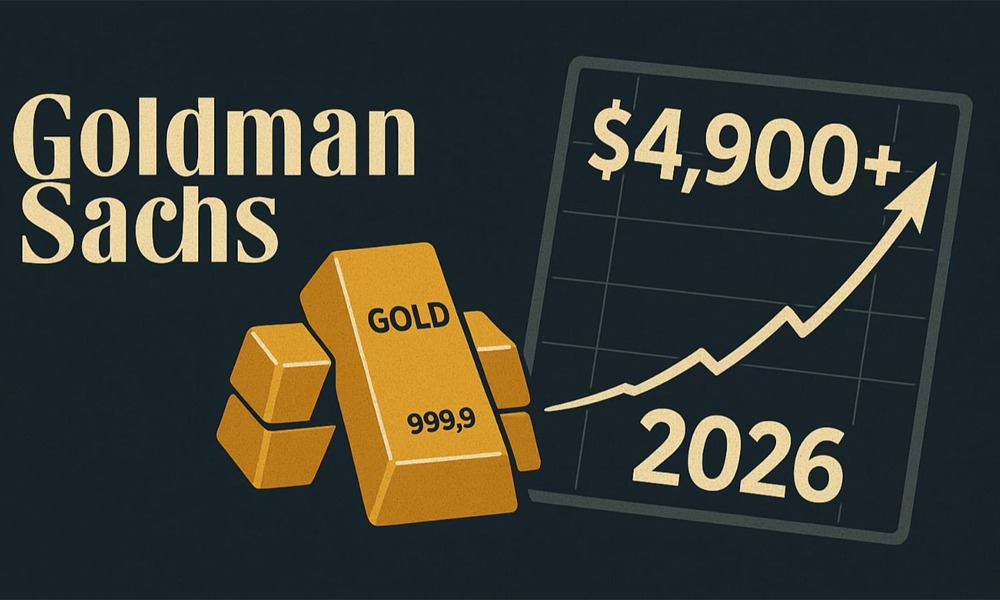
Gold prices are on track to reach $4,900 per ounce by the end of 2026, driven by aggressive central bank purchases—led by undisclosed buying from China—and recovering exchange-traded fund (ETF) demand, Goldman Sachs said in a research note.
The bank maintained its bullish base-case target for bullion while warning that positioning in options markets could amplify price volatility in both directions. Central banks accumulated an estimated 44 tonnes of gold in July, well above the pre-2022 monthly average of 17 tonnes, according to Goldman Sachs’ nowcast model. On a three-month seasonally adjusted basis, central bank buying stood at 91 tonnes per month.
China was the primary driver, with Goldman estimating the People’s Bank of China bought 35 tonnes in July—roughly 75% more than official public disclosures indicated.
To account for unreported sovereign purchases, Goldman’s model tracks physical bullion flows through London’s over-the-counter (OTC) market into custodian vaults. The Bank of England’s central bank holdings alone rose by 63 tonnes in July, exceeding outflows from the Federal Reserve Bank of New York.
Price Risks and Volatility
Goldman’s $4,900/oz forecast assumes central bank demand averages 50 tonnes per month in 2026 and 40 tonnes per month in 2027, alongside steady Federal Reserve policy and a rebound in private ETF inflows.
However, analysts noted that elevated demand for gold call options—used by investors to hedge against macroeconomic and geopolitical risks—creates mechanical upside and downside risks:
Bullish Case: Continued strong ETF inflows combined with existing call option positioning could force options dealers to buy underlying metal to hedge short exposure, pushing prices “well above” $4,900.
Bearish Case: If the Federal Reserve resumes interest rate hikes, unwinding hedge positions and triggering ETF outflows, gold could drop to $4,440/oz by end-2026. Goldman noted that ongoing central bank buying would limit further downside.
Goldman expects the Federal Reserve to remain on hold through 2026 as inflation cools, removing a key interest rate headwind for the non-yielding asset.


-

 ShowBuzz21 minutes ago
SSI 2026 SETS A BIGGER STAGE FOR SILVER
-

 ShowBuzz5 hours ago
Silver Show Of India- Delhi 3rd Edition Unveiled At Yashobhoomi, Delhi
-

 ShowBuzz4 hours ago
Silver Trends To Watch At SSI Delhi 2026
-

 ShowBuzz8 hours ago
GJIIF 2026 Sets New Benchmarks As India’s Biggest-Ever Jewellery Trade Show Opens In Chennai
