
TechBuzz
AI Is Transforming Jewellery Manufacturing: Streamlining Workflows From Design To Production
Key Applications Include Sketch-To-Render Visualization, 3D Mesh Generation, Predictive Inventory Management, Automated Quality Control

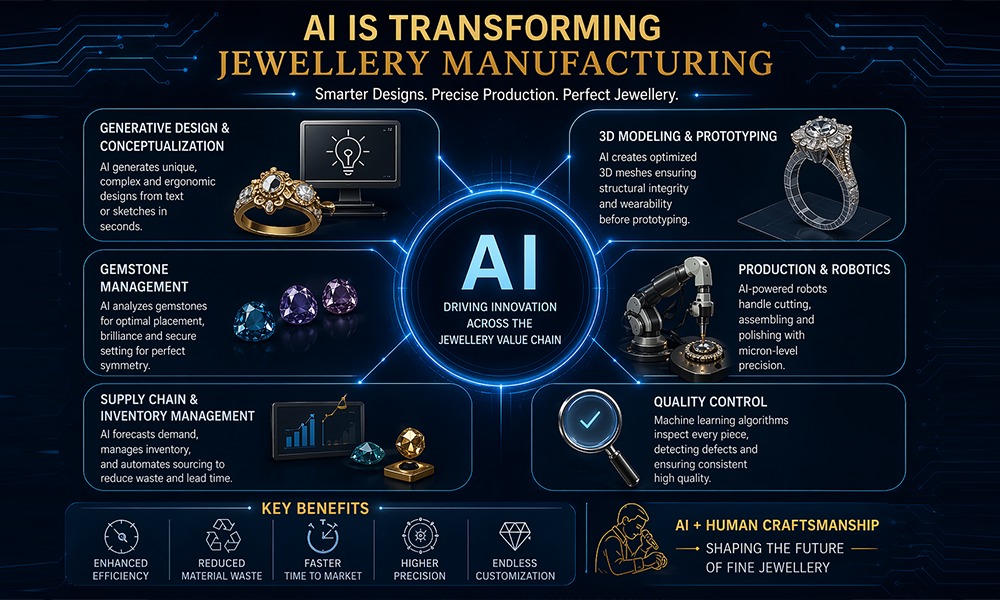
AI is transforming jewellery manufacturing by enhancing precision, speed, and customization, integrating technologies like generative design and automated robotics to streamline workflows from design to production. Key applications include sketch-to-render visualization, 3D mesh generation, predictive inventory management, and automated quality control, significantly reducing material waste and production timelines.
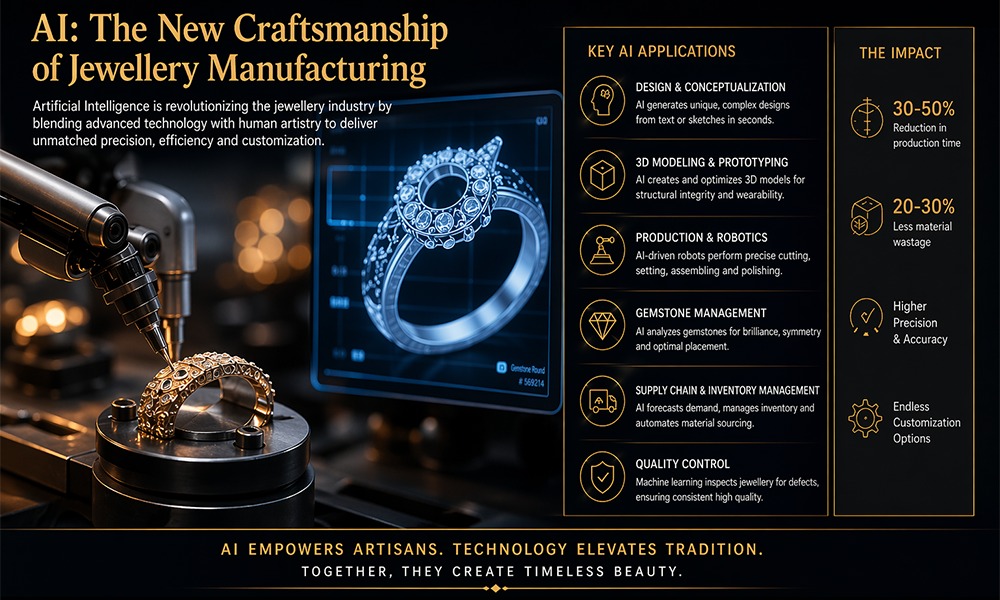
Key AI Applications in Jewellery Manufacturing:
- Generative Design & Conceptualization: AI tools generate complex, unique, and ergonomic design concepts, including text-to-image and sketch-to-render, often in seconds.
- 3D Modelling & Prototyping: AI facilitates early-stage 3D mesh generation and optimizes designs for structural integrity and wearability before physical prototyping.
- Production & Robotics: AI-controlled robots and automation are increasingly used for precise cutting, assembling, and polishing, reducing human error, particularly in detailed and delicate settings.
- Gemstone Management: AI optimizes gemstone placement, analyzing stone dimensions and brilliance to ensure perfect symmetry and secure setting techniques.
- Supply Chain & Inventory Management: AI forecasts demand and manages inventory by analyzing trends, reducing waste, and automating the sourcing of materials.
- Quality Control: Machine learning algorithms inspect jewelry for defects, ensuring high quality in mass production.
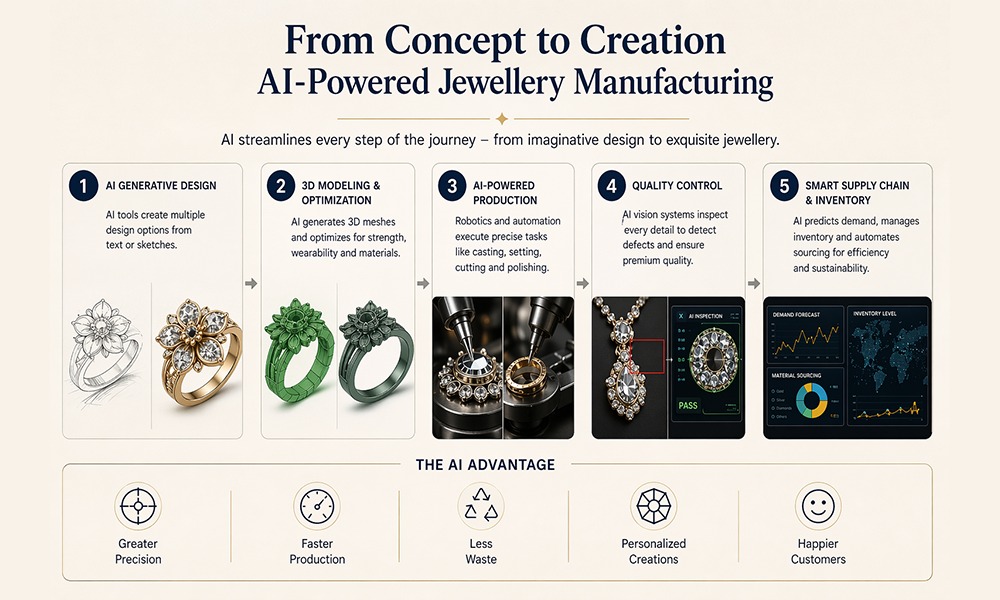
Key Benefits:
- Enhanced Efficiency: Automating repetitive tasks frees artisans to focus on complex design elements.
- Cost Reduction: Improved material usage and optimized production reduce waste and costs. AI algorithms calculate the most efficient way to cut and set materials, ensuring virtually zero precious metal or gemstone waste.
- Hyper-Personalization: AI enables bespoke, custom design experiences that can be immediately simulated and priced.
- Labour Cost Reduction: Automated precision machinery handles repetitive tasks, reducing manual overhead and lowering the final price point for consumers.
- Energy Optimization: Smart systems monitor and adjust power usage in real-time, significantly lowering the carbon footprint of the production facility
- Process Optimization: AI-driven logistics and scheduling streamline the production pipeline, resulting in faster turnaround times without sacrificing detail.
Leading players use AI to optimize manufacturing output

Pandora:
The world’s largest jewellery brand uses AI to optimize its massive manufacturing output (millions of pieces annually). In 2026, they leverage Predictive Intelligence to forecast material demand—such as their shift toward lab-grown diamonds and recycled silver—ensuring their automated production lines in Thailand are aligned with global sales trends.
Signet Jewellers (James Allen, Kay, Zales):
Signet utilizes AI-driven supply chain management to reduce “lead-to-market” time. By analyzing consumer data, they can trigger specific manufacturing batches of trending styles, reducing excess inventory and material waste.


Tiffany & Co. (LVMH):
While emphasizing “hand-crafted” luxury, Tiffany uses AI in the technical design (CAD) phase. AI tools assist their master crafters by performing complex stress-test simulations on new high-jewelry designs to ensure structural integrity before a single gram of gold is cast.


TechBuzz
The Titanium Jewellery Manufacturing:Convergence Of Advanced Manufacturing, AI, and Surface Chemistry
For Trade Professionals, Understanding The Tech Powering This Shift Isn’t Just Academic—It’s The Key To Navigating The Next Decade Of Luxury Design
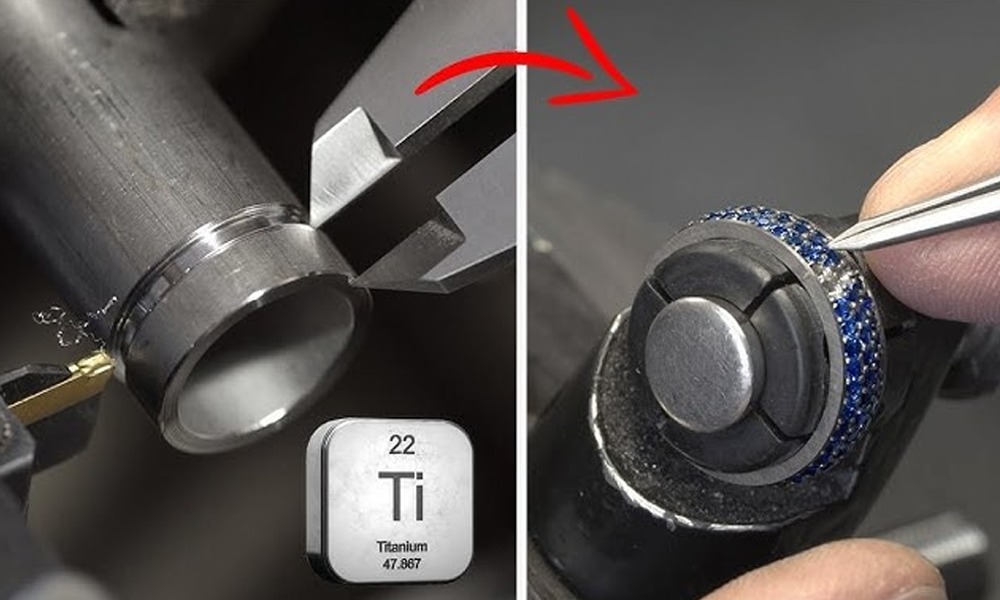
Titanium has officially broken free from its industrial roots. Long reserved for aerospace engineering and medical implants, this ultra-tough metal has been repositioned at the pinnacle of luxury watchmaking and high jewelry. Driven by a convergence of advanced manufacturing, AI, and surface chemistry, titanium is giving traditional precious metals a run for their money.
For trade professionals, understanding the tech powering this shift isn’t just academic—it’s the key to navigating the next decade of luxury design. Here are the core innovations driving the titanium revolution.
1. 3D Printing & Direct Metal Laser Sintering (DMLS)
Working with titanium presents a notorious metallurgical hurdle: its extreme melting point () makes traditional casting and soldering nearly impossible. Enter Direct Metal Laser Sintering (DMLS).
By using high-powered lasers to fuse microscopic titanium powder layer by layer, designers can bypass traditional workbench limitations entirely. This additive manufacturing capability allows ateliers to produce complex, hollow, and lattice-like organic structures. The result? Massively oversized, avant-garde statement pieces that remain remarkably lightweight and structurally indestructible.
2. Precision via AI-Driven CNC Machining
Titanium’s legendary hardness routinely destroys standard bench tools, making traditional hand-carving or standard machining painfully slow and cost-prohibitive. To solve this, forward-thinking manufacturers are deploying AI-driven Computer Numerical Control (CNC) machining.
AI algorithms optimize tool paths in real-time, reducing tool wear while carving intricate geometries at unprecedented speeds. Furthermore, these smart CNC systems achieve an ultra-refined grain size on the metal’s surface—a crucial prerequisite for achieving a flawless, mirror-like finish and vibrant color differentiation.
3. Electrochemical Anodization: Painting with Electricity
One of titanium’s most disruptive luxury features is its ability to take on vivid coloration without the use of fragile paints, platings, or enamels. Through electrochemical anodization, jewelers submerge the metal in an electrolytic bath and apply precise electrical currents.
Rather than adding a pigment, this process alters the thickness of the titanium’s natural oxide layer, changing how light refracts off the surface. Ateliers can consistently achieve fade-resistant, biocompatible hues ranging from deep electric blues and magentas to striking rainbow gradients.
[Electric Current Applied] ➔ [Oxide Layer Thickens/Shifts] ➔ [Light Refraction Alters] ➔ [Vibrant, Fade-Resistant Color]
4. Next-Gen Wearable Tech Integration
The booming smart jewelry sector demands materials that are bio-friendly, exceptionally durable, and featherlight. Aerospace-grade titanium has become the gold standard for this niche.
Market leaders like Ultrahuman utilize titanium chassis to house highly sensitive, medical-grade sensors. Because titanium acts as a rugged, hypoallergenic shield, it seamlessly protects internal components tracking Heart Rate Variability (HRV), skin temperature, and sleep cycles, all while offering the comfort of a traditional wedding band.
5. High-Jewelry’s “Stealth Wealth” Aesthetic
In the high-jewelry circuit, “heavy” no longer automatically equates to “valuable.” Elite international ateliers are embracing raw and black titanium as the ultimate canvas for haute joaillerie.
Weighing 45% lighter than stainless steel and a fraction of the weight of platinum, titanium allows designers to set massive, multi-carat precious gemstones into expansive designs without weighing down the wearer. Its deep, muted tones offer a stark, contemporary contrast to diamonds and colored gems, perfectly capturing the minimalist, “stealth wealth” aesthetic coveted by modern collectors.


-

 National News37 minutes ago
India’s Consul General to Dubai, Shri V V Reddy, Interacts with BDB Committee
-

 National News54 minutes ago
Shankesh Jewellers Ltd. Unveils New Corporate Office at Kalbadevi Road, Mumbai
-

 BrandBuzz44 minutes ago
MARVEL X-Men x Swarovski Relaunch Iconic Collaboration
-

 New Premises1 hour ago
USAKEE Unveils New Corporate Office In Bengaluru
