National News
Rapid Growth In Gold Loan Merits Continued Vigilance: RBI FSR
The Report Cautioned That A Prolonged Correction In Gold Prices Could Weaken Collateral Protection

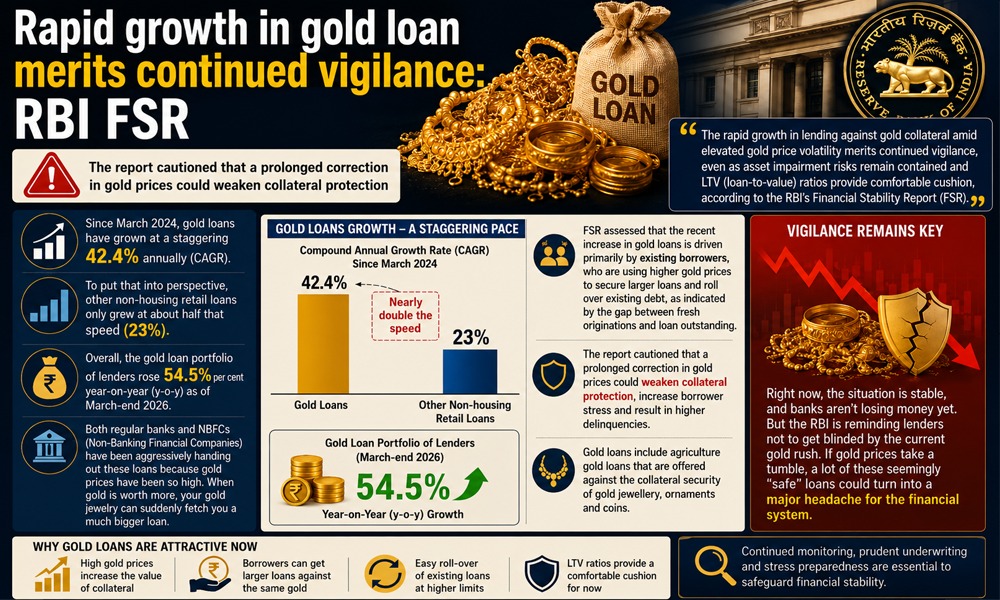
The rapid growth in lending against gold collateral amid elevated gold price volatility merits continued vigilance, even as asset impairment risks remain contained and LTV (loan-to-value) ratios provide comfortable cushion, according to the RBI’s Financial Stability Report (FSR).
Since March 2024, gold loans have grown at a staggering 42.4% annually (CAGR). To put that into perspective, other non-housing retail loans only grew at about half that speed (23%). Overall, the gold loan portfolio of lenders rose 54.5 per cent year-on-year (y-o-y) as of March-end 2026.
Both regular banks and NBFCs (Non-Banking Financial Companies) have been aggressively handing out these loans because gold prices have been so high. When gold is worth more, your gold jewelry can suddenly fetch you a much bigger loan.
FSR assessed that the recent increase in gold loans is driven primarily by existing borrowers, who are using higher gold prices to secure larger loans and roll over existing debt, as indicated by the gap between fresh originations and loan outstanding.
The report cautioned that a prolonged correction in gold prices could weaken collateral protection, increase borrower stress and result in higher delinquencies. Gold loans include agriculture gold loans that are offered against the collateral security of gold jewellery, ornaments and coins.
Right now, the situation is stable, and banks aren’t losing money yet. But the RBI is reminding lenders not to get blinded by the current gold rush. If gold prices take a tumble, a lot of these seemingly “safe” loans could turn into a major headache for the financial system.


National News
World Gold Council – India Gold Market Update
Gold ETF Inflows Continue For The Fifth Consecutive Month, While Imports Rebound In October; Futures Trading Activity Hits A Multi-Month Low

India’s gold market witnessed healthy festive demand in October and early November 2026, despite a correction in domestic and international gold prices, according to the latest India Gold Market Update by the World Gold Council (WGC). Buying during Dhanteras and Diwali remained broad-based across regions, with both jewellery and investment products witnessing encouraging demand. Meanwhile, gold ETFs continued to attract investor interest, while imports recovered from September’s lows.
Key Highlights
- Gold prices decline: International gold prices fell 6.3% in October to US$3,913/oz, marking the second consecutive monthly decline, amid expectations of further US Federal Reserve rate hikes, a stronger dollar and investor selling.
- Festive demand remains healthy: Retailers reported higher footfall and sales during Dhanteras and Diwali, with demand across jewellery, bars and coins.
- Gold ETFs maintain momentum: Indian gold ETFs recorded their fifth consecutive month of net inflows in October, attracting INR35 billion (US$364 million). The positive trend continued into November.
- Imports rebound: Gold imports more than tripled month-on-month to US$5.51 billion in October, supported by festive restocking and softer prices, although they remained significantly below year-ago levels.
- Futures trading slows: Average daily gold futures volumes on MCX declined 30% month-on-month to 12.7 tonnes, the lowest level since January 2025.
Gold Prices Witness Further Correction
After remaining relatively stable during the first half of October, international gold prices declined sharply, closing the month 6.3% lower at US$3,913 per ounce. This marked the second consecutive monthly decline, driven by expectations of further Federal Reserve rate hikes, a stronger US dollar and a shift in investor preference towards bonds. Selling pressure in gold futures also contributed to the decline.
Domestic gold prices followed the international trend, falling 1.8% during October. The correction extended into November, with international prices declining another 1% to US$3,870 per ounce by 12 November. Domestic prices registered a sharper 5.3% decline during the same period, partly due to a 1.7% strengthening of the Indian rupee against the US dollar since the end of October.
Domestic gold discounts also narrowed significantly, moving from an average of US$66 per ounce in September to US$5 per ounce by 12 November, reflecting improved seasonal demand.
Festive Gold Demand Remains Resilient
Despite elevated gold prices, the Indian jewellery market recorded healthy buying during the Dhanteras and Diwali period. Retailers across regions reported improved customer footfall and sales, supported by the correction in gold prices since mid-October.
According to retailer estimates, gold demand in value terms increased by 15–25% year-on-year, while volumes remained largely flat to marginally higher. Average gold prices during this year’s festive period were nearly 10% higher than during the corresponding period last year, with year-on-year prices up 17%.
Jewellery demand reportedly performed better than a year ago, with higher customer participation supporting overall sales. However, consumers continued to favour lighter-weight jewellery, while promotional offers and newer designs helped attract buyers.
Old-gold exchange remained an important contributor to jewellery sales, accounting for approximately 40–60% of transactions at several retailers. Meanwhile, demand for bars and coins was also healthy, particularly in smaller denominations ranging from 0.5g to 5g, reflecting the preference for token investment purchases.
Gold ETFs Record Fifth Consecutive Month of Inflows
Investor interest in financial gold remained strong, with Indian gold ETFs registering their fifth consecutive month of positive net inflows in October.
Inflows stood at INR35 billion (US$364 million), although this was 22% lower than September. Nevertheless, the figure remained above the average monthly inflows of INR24 billion recorded over the preceding six months.
Gold ETF assets under management declined 3% month-on-month to INR1,799 billion (US$18.8 billion) at the end of October, primarily reflecting lower gold prices. However, holdings increased by 2.2 tonnes to 126 tonnes.
Cumulatively, gold ETF holdings increased by 31.3 tonnes during January–October 2026, registering a 22% year-on-year growth. The momentum continued into November, with estimated net inflows of INR24.5 billion (US$262 million) between 1 and 11 November, adding another 1.75 tonnes to holdings.
The addition of 64,163 investor folios during October took the total number of gold ETF folios to 12.74 million. The continued inflows amid declining prices indicate that investors are increasingly using price corrections as opportunities to accumulate gold through financial products.
Gold Futures Trading Activity Weakens
India’s gold futures market witnessed a significant slowdown in October. Average daily turnover declined to INR176.5 billion (US$1.85 billion), while average daily trading volumes fell 30% month-on-month to 12.7 tonnes, the lowest level since January 2025.
The decline in trading activity was largely associated with softer gold prices, which may have reduced investor interest in hedging and speculative trading. The trend was consistent with the broader global slowdown in gold trading activity during the month.
India’s gold futures trading accounted for 0.5% of global gold trading volumes and 1.3% of global exchange-traded volumes in October.
Gold Imports Rebound in October
India’s gold imports recovered sharply in October after reaching subdued levels in September, recording their highest level in six months. The rebound was supported by festive restocking and relatively softer gold prices.
In value terms, gold imports stood at US$5.51 billion, more than three times September’s figure, although 63% lower year-on-year. Gross import volumes were estimated at approximately 70 tonnes, compared with 23 tonnes in September and 128 tonnes in October 2025.
Despite the monthly recovery, the seasonal import build-up remained below historical levels. Combined imports during September and October 2026 were estimated at around 93 tonnes, significantly lower than the 2021–2025 average of approximately 180 tonnes for the corresponding period.
The gap suggests that a portion of domestic demand was met through alternative supply channels, including recycled gold from old-gold exchange programmes and unofficial imports.
Overall, official gold imports during January–October 2026 amounted to US$47.36 billion, down 6% year-on-year, while gross import volumes were estimated at approximately 470 tonnes, registering a decline of around 14%.
Outlook: Lower Prices and Wedding Season to Support Demand
Looking ahead, the World Gold Council expects lower gold prices and the ongoing wedding season to support jewellery demand in India. However, any significant recovery in prices could affect consumer sentiment and moderate buying activity.
Investment demand is expected to remain steady, supported by continued interest in gold ETFs and the growing preference for financial gold as investors look to diversify their portfolios.



DMCC Concludes 14th Dubai Precious Metals Conference

Silver Wholesale Goes Digital: How India’s 925 Silver Trade Is Changing The Way It Buys and Sells

Malabar Gold & Diamonds Strengthens Its Presence in Lucknow With New Showrooms In Mahanagar and Patrakarpuram

From White Gold to Sterling Silver: Gargi by PNGS Opens Its 51st Store in Akola
Malabar Gold & Diamonds Strengthens Its Presence in Lucknow With New Showrooms In Mahanagar and Patrakarpuram
Silver Wholesale Goes Digital: How India’s 925 Silver Trade Is Changing The Way It Buys and Sells
-
 New Premises1 day ago
From White Gold to Sterling Silver: Gargi by PNGS Opens Its 51st Store in Akola
-
 New Premises4 hours ago
Malabar Gold & Diamonds Strengthens Its Presence in Lucknow With New Showrooms In Mahanagar and Patrakarpuram
-
 JB Insights4 hours ago
Silver Wholesale Goes Digital: How India’s 925 Silver Trade Is Changing The Way It Buys and Sells
-
 International News4 hours ago
DMCC Concludes 14th Dubai Precious Metals Conference