
JB Insights
New Plumb Club research shows growing awareness and acceptance of lab-grown diamonds, gems

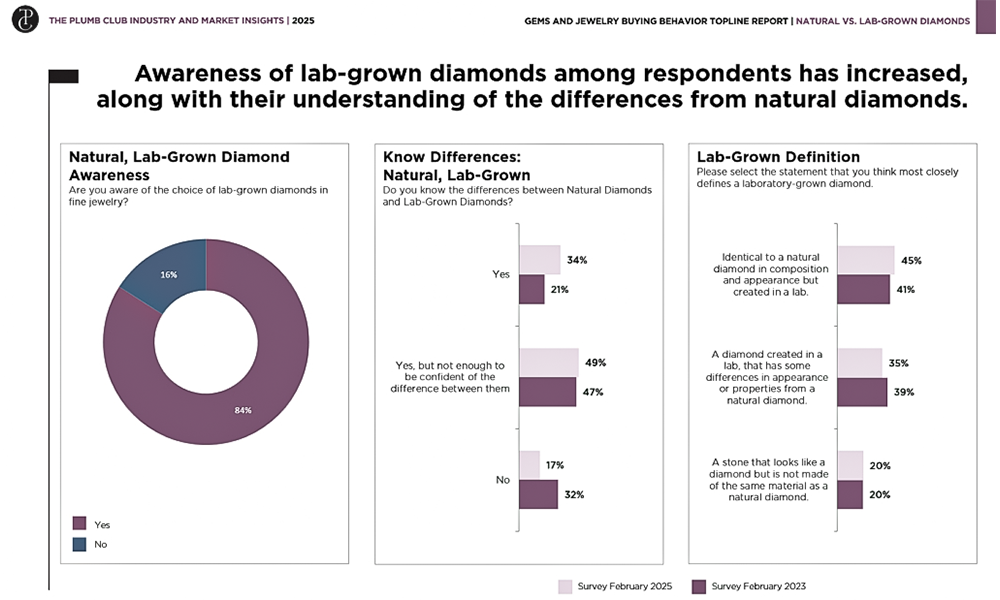
The Plumb Club Industry and Market Insights 2025 reveals that shoppers are increasingly aware of, and more open to, lab-grown gem options. This, despite the industry having many different opinions on the subject. The consumer survey, completed with over 2,000 jewelry buying ,consumers across the county, shows a definite upswing among customers compared to only 2 years prior and provides retailers with insight and direction for business planning.
84% of consumer respondents said they are aware of the choice of lab-grown diamonds in fine jewelry. The 2025 survey noted an increase of 13% from the 2023 survey in customers who feel they know the differences between natural and lab-grown diamonds and a decrease of 15% in customers who feel they do not know the difference. 49% said they are not confident of the differences.
The survey highlights that for lab-grown gems, such as rubies, emeralds and sapphires, 83% of customers say that if they learned the gems were chemically, optically and physically the same as their mined counterparts they would be open to buying them. Regarding the openness to receiving lab-grown diamonds in jewelry, other than engagement and bridal pieces, 83% say that they are. 74% said they would be open to receiving a lab-grown diamond for an engagement ring.
Price consideration is a determining factor for 31% of consumers considering a lab-grown diamond or lab-grown diamond engagement ring, while getting a higher clarity or color of diamond is the determining factor for 30%.
When it comes to preference for a diamond’s origin, 37% of respondents say they do not have enough information to make the decision between natural or lab-grown. 33% said they would prefer a lab-grown and 30% said they would prefer a natural diamond. When comparing two diamonds of the same cut, color, quality and size, 49% of respondents said they would prefer a natural diamond.
The insights shared here are part of a multi-faceted research study initiated by The Plumb Club with the assistance of Paola Deluca, The Futurist, and Qualtrics, a world-renowned survey and analytics firm. The study was conducted with a sampling of over 2,000 men and women from the ages of 25 – 60 with a balanced demographic and psychographic mix across the US with the goal of understanding how individuals engage with jewelry. Respondents had all attended some college or higher and had a combined household income of at least $75K/year. Additional information from this expansive research will be shared over the next several weeks.
The research document will be shared in its entirety during the JCK Las Vegas Show with a presentation on Saturday, June 7 2025.








JB Insights
From Customer Intelligence To Autonomous Growth Intelligence: Deepansh Bhargava Senior Vice President & Head Marketing at VBJ
From Customer Intelligence To AI-powered Growth Decisions, The Next-Gen CDP Is Built To Create Measurable Incremental Value.

For the last 6 years, Customer Data Platforms have transformed how brands understand their customers. They have brought fragmented data together, created unified customer profiles, enabled segmentation and made personalisation more intelligent. But the next evolution of CDPs will not be defined by how much customer data they can organise. It will be defined by how intelligently AI can convert that data into consumer value and incremental business outcomes.
The shift is from Customer Intelligence to Growth Intelligence.
Businesses today know more about their existing customers than ever before their purchase history, frequency, preferences, lifetime value and likelihood of buying again. Yet the larger opportunity lies in moving beyond what customers did to understanding what they need next, where their behaviour is changing and where the next phase of growth will come from. This also requires a sharper focus on incrementality.
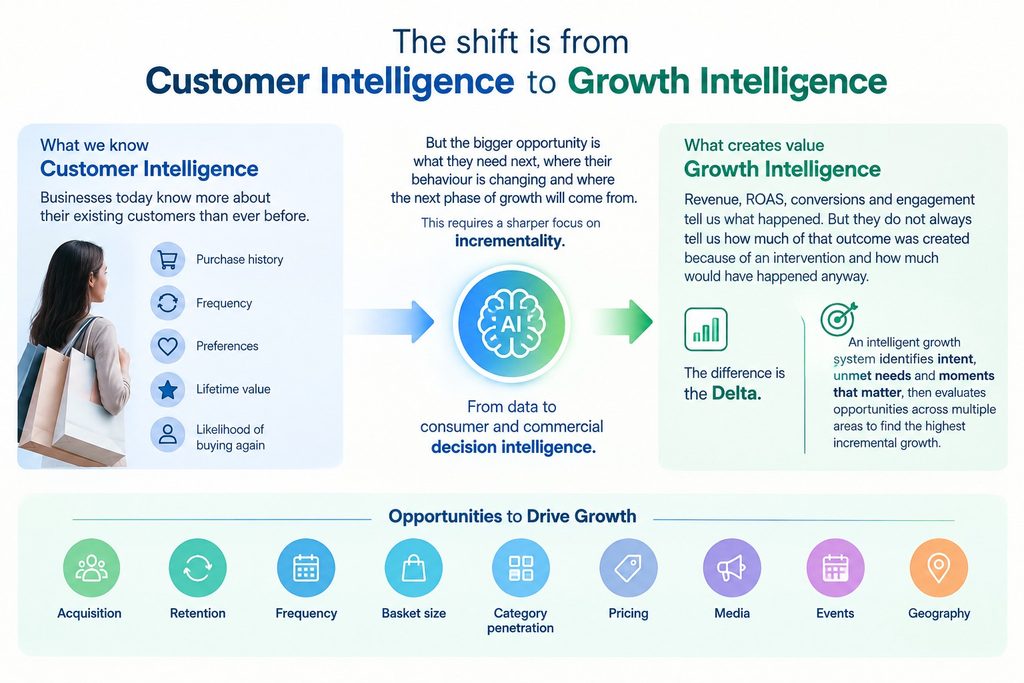
Revenue, ROAS, conversions and engagement tell us what happened. But they do not always tell us how much of that outcome was created because of an intervention and how much would have happened anyway.
That difference is the Delta. AI can help take CDPs beyond systems of customer intelligence and turn them into systems of consumer and commercial decision intelligence. Instead of simply identifying customers with a high propensity to purchase, an intelligent growth system could identify intent, unmet needs and moments that matter then evaluate opportunities across acquisition, retention, frequency, basket size, category penetration, pricing, media, events and geography to identify where the highest incremental growth opportunity lies.
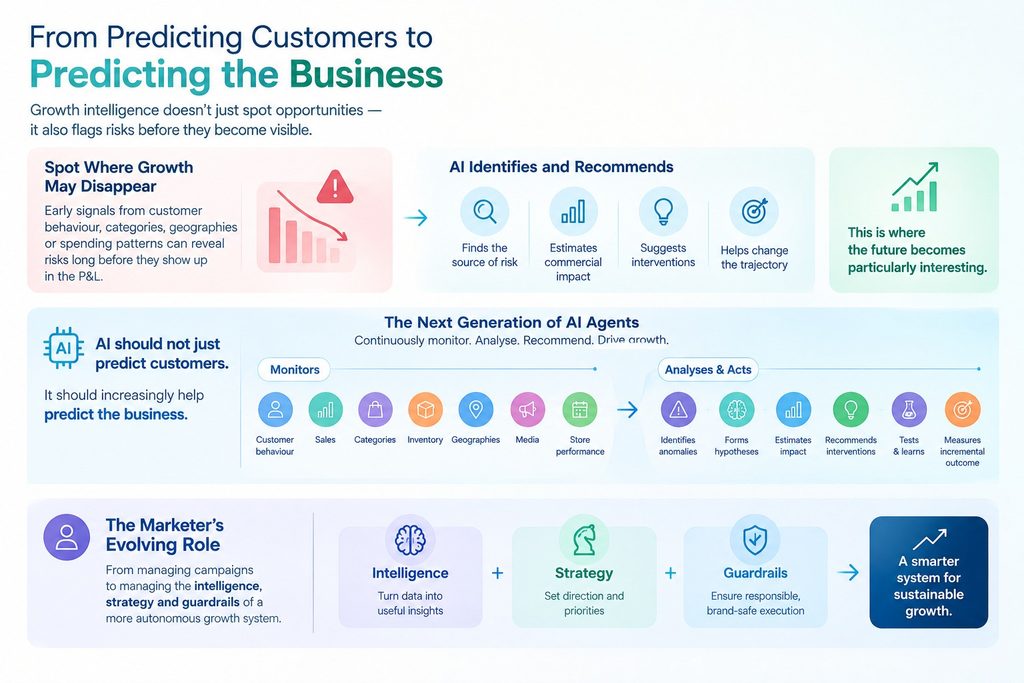
Growth intelligence should also help businesses identify where growth is likely to disappear. Early signals from customer behaviour, categories, geographies or spending patterns could reveal risks long before they become visible in the P&L. AI could identify the source of the risk, estimate its potential commercial impact and recommend interventions to change the trajectory. This is where the future becomes particularly interesting.
AI should not just predict customers. It should increasingly help predict the business.
The next generation of AI agents could continuously monitor customer behaviour, sales, categories, inventory, geographies, media and store performance. They could identify anomalies, form hypotheses, estimate commercial impact, recommend interventions, test them and measure the incremental outcome.
The role of the marketer would evolve from simply managing campaigns to managing the intelligence, strategy and guardrails around a more autonomous growth system.
This evolution can be built around three principles: Anticipate, Act and Account.
1. Anticipate where consumer needs and growth will emerge and where they may disappear.
2. Act by identifying and eventually executing the most relevant intervention for the consumer and the business.
3. Account for whether that intervention genuinely created incremental value.
The CDP of the future, therefore, should move beyond being a platform that simply manages customer data. It should become a Growth Decision Platform one that helps businesses understand consumers better, identify opportunities, detect risks, recommend actions, measure incrementality and continuously learn from every intervention. The ultimate measure of such a platform should not be the volume of data it manages.
It should be much simpler:
Show me the Delta you create.
Because ultimately, consumer centricity is not the opposite of growth. It is where sustainable growth begins.



Belgian Prime Minister Bart De Wever opens expanded HRD Antwerp laboratory in Mumbai

Verlas Introduces the ‘Alyssa’ Collection in India, Bringing Modern Luxe Floral-Inspired Design to Lab-Grown Diamond Jewelry Crafted in Fine Gold

Gold rebounds,Silver reclaims Rs 2.33 lakh mark

Limelight Lab Grown Diamonds Inaugurates Showroom In Kalyan, Its 8th Exclusive Store MMR
Verlas Introduces the ‘Alyssa’ Collection in India, Bringing Modern Luxe Floral-Inspired Design to Lab-Grown Diamond Jewelry Crafted in Fine Gold
Belgian Prime Minister Bart De Wever opens expanded HRD Antwerp laboratory in Mumbai
-
 National News2 days ago
Limelight Lab Grown Diamonds Inaugurates Showroom In Kalyan, Its 8th Exclusive Store MMR
-
 BrandBuzz18 hours ago
Verlas Introduces the ‘Alyssa’ Collection in India, Bringing Modern Luxe Floral-Inspired Design to Lab-Grown Diamond Jewelry Crafted in Fine Gold
-
 DiamondBuzz18 hours ago
Belgian Prime Minister Bart De Wever opens expanded HRD Antwerp laboratory in Mumbai
-
 National News20 hours ago
Gold rebounds,Silver reclaims Rs 2.33 lakh mark
