JB Insights
Antistatus and Vandals: Jewellery For The Rebellious and The Defiant
These Brands Are Chasing A Consumer Who Has Grown Allergic To Templates.They Do Not Want Jewellery Merely To Signal Wealth, Marital Status Or Social Approval; They Want It To Signal Taste, Nerve and A Point Of View.


Status? Overrated. Rebellion? Wearable

Antistatus and Vandals are turning jewellery from a badge of conformity into a weapon of self-definition. One is a newly launched statement-silver label with a “Defy the Norm” manifesto; the other is a Mumbai-based avant-garde brand that treats every piece like graffiti. Together, they signal a shift: rebellion is no longer just a mood board—it is the product.
Antistatus: Status, Rewritten
Launched by former VIDA executives Manav Sethi and Pallavi Singh, Antistatus is a statement silver jewellery and lifestyle brand built around a deceptively simple idea: status is not assigned by society; it is defined by you.
The collection leans into biker culture, gothic aesthetics, music and street culture—think handcrafted statement rings, pendants, necklaces, bracelets and belt buckles with enough edge to make a boardroom feel like a back alley. The brand begins with men’s-focused, gender-neutral jewellery, then plans to expand into eyewear, bags and accessories.
Its pitch is not “look expensive.” It is “look like yourself.” Antistatus wants to build a community of people whose identity is theirs to define, not something society hands them with a dress code attached.
Vandals: Luxury with Spray Paint on Its Fingers

Vandals, founded by Vandana M. Jagwani, has been operating from a similarly unruly corner of Indian jewellery. The Mumbai label draws from street art, using jewellery as a way to question the status quo and leave a personal mark.
Its manifesto is explicit: artistic rebellion meets craftsmanship, and luxury is reimagined for “daring souls who defy the norm.” The brand blurs art and jewellery, positioning its audacious designs and sustainable practices as an alternative to safe, predictable luxury.
Where conventional fine jewellery often whispers heritage, Vandals prefers to shout individuality. Every piece is framed as a personal story—less “heirloom in a velvet box,” more “artwork that refuses to behave.”
The New Consumer: Anti-Template, Pro-Story
These brands are chasing a consumer who has grown allergic to templates. They do not want jewellery merely to signal wealth, marital status or social approval; they want it to signal taste, nerve and a point of view.
| Brand | Core attitude | Design language | Consumer promise |
| Antistatus | Defy the norm | Biker, gothic, music and street-inspired handcrafted silver | Define your own status |
| Vandals | Rebellion against the ordinary | Street-art-inspired, avant-garde, sustainable luxury | Leave your own mark |
Both are selling permission. Permission to wear silver that looks dangerous. Permission to reject the idea that polish equals propriety. Permission to make luxury feel personal rather than prescribed.
Why This Matters for Indian Jewellery
India’s jewellery market has long been dominated by occasion-led buying—weddings, festivals, gifting and investment. Antistatus and Vandals are carving out a different lane: everyday identity jewellery, where the purchase is emotional, stylistic and cultural rather than ceremonial.
Antistatus’s ambition to become an India-origin premium lifestyle brand with global reach suggests that rebellion is being treated as an exportable design language, not a passing trend. Vandals already demonstrates that Indian consumers will respond when jewellery carries ideology as well as sparkle.
The Verdict
Antistatus and Vandals are proof that the most compelling jewellery today is not necessarily the quietest. It is the kind that starts a conversation, breaks a rule and makes conformity look like the boring option.
In their hands, a ring is not just an accessory. It is a small, shining refusal.From statement silver with a streetwise edge to avant-garde pieces with graffiti in their soul, this is jewellery for the beautifully defiant.
Antistatus and Vandals are proving that the boldest jewellery isn’t made to blend in—it’s made to break rules, start conversations and define you on your own terms.


JB Insights
Jewellery Advertising and Promotion Hijacked By AI and Algorithms
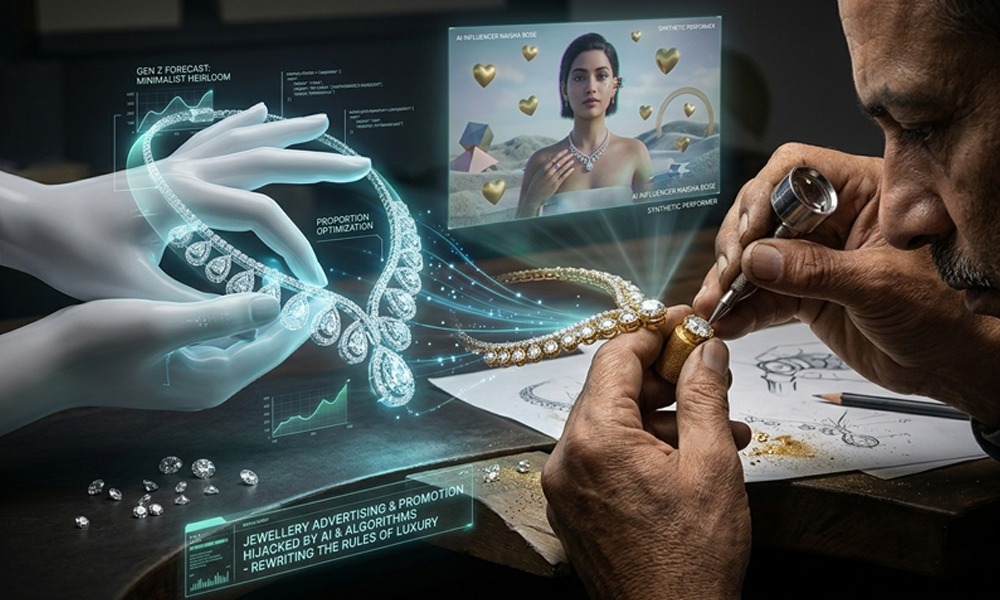
From decoding what Gen Z wants before they even know they want it, to conjuring surreal ad campaigns featuring models who don’t have a pulse, tech is rewriting the rules of luxury.
By Steve Fernandes
Forget dusty velvet trays and weeks of agonizing over sketches. The jewellery world—an industry notoriously obsessed with heritage, heavy gold, and “the way we’ve always done it”—just got a massive software update.Artificial Intelligence has officially crashed the atelier. From decoding what Gen Z wants before they even know they want it, to conjuring surreal ad campaigns featuring models who don’t have a pulse, tech is rewriting the rules of luxury.
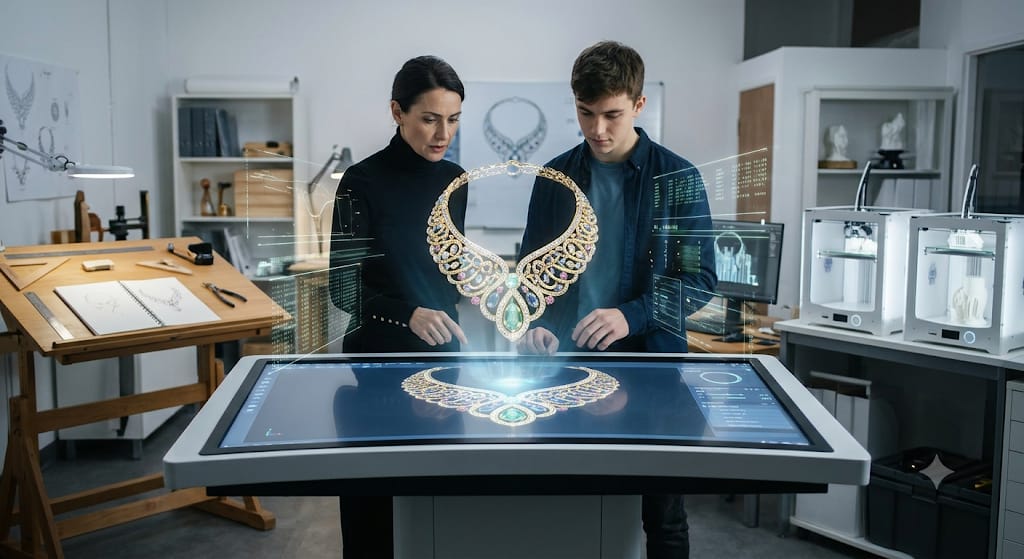
But while algorithms are churning out prototypes at warp speed, the industry’s heavy hitters are drawing a hard line in the gold dust: AI can crunch the numbers, sure, but only human hands can give a piece a heartbeat.
The Tireless Studio Assistant
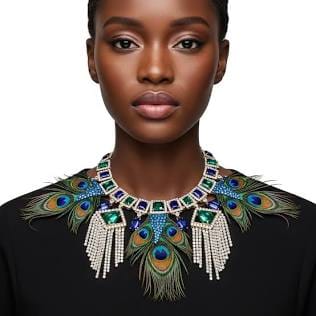
Walk into a modern design studio today, and you’re just as likely to see prompt engineering as you are pencil shavings. With gold prices hovering in the stratosphere and lifestyles shifting toward lighter, everyday statement pieces, brands can no longer afford to guess what will sell.
The conversation around AI isn’t about replacing artisans—it’s about removing the guesswork. AI test-drives hundreds of variations in gemstones, proportions, and finishes before a single gram of gold hits the workbench. Instead of looking in the rearview mirror at last season’s sales, AI scours search trends and social chatter to predict the next big silhouette.
Pair AI-driven trend forecasting with next-gen hardware—think 3D printing, paper casting, and electroforming—and you get intricate, feather-light pieces hitting shelves at record speed. Throw in blockchain for airtight traceability, and suddenly, the ancient trade of goldsmithing looks straight out of Blade Runner.
Decoding the Modern Buyer
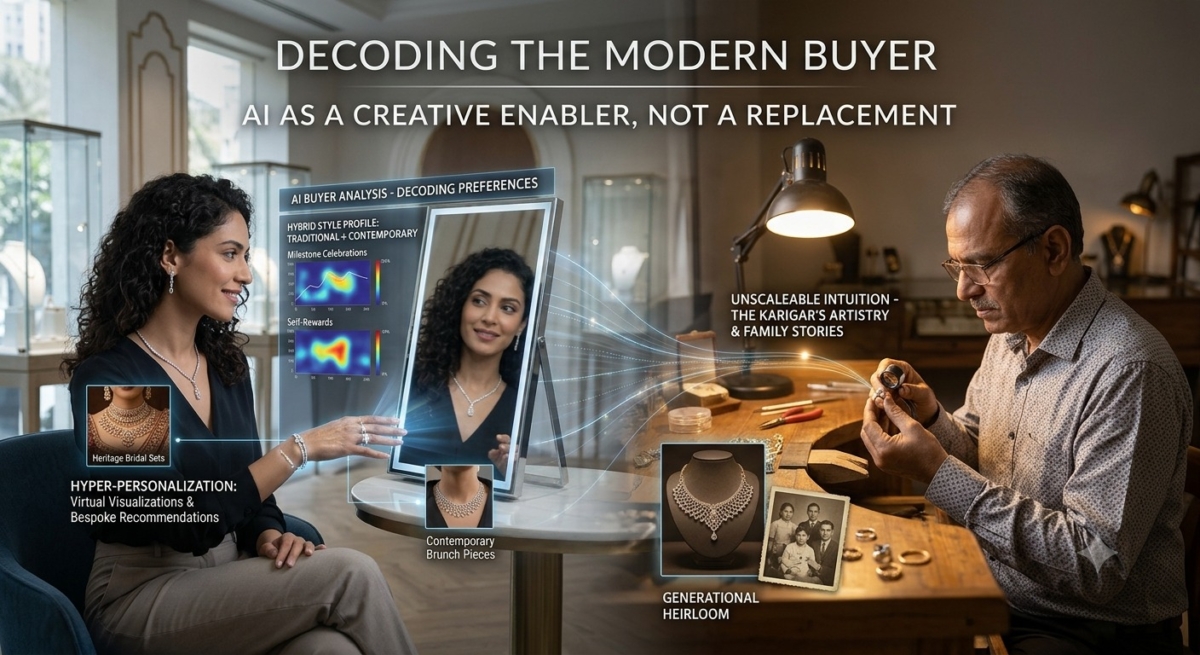
If you think AI is just a backend factory tool, think again. It’s also reading the room—and the customer.
In hyper-discerning markets shoppers want it all: a heritage bridal set steeped in tradition for the wedding, and sleek, contemporary pieces for Monday morning brunch.
By analyzing buyer behavior, AI helps jewellers nail hyper-personalization, offering virtual visualizations and bespoke directions tailored to specific milestones, self-rewards, or celebrations.
Remember: You can’t code the intuition of a seasoned karigar hand-setting a diamond, nor can an algorithm translate a family’s multi-generational story into an heirloom. AI is a creative enabler, not a replacement.
Pixels, Faux-Models,
Of course, the revolution isn’t just happening at the workbench—it’s taking over your feed. Traditional luxury shoots are notoriously brutal on budgets: massive crews, exotic locations, and logistical nightmares. Enter generative AI, slashing content production times by up to 65%.
Brands are ditching physical sets for surreal, dreamlike digital editorials—picture golden heart pendants floating in zero-gravity landscapes—and tapping virtual influencers to front major drops. Just look at Indian label KALON Art Jewellery, which rolled out its “Wildfire” collection starring AI influencer Naisha Bose.
The Glitch in the Glamour
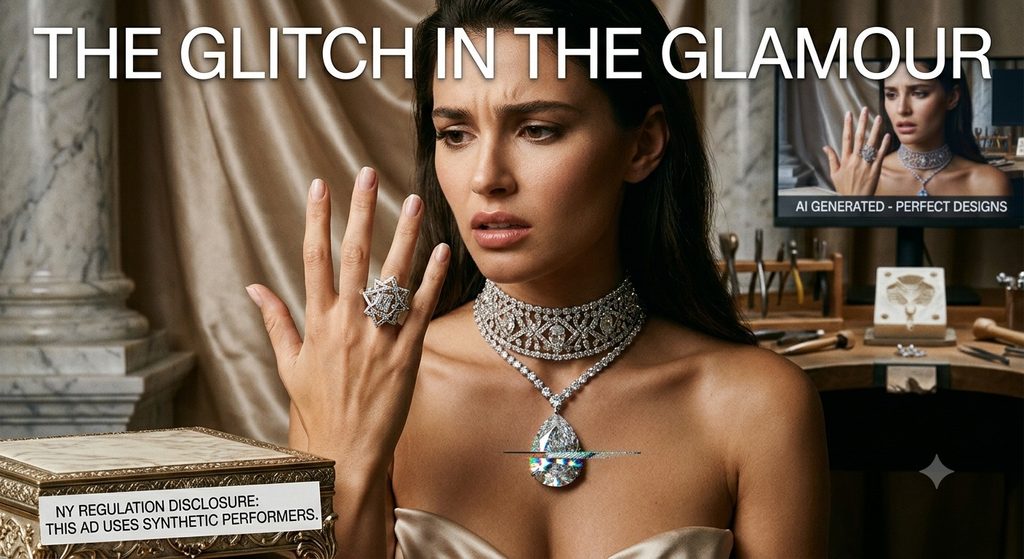
Before we hand the keys of the vault over to our silicon overlords, let’s talk about the catch. For all its swagger, AI still has a glaring blind spot: reality.
Generative algorithms don’t understand physics, metal thickness, or stone-setting mechanics. A ring that looks transcendent on a screen might be structurally impossible to forge in a real workshop without a complete CAD overhaul. Worse, AI still trips over basic human anatomy—nothing kills a luxury vibe faster than a viral campaign featuring a model with six fingers or a warped gemstone.
Then there’s the trust factor. Buying fine jewellery is an emotional, high-stakes flex, and consumers are starting to push back when they realize the radiant model wearing a diamond choker doesn’t actually exist.
The law is catching up, too—New York just passed a landmark regulation forcing brands to slap a disclosure label on ads using “synthetic performers.”
The Verdict
The future of fine jewellery isn’t a cage match between the algorithm and the artisan—it’s a collab. The brands poised to win the next decade are the ones bold enough to let AI handle the heavy lifting of data, speed, and hyper-personalization, while fiercely protecting the raw, messy, irreplaceable magic of human craftsmanship.

-

 JB Insights6 hours ago
Jewellery Advertising and Promotion Hijacked By AI and Algorithms
-

 National News7 hours ago
P N Gadgil Jewellers Limited – Diwali Sales Update
-

 National News4 hours ago
5 Ways To Elevate Your Diwali Style With Diamond Stacking
-

 BrandBuzz11 hours ago
UNTAME Launches In India With Versatile Everyday Fine Jewellery