National News
Malabar Gold & Diamonds to Open 12 New Showrooms in March, Expands Global Network to 391 showrooms across 13 countries


Malabar Gold & Diamonds, world’s 6th largest jeweler, is set to launch 12 new showrooms by March 2025 to further strengthen its presence across India. The latest expansion drive will take the total showroom count to 391 showrooms across 13 countries and presence in 19 states across India.
The new showrooms will be located at Panvel in Mumbai, Sinhagad Road in Pune, Brahmapur and Soubhagya Nagar in Odisha; Dhanbad in Jharkhand, Hospet, Nagarbhavi and Chitradurga in Karnataka; Nandyal, Amalapuram, Machilipatanam in Andhra Pradesh, Varanasi in UP.
Malabar Group has invested Rs. 600 crores in this expansion phase and hired 406 employees in various roles this financial year.
Malabar Gold & Diamonds plans to open 60 new showrooms in 2025, further expanding its global presence. In April 2025, the Group is set to inaugurate 5 new showrooms, marking its expansion into the Middle East, UK, and Canada.
Malabar Gold & Diamonds has launched a consumer awareness campaign with prolific actor and brand ambassador NTR Jr. The campaign highlights the brand as a responsible jeweller, emphasizing its commitment to sustainable practices, authentic hallmarked jewellery, and certified natural diamonds.
Commenting on the expansion, MP Ahammed, Chairman, Malabar Group said, “Our expansion plan is aligned with our broader vision of extending our global footprint and offering quality-focused, transparent retail practices coupled with a world-class shopping experience to more people across the world. We are deeply committed to ethical business practices and responsible sourcing, which are at the core of our values. As we continue to grow and enter new markets, each showroom opening represents a step closer to realizing our vision of becoming the world’s number one jewellery and luxury brand. This global market penetration not only broadens our reach but also strengthens our position as a trusted brand that offers excellence, integrity, and unparalleled luxury to our customers worldwide.”
All our showrooms will offer a diverse range of traditional and contemporary jewellery collections, coupled with a personalized shopping experience, demonstrating Malabar Gold & Diamonds’ dedication to customer service excellence.
Malabar Gold & Diamonds operates 11 state-of-the-art factories across India and 5 international units, ensuring world-class craftsmanship and quality in jewelry manufacturing. Its key facilities in Hyderabad, Jaipur, and Bangalore serve as innovation hubs, equipped with the latest technology to create exquisite designs while adhering to the highest standards of legal compliance, quality assurance, and sustainability. Beyond production, the company places a strong emphasis on employee well-being, occupational health, and safety, fostering a work environment that empowers artisans and upholds global best practices.
Malabar Gold & Diamonds is renowned for its commitment to customer satisfaction through its “Malabar Promises,” which include transparent pricing with a detailed cost breakdown, lifetime free maintenance services available at all global showrooms, and a 100% exchange value for old gold and diamonds. The company ensures that all jewellery is 100% HUID- compliant, offering complete transparency and authenticity. Certified diamonds undergo 28- point quality checks, and every jewellery purchase comes with one year of free insurance, with options for extended coverage and warranty. The brand also guarantees its gold is responsibly sourced from authorised channels, ensuring ethical practices throughout its supply chain.
Beyond India, Malabar Group’s global presence spans across the UAE, Qatar, Kuwait, Oman, Saudi Arabia, Bahrain, Singapore, Malaysia, USA, UK, Canada, and Australia. The company employs over 25,000 professionals from 26 countries. Malabar Gold & Diamonds also operates 14 wholesale units across eight countries, 15 jewellery manufacturing units in five countries, design studios, and boasts over 25 exclusive brand collections, serving more than 15 million satisfied customers from 100 countries.
A cornerstone of Malabar Group’s corporate social responsibility initiatives is the ‘Hunger Free World’ project, which aims to alleviate hunger by providing nutritious meals. Currently, the initiative distributes food packets to 60,000 individuals daily across 81 cities in 17 Indian states. In addition, 10,000 food packets are distributed daily to schoolchildren in Zambia, Africa. To date, Malabar Group has invested over ₹286 crore in various CSR activities.
Additionally, as part of the Malabar Group’s ongoing Hunger Free World initiative, 581 micro learning centers have been established across the country to provide basic education to street children and facilitate their transition into formal schooling.
So far, 25,800 children have been enrolled in these centres, where they receive one year of foundational education to help them return to or begin formal education. The initiative ensures each child continues their studies in a structured school environment, with an annual expenditure of Rs. 10,000 per child to support their education.
Children who complete their 10th standard will receive support for higher studies on campuses across various states, with additional scholarships available to girls as part of the Group’s commitment to women’s empowerment







National News
Gold Loans Surge 60.6% y-o-y to Rs 23.3 Lakh Crore as India’s Borrower Base Expands
Gold loans are increasingly used beyond short-term emergency funding, including by small businesses and households seeking liquidity without selling jewellery. The rapid expansion has been supported by rising gold prices, easier access to formal credit, and growing participation from smaller cities.
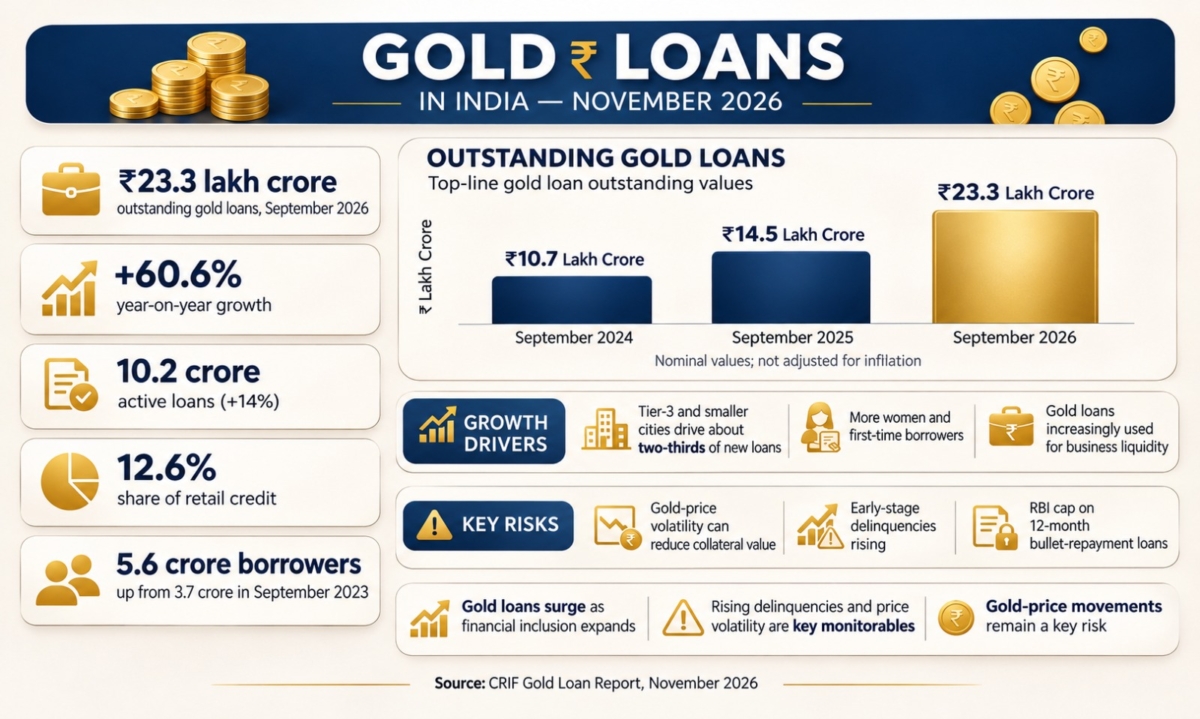
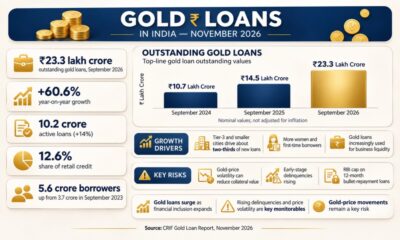
India’s gold-loan market entered November 2026 in a strong but increasingly risk-sensitive phase. Outstanding gold loans rose 60.6% year-on-year to Rs 23.3 lakh crore as of September 2026, while active loans increased 14% to 10.2 crore; however, early-stage delinquencies are rising and lenders are watching gold-price volatility closely.
Market size and growth
The gold-loan portfolio reached Rs 23.3 lakh crore in September 2026, up from Rs 14.5 lakh crore a year earlier and Rs 10.7 lakh crore in September 2024—more than doubling in two years.

As of September 2026, India’s outstanding gold-loan portfolio stood at Rs 23.3 lakh crore, representing a 60.6% year-on-year increase. Active gold loans rose 14% to 10.2 crore, while gold loans accounted for 12.6% of total retail credit, an increase of 3.3 percentage points. The number of borrowers reached 5.6 crore, up from 3.7 crore in September 2023, reflecting the expanding reach of formal gold-loan credit across the country
The sharp rise in portfolio value relative to the increase in loan accounts indicates that the market is being driven primarily by larger average ticket sizes rather than simply more borrowers.
Demand drivers
Gold loans are increasingly used beyond short-term emergency funding, including by small businesses and households seeking liquidity without selling jewellery. The rapid expansion has been supported by rising gold prices, easier access to formal credit, and growing participation from smaller cities.
- Tier-3 and smaller cities accounted for roughly two-thirds of new gold loans, signalling deeper penetration beyond major metros.
- Women and first-time borrowers are forming a growing share of the customer base, expanding the market’s financial-inclusion role.
- Borrowers grew at a three-year CAGR of 15.6%, from 3.7 crore in September 2023 to 5.6 crore in September 2026.
Asset quality
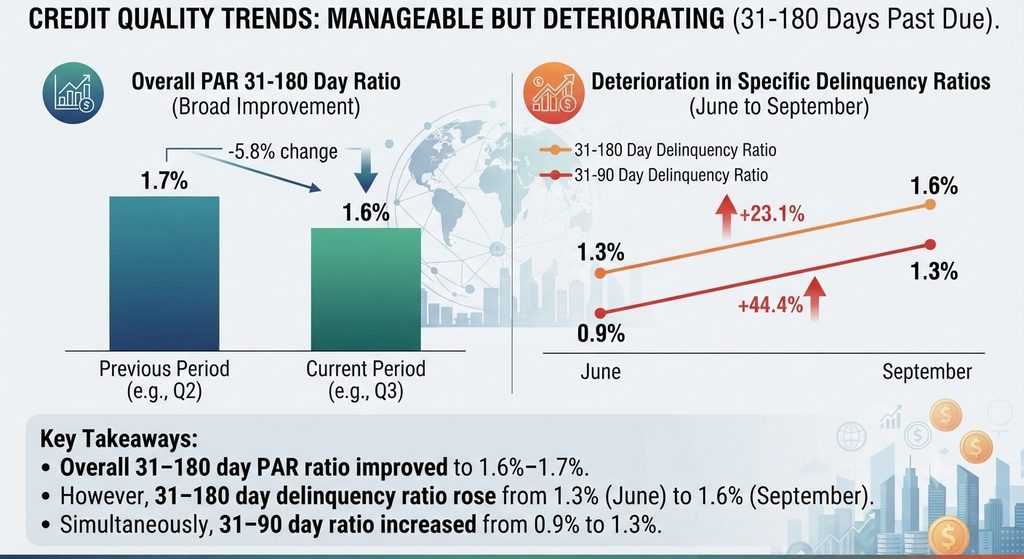
Credit quality remains broadly manageable, but the trend is deteriorating. The 31–180 day past-due (PAR) ratio improved to 1.6%–1.7% overall, yet the 31–180-day delinquency ratio rose from 1.3% in June to 1.6% in September, while the 31–90-day ratio increased from 0.9% to 1.3%.
Single-gold-loan borrowers—about 61% of borrowers—continue to support overall portfolio performance. The concern is the sequential rise in early delinquencies and a growing share of higher-risk borrowers as lending expands rapidly.
Key risks
The principal near-term risk is a meaningful fall in gold prices. After an approximately 80% surge in gold prices, industry executives warned that a 15% correction could create repayment pressure, particularly for borrowers whose loan-to-value positions have become tighter.
- Gold-price volatility: A sharp price correction can reduce collateral value and increase refinancing or repayment stress.
- Rising delinquencies: Early-stage delinquency ratios have moved higher over the September quarter.
- Regulatory impact: The RBI’s cap on bullet-repayment gold loans at 12 months has pushed more borrowers toward regular servicing schedules, which may expose repayment-capacity weaknesses.
- Concentration risk: Rapid growth in smaller cities and among newer borrowers requires stronger underwriting, valuation controls, and collection infrastructure.
Outlook
Gold loans are likely to remain India’s fastest-growing retail-credit segment in the near term, supported by high gold prices, liquidity needs, and expansion into smaller cities. However, growth is expected to become more selective as lenders respond to rising early delinquencies, tighter repayment norms, and gold-price risk.
For lenders, the priority is disciplined loan-to-value management, accurate collateral valuation, transparent interest-rate disclosure, and early-warning systems for repayment stress. For borrowers, gold loans remain a fast, collateral-backed liquidity option—but rising loan sizes and price volatility make timely repayment and awareness of auction or foreclosure terms especially important.



Gold Loans Surge 60.6% y-o-y to Rs 23.3 Lakh Crore as India’s Borrower Base Expands

Senco Gold & Diamonds Opens 100th Franchise Store in Siwan with Rakul Preet Singh

Domestic gold prices see decline
Senco Gold & Diamonds Opens 100th Franchise Store in Siwan with Rakul Preet Singh
Gold Loans Surge 60.6% y-o-y to Rs 23.3 Lakh Crore as India’s Borrower Base Expands

BDB Commemorates Martyrs At Solemn Function On 18th Anniversary Of 26/11
-
 GlamBuzz1 hour ago
Senco Gold & Diamonds Opens 100th Franchise Store in Siwan with Rakul Preet Singh
-
 National News30 minutes ago
Gold Loans Surge 60.6% y-o-y to Rs 23.3 Lakh Crore as India’s Borrower Base Expands
-
 National News20 hours ago
BDB Commemorates Martyrs At Solemn Function On 18th Anniversary Of 26/11
-
 National News2 hours ago
Domestic gold prices see decline