
By Invitation
India: A colour gemstones powerhouse
The future for India colour gemstones industry is bright. The next five years will be great for India’s colour gemstones industry: Nirmal Bardiya


Nirmal Bardiya, MD-RMC GEMS and Regional Chairman- Rajasthan Region,GJEPC is an icon in the colour gemstone industry. His exemplary leadership and deep domain expertise of the colour gemstone industry has seen him ably leading his enterprise RMC GEMS, as well as GJEPC for Rajasthan region. Nirmal Bardiya has been honoured with “Gem Dealer of the Decade” award by Indian Diamond and Colour Stone Association (IDCA), USA in 2010.He spoke to JEWELBUZZ on India’s might in the global colour gemstone market, export and domestic market overview and other aspects of the colour gemstone sector.


Overview of Indian colour gemstone segment
The domestic colour gemstone market was a bit slow in the last few months , but now there’s an uptick , and there will be further spike with purchase for the forthcoming marriage season. Also, the dip in demand for diamonds has aided the growth of coloured gemstones segment.
Indian colour gemstones exports are mainly to the US, Europe, Russia and China. 7The slowdown in China has greatly affected the quantum of exports. Exports have slowed down, but we should see an increase, especially for the US region driven by demand for the forthcoming Christmas season. October onwards there will be uptick in both domestic and exports segment.


Market Trends
Besides emeralds and rubies, which have always been best sellers, the stones that have gained popularity are rubellite, tourmaline, kunzite, peach morganite and tanzanite. There are also stones like paraiba , which are in the premium category; they are expensive and not within reach of all consumers.
Designers are increasingly emphasizing on gemstones. In India, US and other markets, diamonds+colour gemstones combination is a hot trend.
Challenges
Speaking of challenges or problems,there is raw material supply shortage for most colour stones besides emerald; emerald supply is steady.
Certification
Certification provides consumers with confidence in the authenticity of their purchase. Currently the certification system for gemstones is not regulated. Many of the labs are not adhering to standards and their certification has no value. GJEPC is working with the Indian government to establish uniform certification standards and ensure that only certification from authorized labs (a mix of government and private labs) will be considered valid. Currently government labs are based in Mumbai, Delhi and Rajasthan.


Sustainability and ethical sourcing
Sustainability and ethical sourcing is a very important issue. it is essential for exporters to show they comply with sustainability and ethical sourcing norms, else they will lose global customers.
Exports oriented in Sitapur export zone are regularly audited for sustainability and ethical sourcing. Exporters are also obtaining Responsible Jewellery Council (RJC) certification.RJC’s Code of Practices is a landmark standard for the jewellery supply chain and addresses a wide range of supply chain issues, including business ethics, human rights, social and environmental performance.
India jewellery designing
India is known for its expertise in gemstone cutting and jewellery designing and manufacturing. In our current jewellery designers we see traditional craftsmanship meeting modern design.With regard to our current jewellery design education and training, I feel it needs to be strengthened further to make us truly competitive globally.
GJEPC’s aggressive promotion
GJEPC has been aggressively promoting the colour gemstones segment.Initiatives include exhibitions, marketing outreach and advertising campaigns. GJEPC’s International Gem & Jewellery Show which features only select foreign buyers is a great buyer-seller platform to drive colour gemstones exports.


India: A colour gemstones powerhouse
India, renowned for its rich heritage in gemstone mining and jewellery making, is capitalizing on a global resurgence in demand for coloured gemstones.India is seen as a powerhouse in the colour gemstones segment. Jaipur and Bangkok , the two main colour gemstones markets control 90 percent of the global trade.Jaipur is truly a global capital for colour gemstones jewellery.
The future for India’s colour gemstones industry is bright: both, domestic sales and exports will see steady growth. The next five years will be great for India’s colour gemstones industry.









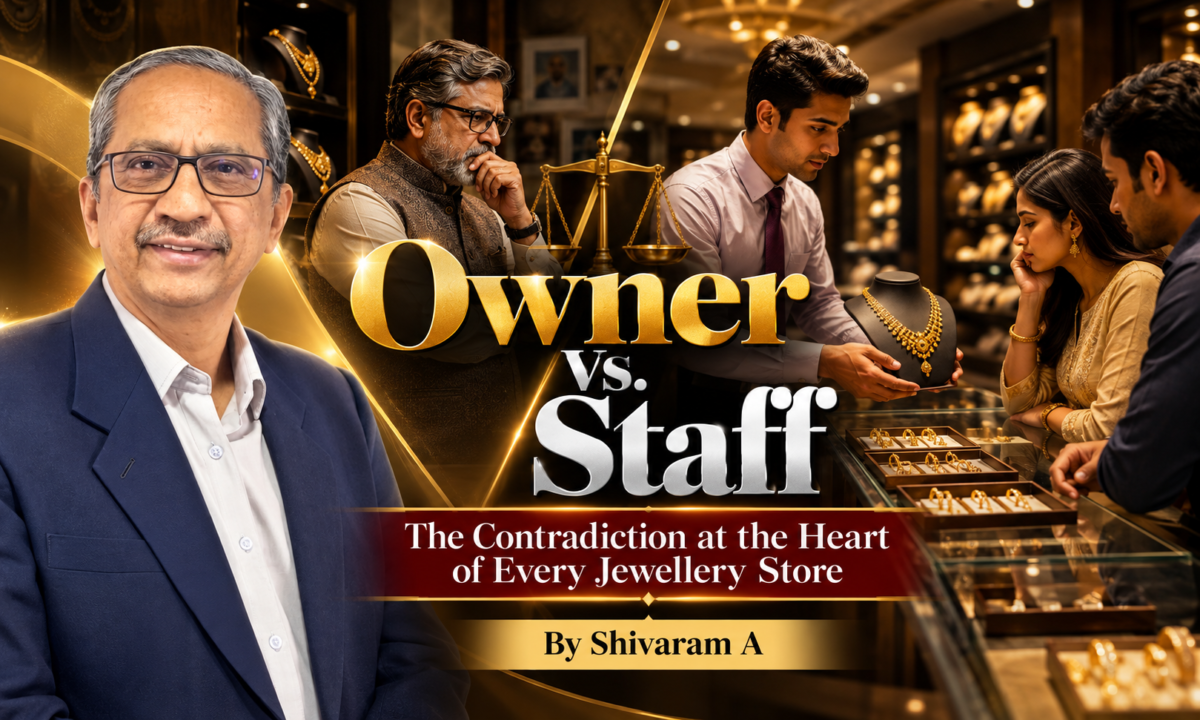
By Shivaram A
The Core Issue
The owner carries the entire risk of the business — investment, gold stock, working capital, loans, everything is in their name. The long-term asset also belongs to the owner — reputation, brand, the customer base built over years, often meant to pass to the next generation. But the moment that matters most — when the customer is standing at the counter, when trust is being built or broken — that moment is entirely controlled by the staff.
The person with the most risk is not present at the decisive moment. And the person with the least to lose holds the most power in that moment. This structural mismatch creates frustration on both sides — and it’s rarely discussed openly.
Making the Conflict Explicit
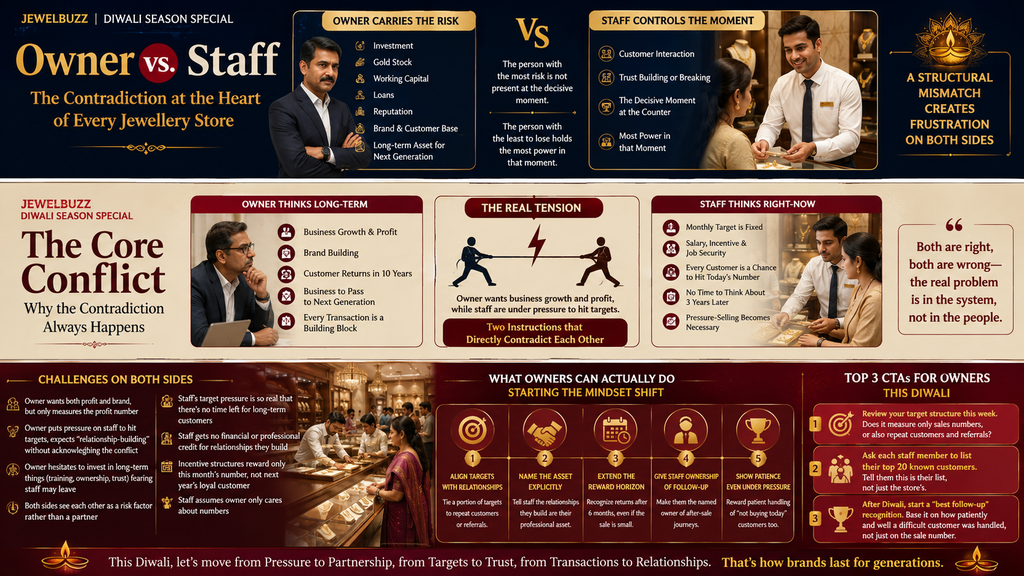
The real tension is this: the owner wants business growth and profit, while staff are under pressure to hit targets.
The owner thinks long-term — how does the brand grow, how does a customer come back after ten years, how does the business pass to the next generation. For the owner, every transaction is a building block toward something bigger.
The staff’s reality is completely different. Their monthly target is fixed. Their salary, incentive, and sometimes even job security depend on how much they sold this month, this Diwali. For staff, every customer is a chance to hit today’s number — right now, this moment. They cannot afford to think about whether this customer comes back in three years, because their performance is reviewed at month-end, not three years later.

So when the owner says “build the relationship, be patient,” and in the same breath increases the target by 20%, these two instructions directly contradict each other. Staff are not confused about what they should ideally do — they understand it perfectly. But they don’t have the choice. The target has to be met, so pressure-selling becomes necessary — even if it means pushing a customer slightly, or using lines like “buy today, rate will go up tomorrow” that create small cracks in trust.
These cracks don’t show up immediately. But after Diwali, when that customer doesn’t return a second time, the owner assumes it’s the staff’s fault. The staff believes the owner set an unrealistic target. Both are right, and both are wrong — because the real problem is in the system, not in the people.
The Challenges on Both Sides
- Owner wants both profit and brand, but only measures the profit number
- Owner puts pressure on staff to hit targets, then also expects “relationship-building” — without acknowledging the two often can’t coexist
- Owner hesitates to invest in long-term things (training, ownership, trust) due to fear that staff will leave anyway
- Staff’s target pressure is so real that there’s no time left to think about the long-term customer
- Staff gets no financial or professional credit for the relationships they build
- Incentive structures reward only this month’s number, not next year’s loyal customer
- Both sides see each other as a risk factor rather than a partner — the owner assumes staff will eventually leave, staff assumes the owner only cares about numbers
What Owners Can Actually Do — Starting the Mindset Shift
- Stop treating targets and relationships as separate — align them. Don’t set targets purely on sales numbers. Tie a small portion of the target to repeat customers or referrals, so staff know that long-term customers count too.
- Name the asset explicitly. Tell staff directly: the relationship you’re building with a customer is your professional asset, not just the store’s. This has to be shown in practice, not just said out loud.
- Extend the reward horizon. Don’t reward only Diwali-week sales — when a customer returns six months later and asks for that staff member by name, recognize that, even if the sale itself is small.
- Give staff ownership of the follow-up. Make each staff member the named owner of their customers’ after-sale journey — repairs, exchanges, the next occasion. This helps them feel the relationship is theirs, not just a transaction.
- Show patience even under pressure. If Diwali week only rewards closed sales, staff will only chase closing. If a staff member who handles a “not buying today” customer well is also appreciated, that’s when the mindset actually starts to shift — because staff notices what the owner actually rewards, not just what they say.
Top 3 CTAs for owners this Diwali
- Review your target structure this week. Does it only measure sales numbers, or does it also give weight to repeat customers and referrals? If not, try a small adjustment starting this Diwali.
- Ask each staff member to list their top 20 known customers. Tell them this is their list, not just the store’s. This builds a sense of ownership.
- After Diwali, start a “best follow-up” recognition. Base it not on the sale number, but on how patiently and well a difficult customer was handled. Staff need to see that patience is rewarded too, not just closing.
Shivaram A
Retail Gurukul



Festive Dressing, But Make It QWEEN: 10 Jewellery Pieces To Add To Your Festive Wardrobe

WGC Report-Digital Gold: Unlocking a $700bn Opportunity

Malabar Gold & Diamonds Unveils ‘SWAYE’, A Natural Diamond Collection Inspired By Spiral Forms and Modern Elegance

Limelight Lab Grown Diamonds Crosses 100 Stores Milestone This Dussehra: Targets 200 In 2027
Malabar Gold & Diamonds Unveils ‘SWAYE’, A Natural Diamond Collection Inspired By Spiral Forms and Modern Elegance
Festive Dressing, But Make It QWEEN: 10 Jewellery Pieces To Add To Your Festive Wardrobe
-
 National News2 days ago
Limelight Lab Grown Diamonds Crosses 100 Stores Milestone This Dussehra: Targets 200 In 2027
-
 BrandBuzz14 hours ago
Malabar Gold & Diamonds Unveils ‘SWAYE’, A Natural Diamond Collection Inspired By Spiral Forms and Modern Elegance
-
 National News10 hours ago
Festive Dressing, But Make It QWEEN: 10 Jewellery Pieces To Add To Your Festive Wardrobe
-
 International News11 hours ago
WGC Report-Digital Gold: Unlocking a $700bn Opportunity
