

National News
Impact of US Reciprocal Tariffs on Indian Gem & Jewellery Exports: Kirit Bhansali, Chairman, GJEPC
US Imposes 50% Tariff on Indian Goods, Sparking Fears of Export Disruptions and Economic Fallout

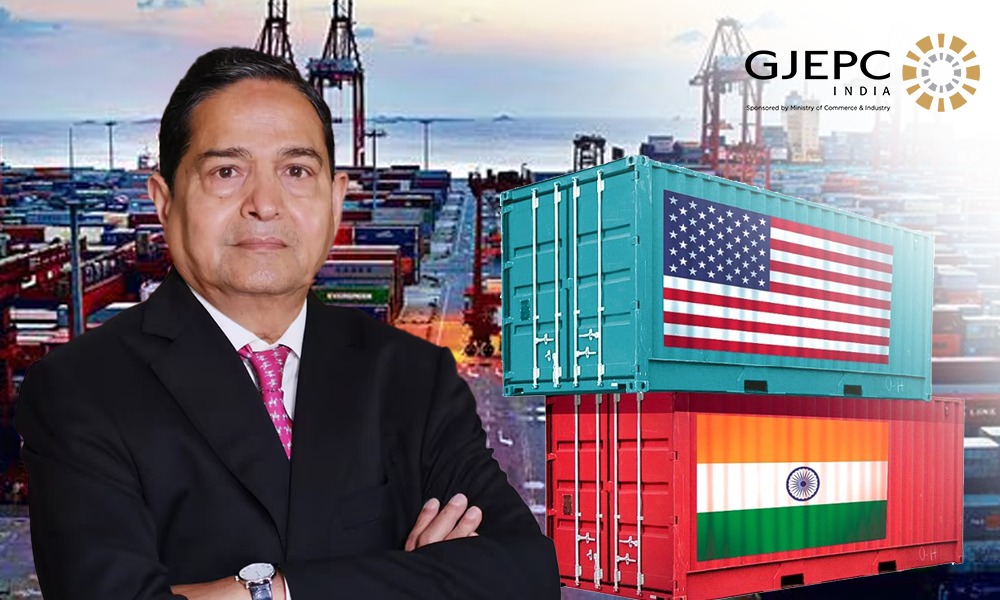
The US announcement of a sweeping 50% tariff on all Indian goods is a deeply concerning development. This move would have far-reaching repercussions across India’s economy—disrupting critical supply chains, stalling exports, and threatening thousands of livelihoods.
The Indian gem and jewellery sector, in particular, stands to be severely impacted. The United States is our single largest market, accounting for over $10 billion in exports—nearly 30% of our industry’s total global trade. A blanket tariff of this magnitude is severely devastating for the sector.
There is significant dependency on the US market, as 85% of exports from SEEPZ SEZ, which provides 50,000 jobs, is directed there. For cut and polished diamonds, half of India’s exports are US-bound. With revised tariff hike, the entire industry may come to a standstill, placing immense pressure on every part of the value chain—from small karigars to large manufacturers.
What adds to the concern is that competing manufacturing hubs such as Turkey, Vietnam and Thailand continue to enjoy significantly lower tariffs of 15%, 20% and 19% respectively, making Indian products relatively less competitive in the US market. This imbalance, if unaddressed, could erode India’s long-standing position as a key supplier to the US.
We are also concerned about the possibility of trade rerouting through low-tariff destinations such as Mexico, Canada, Turkey, UAE, or Oman—undermining the spirit of legitimate trade and impacting transparency.
Despite these challenges, the Indian gem and jewellery industry remains resilient. The recent success of IIJS Premiere 2025, the world’s largest jewellery fair, was a testament to strong domestic demand, with projected business ranging from Rs. 70,000 crore to Rs. 1 lakh crore. The domestic market—currently pegged at $85 billion—is expected to grow to Rs. 130 billion in the next two years. This domestic growth offers some cushion, particularly for the diamond sector.
Simultaneously, GJEPC is actively exploring new markets. The upcoming Saudi Arabia Jewellery Exhibition (SAJEX) is one such initiative aimed at opening fresh avenues in emerging regions and diversifying India’s export destinations.
While we understand that no trade talks can happen in the current scenario, we urge the Government for immediate relief. We appeal for policy reforms and extensive support to aid the industry in these extraordinarily challenging times.
As a responsible industry and as citizens of this nation, we are respectfully aligned and stand in solidarity with the Government of India. In these testing times, we remain committed to protecting the integrity of our trade and upholding the nation’s economic interests with unity and resolve.
Relief sought from the Government of India
Duty Drawback Scheme: The Government of India may introduce a targeted scheme on the lines of Duty Drawback or reimbursement scheme, covering approximately 25–50% of the new tariffs imposed on gems and jewellery exports only to the USA from August to December 2025. This initiative aims to partially offset the impact of the new tariff structure, mitigate financial strain on exporters, reduce the risk of order cancellations, and help maintain India’s market share in an increasingly competitive and price-sensitive global market.
Financial Support for Market Diversification: Financial assistance under the MAI Scheme is proposed to support the exploration of new markets beyond the traditional U.S. focus. This includes backing for the upcoming SAJEX jewellery exhibition, scheduled from 11th to 13th September 2025 in Jeddah, as well as the establishment of an India Jewellery Exposition Centre in Saudi Arabia, modelled on the IJEX-Dubai platform.
Deferment of Interest on Working Capital Facilities: In respect of working capital facilities sanctioned, lending institutions may be permitted to allow a deferment of interest of six months, from 1st August 2025 to 1st January 2026, as was done during the COVID-19 period.
Allowance of reverse job work by units located in SEZs: By allowing reverse job work to SEZ, the SEZ units would be able to utilise their machinery and engage their labour for manufacture and supply of jewellery in the DTA which can be a saviour during this crisis. The duty should be on the value of duty foregone on the duty-free inputs used by the SEZ unit in manufacturing jewellery for DTA.
Allowing DTA sales: Cancellation of orders will cause blockage of working capital and may result in unit becoming NPA, it is suggested that the SEZ unit may offload their existing stock/pipeline to the domestic market. This sale to DTA should be on duty foregone on the duty-free inputs used in manufacturing of jewellery. Permitting SEZ for reverse job work and DTA sales will support the SEZ to support and retain its workers/artisans/cutters (around 1.25 lakh) and survive at the threshold level amid this emergence situation.
Pre-Shipment Finance Relief: Given potential shipment delays, banks should be encouraged to extend pre-shipment loan due dates by at least 90 days without penalties.
Interest Equalisation Scheme: The interest equalisation scheme has served an important purpose as it has provided much-needed competitiveness to Indian exports, particularly to MSMEs, as the interest costs in India is much above that in competitor countries. The interest subvention scheme may be re-introduced to provide the much-needed financial support to the exporters.
Relief /Liquidity Packages – Similar to the concessional Covid-era loans, Govt/RBI could introduce special short term Relief packages /measures for the sector.
Credit Rating to gems and jewellery sector: Ensuring ratings remain stable for the G&J sector by the rating agency. It is requested to ensure that rating agency should not downgrade the rating of the G&J sector amid the slowdown of businesses which is obvious due to this sudden imposition of high tariffs.







India’s appetite for borrowing against gold is reshaping the country’s credit landscape. Outstanding gold-backed loans have surged 128% from a year earlier, crossing Rs.4 lakh crore ($48 billion) for the first time, according to data from the Reserve Bank of India. As of Jan. 31, loans secured by gold jewellery stood at Rs.4,00,517 crore, marking one of the fastest expansions in retail credit in recent years.
The boom in gold loans has helped propel overall non-food bank credit growth to 14.4% year-on-year. Personal loans now account for 34.5% of total bank lending, outpacing other segments and underscoring a broader shift toward consumer-driven credit expansion
Gold loans alone contributed roughly 9% of incremental bank credit during the period. Between January 2024 and January 2026, outstanding gold-backed credit rose by nearly Rs.3.1 lakh crore—an increase of about 338% over two years—more than quadrupling the size of the portfolio.
Two factors are driving the surge. First, gold prices have climbed roughly 152% over the past two years, increasing the collateral value of household holdings. Second, regulatory guidance requiring banks to classify loans secured by gold explicitly as gold loans has sharpened reporting and accelerated balance-sheet growth in the segment.
The trend highlights a distinctive feature of India’s financial system: households’ vast stock of physical gold, long viewed primarily as a store of wealth, is increasingly being mobilized as collateral for formal credit.
While personal lending and credit to nonbank financial companies within the services sector continue to expand rapidly, industrial credit remains uneven. Loans to micro, small and medium enterprises are growing steadily, but borrowing by large corporations has stayed relatively muted.
Since March 21, 2025, banks have added Rs.21.8 lakh crore to their non-food loan books, translating into 12% growth for the financial year to date. Yet it is gold—rather than factories or infrastructure—that is emerging as one of the most dynamic engines of India’s current credit cycle.



India International Bullion Summit 2026: A Defining Platform Shaping India’s Bullion & Jewellery Ecosystem

#ViRosh Ki Shaadi: Rashmika Mandanna & Vijay Deverakonda Celebrate Love with Temple Gold & Timeless Tradition

Outstanding gold-backed loans surge by 128% from a year earlier
India International Bullion Summit 2026: A Defining Platform Shaping India’s Bullion & Jewellery Ecosystem

IIBS-11: Navigating the ‘New Gold Rush’ in a fragmenting global economy

Oroarezzo 2026, with Italian Exhibition Group, Manufacturing Explores New Markets
-
 ShowBuzz7 hours ago
India International Bullion Summit 2026: A Defining Platform Shaping India’s Bullion & Jewellery Ecosystem
-
 National News4 days ago
IIBS-11: Navigating the ‘New Gold Rush’ in a fragmenting global economy
-
 International News5 days ago
Oroarezzo 2026, with Italian Exhibition Group, Manufacturing Explores New Markets
-
 GlamBuzz13 hours ago
#ViRosh Ki Shaadi: Rashmika Mandanna & Vijay Deverakonda Celebrate Love with Temple Gold & Timeless Tradition
