
National News
IJEX 6TH Fam provides comprehensive insights into ME market
Five-day immersion under GJEPC’s Export Mentorship Programme equips Indian exporters with market intelligence, retail exposure, and strategic clarity across the UAE jewellery landscape.

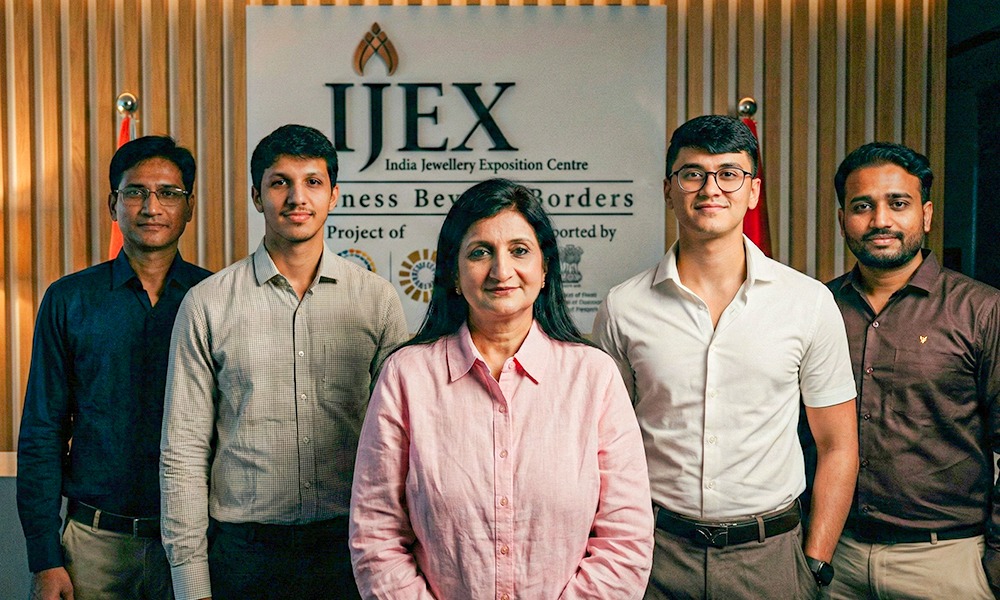
The five-day Familiarisation (FAM) Program by GJEPC’s India Jewellery Exposition Centre (IJEX), Dubai, provided Indian jewellery exporters with comprehensive insights into the Middle East market, focusing on regional dynamics, consumer preferences, and retail environments across the UAE.
The 6th batch of the IJEX FAM Programme, initiated and facilitated under GJEPC’s Export Mentorship Programme (EMP), delivered a structured five-day immersion into the UAE jewellery ecosystem, combining market intelligence, design orientation, logistics guidance, and extensive retail visits across Dubai, Abu Dhabi, and Sharjah. Participants consistently highlighted the programme’s practical value, mentorship, and clarity in building export readiness.
Day 1: Understanding the Middle East Landscape
The programme commenced at IJEX with an introduction session followed by a presentation on navigating the Middle East jewellery market, covering regional dynamics, consumer preferences across emirates, export opportunities, and positioning strategies across wholesale and retail segments. Delegates then visited Ithraa Wholesale & Retail, Goldcenter Building, Gold House, Jewel Plaza, Traditional Gold Souq, African Souq, and Gold Land, together representing around 475 retailers and 460 offices, giving participants a broad view of both wholesale and traditional trading ecosystems.
Day 2: New Dubai Retail and Design Insights
A designer interaction session focused on branding, cultural motifs, and regional aesthetics relevant to GCC consumers. Market visits to Mall of the Emirates, Lulu Hypermarket – Al Barsha, Gold & Diamond Park, and Dubai Hills Mall allowed delegates to observe nearly 115 jewellery retailers across luxury malls, diaspora-focused outlets, and specialised diamond boutiques, highlighting differences in merchandising, product mix, and customer behaviour.
Day 3: Logistics, Compliance and Market Diversity
A session by Ferrari Freight Forwarders covered import procedures, documentation, duties, and secure logistics handling. Subsequent visits to Dubai Mall, Dubai Design District (d3), Karama Centre, and Meena Bazaar brought delegates in contact with about 150 retailers, spanning ultra-luxury international brands to culturally driven Indian diaspora markets, reinforcing the diversity of customer segments within the UAE. .
Day 4: Abu Dhabi Market Exploration
Visits to Madinat Zayed Gold Centre, Hamdan Street, and Abu Dhabi Mall covered roughly 132 jewellery stores, offering insights into the capital’s consumer preferences across luxury, traditional Arabic styles, and price-sensitive segments. Delegates reported improved clarity in identifying suitable positioning and product strategies for different emirates.
Day 5: Strategy Alignment and Expansion
The final day focused on one-to-one consultations with the IJEX team, followed by a certificate ceremony and a visit to Sharjah Blue Souq, where delegates explored around 110 jewellery stores known for 18kt, 21kt, and 22kt gold, diamonds, and silver collections, further expanding their understanding of regional demand across the Northern Emirates.
Overall, participants described the programme as informative, well-organised, and strongly supportive, with several stating that the experience provided clarity, confidence, and a concrete roadmap for entering export markets through IJEX.


National News
June Marked A Strong Rebound In India’s Gem and Jewellery Exports, Surging 26.51% Year-On-Year On Robust Demand Across Key Products and Global Markets

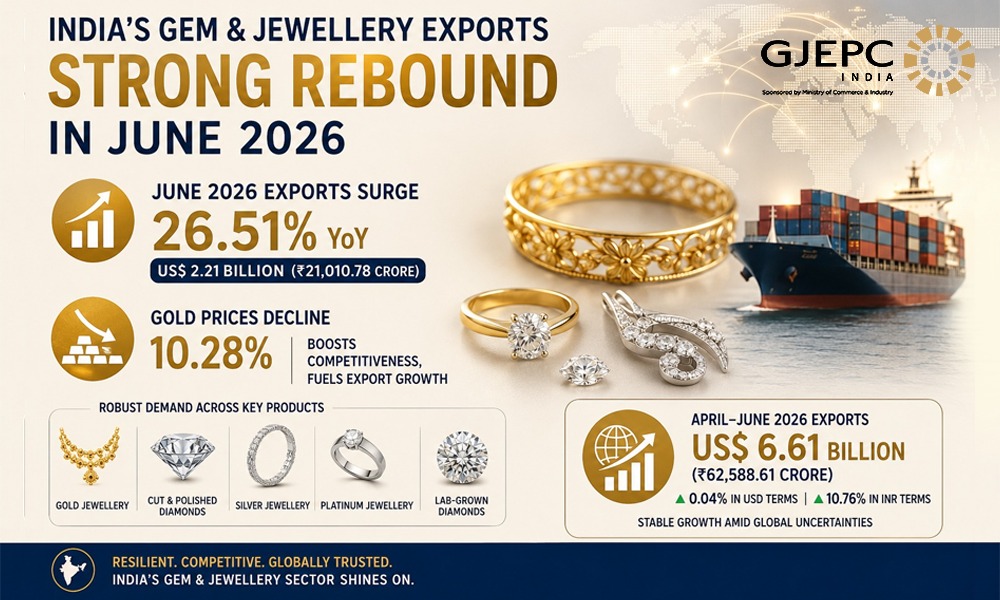
India’s gem and jewellery exports recorded a strong recovery in June 2026, with gross exports rising 26.51% year-on-year to US$ 2.21 billion (Rs. 21,010.78 crore) compared to US$ 1.75 billion (Rs. 15,023.07 crore) in June 2025. The robust monthly performance was driven by healthy demand for gold jewellery, cut and polished diamonds, silver jewellery and platinum jewellery, lab-grown diamonds across key international markets.
For the April–June 2026 period, India’s overall gross gem and jewellery exports remained stable at US$ 6.61 billion (Rs. 62,588.61 crore), registering a marginal 0.04% growth in US Dollar terms and a 10.76% increase in Rupee terms over the corresponding period last year, demonstrating the sector’s resilience amid continued global economic uncertainties and elevated precious metal prices.
Commenting on the export performance, Shri Kirit Bhansali, Chairman, Gem & Jewellery Export Promotion Council (GJEPC), said,
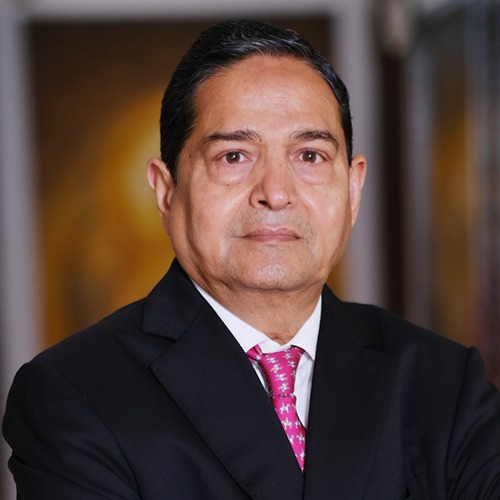
“The strong rebound in June exports reflects the resilience of India’s gem and jewellery sector amid an evolving global trade environment. While exports during the April–June quarter remained broadly stable, the sharp recovery in June is an encouraging sign for the months ahead. Continued demand from key markets, market diversification, and the benefits of recently concluded trade agreements such as the India–UK CETA are expected to further strengthen export growth. GJEPC will continue to work closely with the Government and industry stakeholders to enhance India’s global competitiveness and unlock new export opportunities.”
“The strong rebound in jewellery exports in June 2026 was supported by a significant correction in international gold prices. Gold prices declined by 10.28% month-on-month, falling from US$ 4,723.88 per troy ounce in May 2026 to US$ 4,238.32 per troy ounce in June 2026. The decline in bullion prices lowered raw material costs, enabling Indian exporters to offer more competitive prices in global markets. This improved price competitiveness, coupled with stronger demand in key overseas markets, boosted export volumes and strengthened buyer sentiment. Additionally, the successful participation of Indian exporters in major jewellery exhibitions in Kuwait and Sharjah further supported export orders and contributed to the strong recovery in June exports. However, the problems in availability of gold to exporters continue due to a technical regulatory issue of GST applicability at the import level by the Nominated Agencies notified by RBI. Council is working with the Govt to resolve this issue.”
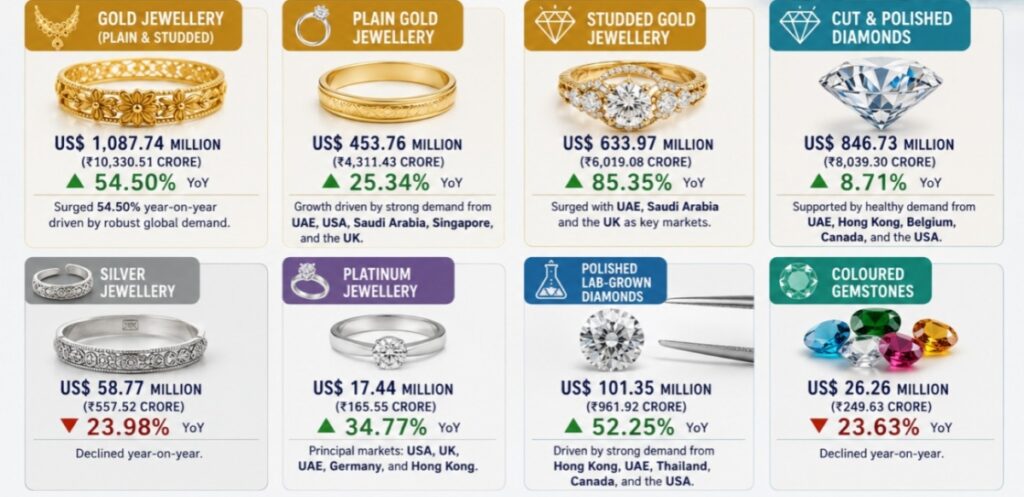
June 2026: Product-wise Export Performance
- Gold Jewellery (Plain & Studded) exports surged 54.50% year-on-year to US$ 1,087.74 million (Rs. 10,330.51 crore).
- Plain Gold Jewellery exports grew 25.34% year-on-year to US$ 453.76 million (Rs. 4,311.43 crore). The growth was driven by strong demand from the UAE, USA, Saudi Arabia, Singapore, and the UK.
- Studded Gold Jewellery exports surged 85.35% to US$ 633.97 million (Rs. 6,019.08 crore), with the UAE, Saudi Arabia and the UK emerging as the key export markets.
- Cut & Polished Diamonds exports increased 8.71% to US$ 846.73 million (Rs. 8,039.30 crore), supported by healthy demand from the UAE, Hong Kong, Belgium, Canada, and the USA.
- Silver Jewellery exports declined 23.98% to US$ 58.77 million (Rs. 557.52 crore) in June 2026.
- Platinum Jewellery exports grew 34.77% to US$ 17.44 million (Rs. 165.55 crore), with the USA, UK, UAE, Germany, and Hong Kong being the principal export markets.
- Polished Lab-Grown Diamonds exports recorded a robust 52.25% growth to US$ 101.35 million (Rs. 961.92 crore), driven by strong demand from Hong Kong, the UAE, Thailand, Canada, and the USA.
- Coloured Gemstones exports declined 23.63% to US$ 26.26 million (Rs. 249.63 crore).
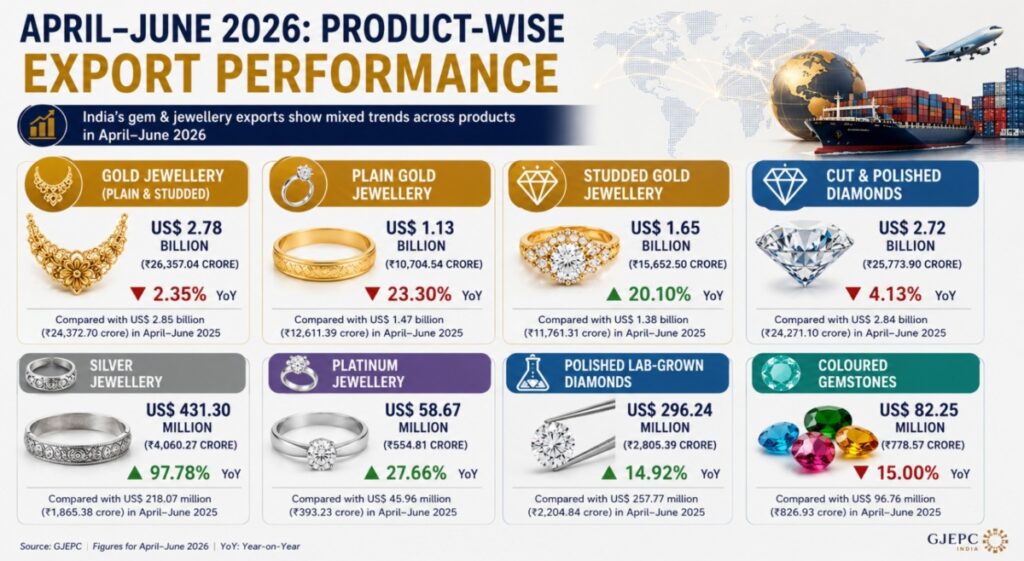
April–June 2026: Product-wise Export Performance
- Gold Jewellery (Plain & Studded) exports stood at US$ 2.78 billion (Rs. 26,357.04 crore) during April–June 2026, registering a 2.35% decline compared with US$ 2.85 billion (Rs. 24,372.70 crore) in the corresponding period last year.
- Plain Gold Jewellery exports declined 23.30% to US$ 1.13 billion (Rs. 10,704.54 crore) during April–June 2026, compared to US$ 1.47 billion (Rs. 12,611.39 crore) in the corresponding period last year.
- Studded Gold Jewellery exports grew 20.10% to US$ 1.65 billion (Rs. 15,652.50 crore) from US$ 1.38 billion (Rs. 11,761.31 crore) in April–June 2025.
- Cut & Polished Diamonds exports declined 4.13% to US$ 2.72 billion (Rs. 25,773.90 crore) compared to US$ 2.84 billion (Rs. 24,271.10 crore) in the corresponding period last year.
- Silver Jewellery exports nearly doubled, rising 97.78% to US$ 431.30 million (Rs. 4,060.27 crore) from US$ 218.07 million (Rs. 1,865.38 crore) in April–June 2025.
- Platinum Jewellery exports increased 27.66% to US$ 58.67 million (Rs. 554.81 crore) from US$ 45.96 million (Rs. 393.23 crore) during the corresponding period last year.
- Polished Lab-Grown Diamonds exports increased 14.92% to US$ 296.24 million (Rs. 2,805.39 crore) from US$ 257.77 million (Rs. 2,204.84 crore) during the same period last year.
- Coloured Gemstones exports declined 15% to US$ 82.25 million (Rs. 778.57 crore) compared to US$ 96.76 million (Rs. 826.93 crore) in April–June 2025.



Iconic Actress Tabu Unveils Kalyan Jewellers First Showroom In Baramati

GJEPC Steps Up UK Outreach Ahead Of IIJS Bharat Premiere 2026

Bullion Prices Recover On Technical Buying Amid Geopolitical Uncertainty AUGMONT BULLION REPORT
Iconic Actress Tabu Unveils Kalyan Jewellers First Showroom In Baramati

Palmonas Unveils Palmonas in Style With Tanya Ghavri, Bringing Celebrity Styling To Everyday Jewellery
GJEPC Steps Up UK Outreach Ahead Of IIJS Bharat Premiere 2026
-
 New Premises2 hours ago
Iconic Actress Tabu Unveils Kalyan Jewellers First Showroom In Baramati
-
 GlamBuzz4 hours ago
Palmonas Unveils Palmonas in Style With Tanya Ghavri, Bringing Celebrity Styling To Everyday Jewellery
-
 International News3 hours ago
GJEPC Steps Up UK Outreach Ahead Of IIJS Bharat Premiere 2026
-
 International News4 hours ago
Bullion Prices Recover On Technical Buying Amid Geopolitical Uncertainty AUGMONT BULLION REPORT
