
International News
Gold continues to get strength on the Middle East conflict
Safe-haven surge lifts bullion to multi-decade highs as Strait of Hormuz crisis fuels oil spike, dollar strength caps gains, and markets eye fresh breakouts toward $5,500 gold and $100 silver.


Safe Heaven hedge – Gold has extended its longest winning streak since 1973, underscoring its role as a core safe-haven asset during periods of systemic stress. With a key global trade chokepoint effectively locked and geopolitical instability intensifying, investors have decisively rotated away from risk assets toward bullion.
Geopolitical Tensions – US President Donald Trump signaled that military operations against Iran could persist for a month or longer, heightening fears of a prolonged conflict. In response, Iran declared the Strait of Humroz closed and warned it would target vessels attempting transit. Given that nearly 20% of global oil supply moves through this corridor, crude prices have surged, amplifying inflationary and growth concerns worldwide.

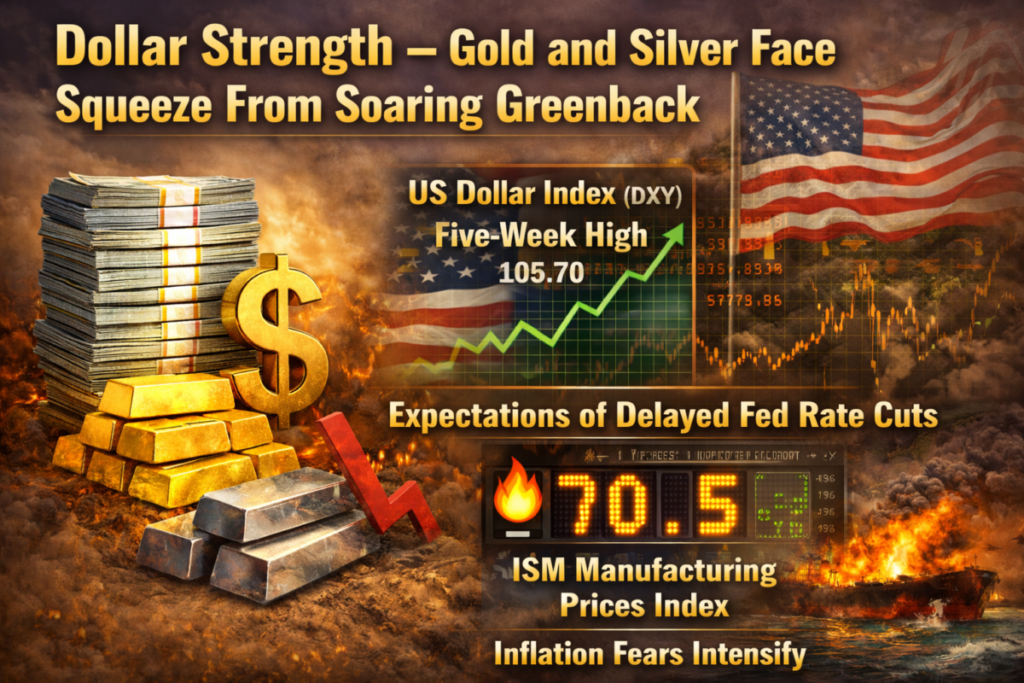
Dollar Strength – Despite strong safe-haven demand, gold and silver witnessed intermittent profit-booking as the US dollar strengthened to five-week high. The greenback gained support from safe-haven inflows and expectations that rising energy prices could stoke inflation, potentially delaying Federal Reserve rate cuts and supporting US yields in the near term. Pressure also intensified as the ISM Manufacturing Prices Index leaped to 70.5, a 11.5 point jump that signaled reignited inflation.
Gold – Support & Resistance Levels
| Market Type | Support Level | Resistance Level |
|---|---|---|
| International | $5150/oz | $5500/oz |
| Domestic | Rs 158,000/10 gm | Rs 172,000/10 gm |
Silver – Support & Resistance Levels
| Market Type | Support Level | Resistance Level |
|---|---|---|
| International | $85/oz | $100/oz |
| Domestic | Rs 255,000/kg | Rs 300,000/kg |
Technical Triggers
- After achieving the target of $5400 (~ Rs. 1,67,000), Gold prices are consolidating and building a base for the new bullish momentum towards $5500 (~ Rs. 1,72,000) and $5600 (~ Rs. 1,76,000).
- After achieving the target of $93 (~ Rs. 2,85,000), Silver prices are expected to consolidate and build a base around $85 and $95 before resuming for the new bullish momentum towards the next resistance level of $100 (~ Rs. 300,000).



International News
Consortium Led By Former De Beers CEO Gareth Penny Selected As The Preferred Bidder To Acquire De Beers
Botswana is expected to play a pivotal role in the transaction. The country, together with Namibia, Angola and other shareholders, already owns a 15% stake in De Beers

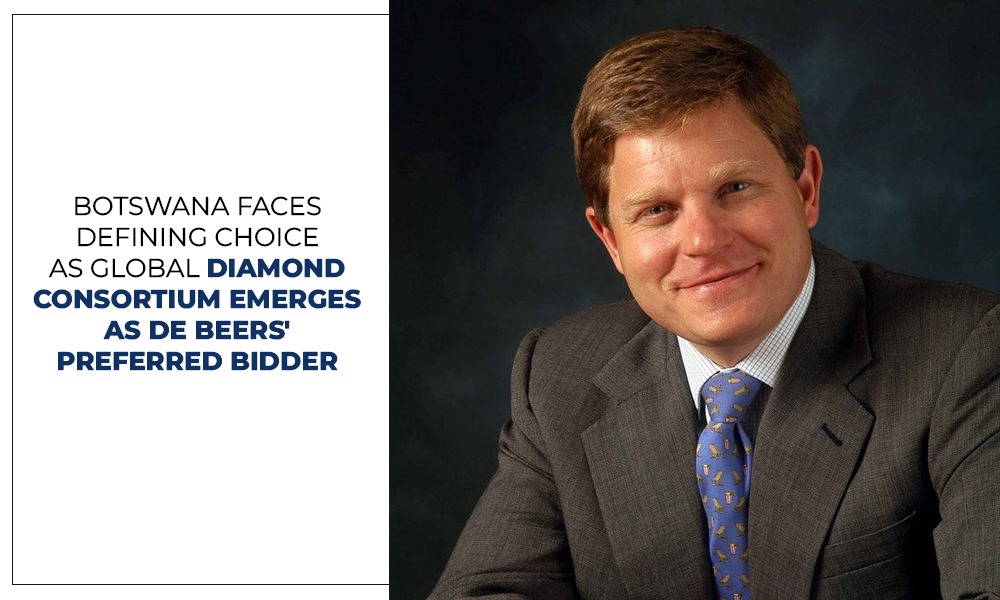
A consortium headed by former De Beers CEO Gareth Penny has been selected as the preferred bidder to acquire De Beers, according to Botswana’s Minister for State President, Defence and Security, Moeti Mohwasa.
Speaking on the development, Mohwasa said Anglo American conducted a competitive sale process involving three shortlisted bidders before identifying the Global Diamond Consortium as its preferred choice.
Anglo American announced plans to divest De Beers in May 2024 as part of a broader restructuring strategy, driven by prolonged weakness in the diamond market and other business priorities.
The sale process has attracted significant interest from industry leaders and investors. Among those previously linked to the bidding were former De Beers CEO Bruce Cleaver, Australian mining executive Michael O’Keeffe, Indian billionaire Anil Agarwal, and Indian diamond companies KGK Group and Kapu Gems.
Botswana is expected to play a pivotal role in the transaction. The country, together with Namibia, Angola and other shareholders, already owns a 15% stake in De Beers and retains important rights under the shareholder agreement. Mohwasa emphasized that Botswana has the flexibility to either join the preferred bidder as a strategic partner or exercise its pre-emptive rights independently or with another investor.
Industry observers believe the eventual owner will seek to preserve De Beers’ vertically integrated business model, spanning diamond mining, trading and global natural diamond marketing, while positioning the company to benefit from a potential recovery in natural diamond demand and prices.



Van Cleef & Arpels Unveils ‘Fascinating Egypt’ High Jewellery Collection Inspired By Ancient Civilisation

Bollywood Star Rakul Preet Singh Unveils Senco Gold & Diamonds’ Flagship Store in Bhubaneswar

Rajiv Jain Elected Chairman Of Jaipur Jewellery Show
Van Cleef & Arpels Unveils ‘Fascinating Egypt’ High Jewellery Collection Inspired By Ancient Civilisation
Bollywood Star Rakul Preet Singh Unveils Senco Gold & Diamonds’ Flagship Store in Bhubaneswar

Vinsmera Jewels Expands UAE Presence With Soft Opening Of New Al Barsha Showroom In Dubai
-
 BrandBuzz4 minutes ago
Van Cleef & Arpels Unveils ‘Fascinating Egypt’ High Jewellery Collection Inspired By Ancient Civilisation
-
 New Premises2 hours ago
Bollywood Star Rakul Preet Singh Unveils Senco Gold & Diamonds’ Flagship Store in Bhubaneswar
-
 BrandBuzz23 hours ago
FIFA Unveils First-Ever 18K Gold Diamond Championship Rings to celebrate Spain’s World Cup Victory
-

 National News22 hours ago
Nature’s Elegance, Reimagined: Lotus Arts De Vivre’s Cape Gooseberry Earrings Continue To Captivate
