
OurBuzz
IIJS Premiere 2023:world’s second largest GJ show


Nearly 45,000 visitors expected, 1,850+ exhibitors,
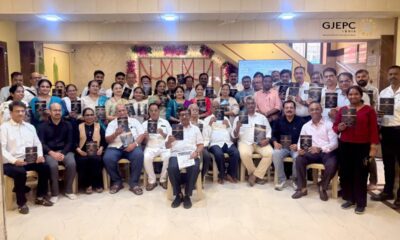
The world’s second largest gem & jewellery fair, IIJS Premiere 2023 will be held concurrently at JIO World Convention Centre (JWCC) Bandra Kurla Complex from 3rd to 7th August 2023 (Thursday-Monday); and at Bombay Exhibition Centre, NESCO, Goregaon East from 4th to 8th August 2023 (Friday-Tuesday) in Mumbai.
IIJS Premiere 2023 will witness the GJ industry’s biggest gathering of domestic and international buyers, and serve as the primary platform for Indian jewellery manufacturers to network with retailers, enabling both segments to gain insight into product design and demand trends.
As of 31 July, 42,000 visitors including international visitors (including global buyers) from 80+ countries and 800+ cities of India visiting the 39th edition of IIJS Premiere.
IIJS Premiere 2023 will have 1,850+ exhibitors, 3,250+ stalls spread over 70,000+ sq. mtrs of exhibition area.







BrandBuzz
Gargi By P N Gadgil & Sons Invites Women To #GETNOTICED This Diwali In New Campaign With Mithila Palkar
The Festive Campaign Flips The Age-Old Advice To “Not Steal The Spotlight” and Encourages Every Woman To Live Her Own Silver Story


Gargi by P. N. Gadgil & Sons (PNGS), the contemporary jewellery brand from the 194-year-old P N Gadgil & Sons legacy, has unveiled its Diwali 2026 campaign featuring actor and brand ambassador Mithila Palkar.
Almost every Indian woman has heard it before a wedding, a family puja or a festive get-together: keep it simple, don’t overdo it, don’t steal the spotlight. Gargi’s Diwali 2026 campaign, #GETNOTICED, gently turns that advice on its head. It tells women that the festive season is the perfect time to show up as themselves, and to enjoy being seen.
The campaign film is set on a busy film shoot with three cameras ready to roll. Mithila Palkar walks up to the video village and asks the director, played by Sarang Sathaye, co-founder of the Marathi digital platform Bharatiya Digital Party (BhaDiPa), which camera is for her close-up. His answer is “None”. He does not want her to be noticed in this shot; she will be revealed later. Slightly offended, Mithila heads to her mark, until her stylist stops her with a box of Gargi earrings.
The moment she puts them on, the set loses its focus. A cameraman involuntarily swings his camera towards her, a second camera follows, and a behind-the-scenes videographer zooms in. Onlookers raise their phones, a CCTV camera rotates, a parked car’s dashcam springs to life, and a satellite orbiting the earth stops to zoom in on her. With all three cameras now on Mithila’s close-up, the director gives in: that’s amazing, let’s shoot it this way. Her earring catches the light, and the film closes on the line “Gargi. Get Noticed.”
The tone is light and witty rather than loud, in keeping with Gargi’s belief that jewellery should express personality, not just mark an occasion. The film puts statement chandelier earrings at the centre of the story, while the campaign photography features necklaces and earrings from Gargi’s Diwali Collection, styled with an ochre embroidered jacket and a blush draped skirt in a warm palette of mustard, gold, blush and maroon. The pieces are designed to move easily from a traditional saree to an Indo-western festive look.
Silver sits at the centre of the campaign’s invitation to “live your silver story”. With silver remaining a preferred Dhanteras purchase for many households, the collection offers an accessible way to honour the tradition of buying something precious, while giving it a contemporary, wearable twist. The range also works as a Diwali gift for sisters, mothers and friends across budgets.
The campaign marks another festive chapter in Mithila Palkar’s association with Gargi, which began in December 2024 and was renewed for 2026. Alongside the film on social media and digital platforms, it runs across print, outdoor hoardings and in-store displays, and invites women to share their own festive looks with #GETNOTICED and @GargibyPNG.
Aditya Modak, Co-founder, Gargi by P N Gadgil & Sons, said:

“Today’s woman does not dress to blend in, and she should not have to apologise for standing out. #GETNOTICED celebrates that confidence. Silver lets her express her style every day and still feel festive, and this Diwali we want every Gargi customer to own her moment. Mithila has grown with Gargi over the last two years, and her easy confidence is exactly the spirit of this campaign.”



Gargi By P N Gadgil & Sons Invites Women To #GETNOTICED This Diwali In New Campaign With Mithila Palkar

IBJA, SAARTHI 360 Sign MoU To Launch ‘NextGen CEO: Leadership for the Future’

Jos Alukkas Unveils New Website For A Seamless Online Jewellery Shopping Experience

Dhanteras Shopping Guide 2026:Gold, Silver, Diamonds & Festive Jewellery Trends To Watch

The Solenne Collection: A Celebration Of Diwali By Bharti Bangur Fine Jewels

From Diya Puja To Diwali Soirées: Jewellery Designed To Go Beyond The Festive Season
-
 JB Insights4 days ago
Dhanteras Shopping Guide 2026:Gold, Silver, Diamonds & Festive Jewellery Trends To Watch
-
 BrandBuzz4 days ago
The Solenne Collection: A Celebration Of Diwali By Bharti Bangur Fine Jewels
-
 BrandBuzz4 days ago
From Diya Puja To Diwali Soirées: Jewellery Designed To Go Beyond The Festive Season
-
 National News4 days ago
Indriya, Aditya Birla Jewellery Unveiled India’s Largest Sustainable Jewellery Rangavalli
