Education
IIG Demonstrates the Future of Industry-Ready Education at Jaipur Jewellery Show 2025
Through immersive industry exposure, factory visits and live design showcases, IIG redefined professional learning beyond the classroom at JJS 2025.


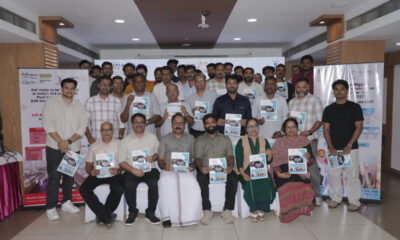
As the Jaipur Jewellery Show (JJS) concluded what is traditionally the final major trade exhibition of the year, the International Institute of Gemology (IIG) used the moment to underline a larger shift underway in professional education, one where classroom learning is no longer sufficient without deep, structured industry immersion.
For IIG students, JJS was not an event to attend but a system to decode. Through its Student Delegation Activity, the institute designed a multi-layered learning experience that combined trade exposure, manufacturing insight, design validation, and cultural context, positioning education as an ecosystem rather than a syllabus.
At the Jaipur Jewellery Show, students engaged directly with the B2B marketplace, studying contemporary Polki and Jadau collections, heritage jewellery from Bikaner, and emerging gemstone formats showcased by leading jewellery houses including Shiv Narayan, Valentine, Saanre, Mrs Marquise, Raanisaa, B.G. Jewellers, among others. The exposure allowed students to understand how design, craftsmanship, sourcing, and commercial viability intersect.
Beyond the exhibition, IIG curated industrial visits that revealed the operational backbone of the jewellery business. Factory visits to Valentine and Achal Jewels Pvt. Ltd. gave students end-to-end visibility into jewellery creation, from design development to Polki Jadau manufacturing and final quality control, while RMC Gems offered insight into international-scale gemstone cutting and polishing operations catering to global brands.
Design education also held a strong presence during the Jaipur programme. At the Jaipur Jewellery Design Festival (JJDF), IIG students presented their manufactured master’s project pieces, offering industry audiences a view into how design thinking is translated into production-ready jewellery.
The institute’s design capability also found recognition at the IJ Design Awards 2025, an evening that marked the elevation of jewellery as a serious art form through exclusive, finely manufactured creations. Among the finalists was Rabiya Malik, an international IIG online student, who secured a place among the Top 5 nominations in the GIA Emerging Designer of the Year category, once again highlighting the institute’s growing global footprint and the credibility of its learning outcomes across geographies.
The visit to the Amrapali Museum and the atelier of Sunita Shekhawat blended heritage with contemporary learning. In a discussion with Digvijay Singh Shekhawat, the industry’s recognition of IIG’s practical, ground-level training was evident, with interest expressed in future internship opportunities for IIG students.
IIG’s growing relevance lies in its ability to offer a complete learning ecosystem. With a diverse portfolio of courses that allows designers to study gemology, creatives to understand merchandising, and entrepreneurs to build retail and business capability, the institute has recently expanded into advanced business and retail boot camps covering branding, technology integration, AI, and experience-led retail strategy. These are complemented by RD Consultancy service, enabling students and alumni to seek guidance on business setup, expansion, and critical decision-making at a discounted rate.

Reflecting on the evolving nature of education, Rahul Desai, CEO & Managing Director, International Institute of Gemology, said, “Earlier, classrooms were enough. Today, education demands equal exposure to industry, process, culture, and decision-making. Immersive experiences like JJS are central to how we prepare students for real careers.”
As the year closes, IIG’s Jaipur immersion stands as a case study in how professional education must evolve, rooted in heritage, aligned with industry, and designed for the realities of modern business.


Education
Jewellery Chemistry and Metallurgy: The Science Behind The Bench
Design Decides What A Piece Of Jewellery Looks Like. Chemistry and Metallurgy Decide Whether It Can Be Made Reliably, Whether It Is What It Claims To Be, and Whether It Lasts.

Jewellery chemistry and metallurgy sit at the intersection of material science, manufacturing and quality control. Where traditional design courses concentrate on aesthetics, technical programmes teach how metals and chemicals actually behave during alloying, casting, refining and surface finishing.
This distinction matters more than ever. India’s jewellery sector is moving towards mandatory hallmarking, tighter traceability, growing demand for lightweight and fashion-led alloys, and the rise of laboratory-grown diamonds. Each of these shifts places a premium on professionals who understand why a metal cracks, why a casting turns porous, why a white gold ring yellows, or why a stone’s colour changes under treatment. Design creates the desire; chemistry and metallurgy protect the value.
This report outlines the six core subject areas of a technical jewellery curriculum, maps the three tiers of educational pathways available, and sets out what each means for manufacturers, hallmarking centres, refiners and next-generation business owners.
1. Why Technical Knowledge Matters
A finished piece of jewellery is the end point of a long chain of physical and chemical events: metals are melted and blended, poured into moulds, cooled, worked, soldered, polished and coated. A failure at any stage becomes a cost further down the line, in the form of rejected lots, rework, customer returns, metal loss or a damaged reputation.
Technically trained professionals help businesses to:
- Reduce metal loss and rework through controlled melting, casting and recovery.
- Meet purity and hallmarking requirements consistently.
- Develop new alloys and finishes with predictable colour, hardness and durability.
- Diagnose production defects at their root cause rather than by trial and error.
- Verify purity and authenticity at the point of purchase, refining or assay.
2. Core Subjects Covered
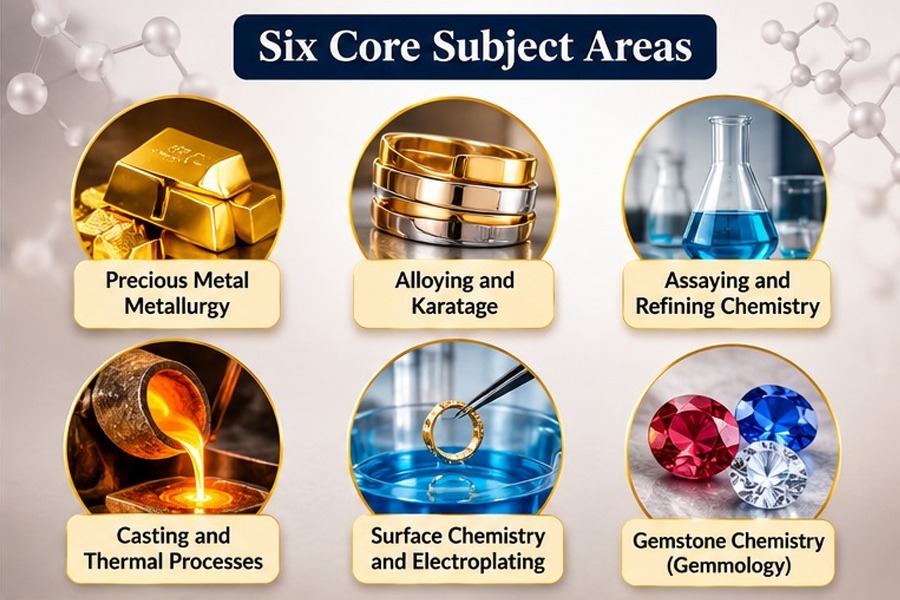
2.1 Precious Metal Metallurgy
The foundation of the discipline is an understanding of how precious metals are built and how they behave. Students study atomic and crystal structure, melting points, malleability, ductility and work-hardening in gold, silver, platinum and palladium. Indicative melting points show why each metal demands different equipment and handling:
| Metal | Approximate melting point |
| Silver | 962 °C |
| Gold | 1,064 °C |
| Palladium | 1,555 °C |
| Platinum | 1,768 °C |
Pure gold is extremely soft and easily deformed. When metal is bent, drawn or hammered, its internal crystal structure becomes strained and hardens, a phenomenon known as work-hardening. Left unmanaged, the piece cracks. Annealing, which is controlled heating that restores a relaxed crystal structure, is the answer, and knowing the correct temperature and time is a core technical skill.
2.2 Alloying and Karatage
Alloying is the deliberate blending of metals to change colour, hardness, melting range, workability and purity. Gold is rarely used pure in jewellery; it is alloyed with copper, silver, zinc, nickel or palladium. Common gold purities and their fineness marks include:
| Karat | Gold content | Fineness mark |
| 24K | 99.9% | 999 |
| 22K | 91.6% | 916 |
| 18K | 75.0% | 750 |
| 14K | 58.5% | 585 |
Colour is largely determined by the companion metals:
- Yellow gold: balanced silver and copper.
- Rose or red gold: higher copper content.
- Green gold: higher silver content.
- White gold: alloyed with palladium or nickel and typically rhodium-plated for brightness.
Students learn to calculate alloy compositions, predict the effect of each addition, and manage trade-offs. Greater hardness may bring brittleness; a lower melting range may help casting but affect soldering. Understanding these trade-offs separates a formulation that works on paper from one that works in a factory.
2.3 Assaying and Refining Chemistry
Purity testing and metal recovery form one of the most commercially important branches of the subject. Key methods include:
- Acid and touchstone testing: a rapid, low-cost screening method for field use.
- Cupellation (fire assay): the traditional reference method, in which a sample is fused with lead and oxidised at high temperature so that base metals are absorbed into the cupel, leaving a precious metal bead to be weighed.
- X-ray fluorescence (XRF) spectroscopy: a non-destructive technique that identifies elemental composition from the surface of an item, widely used for quick, accurate readings.
- Aqua regia refining: a mixture of hydrochloric and nitric acids, classically in a 3:1 ratio, that dissolves gold and platinum group metals so that they can be separated and precipitated in purified form.
Each method has strengths and limits. XRF is fast and non-destructive but measures the surface, so plated or surface-enriched items can mislead. Fire assay is slower and destructive, but remains the benchmark for accuracy. A well-trained professional knows which tool suits which question.
2.4 Casting and Thermal Processes
Lost-wax casting remains the backbone of volume jewellery manufacture. The technical syllabus covers:
- The thermodynamics of melting, flow and solidification.
- Investment powder chemistry, including binders, burnout schedules and mould strength.
- Shrinkage control and sprue design.
- Prevention of gas porosity, which is caused by dissolved gases escaping during cooling.
- Prevention of oxidation and fire scale during casting, soldering and annealing, through correct flux, atmosphere and temperature control.
Many everyday production defects, including pitted surfaces, incomplete fills, brittle joints and dull colour, trace back to a thermal or chemical cause that a trained technician can identify and correct.
2.5 Surface Chemistry and Electroplating
Surface treatment determines how a piece looks on day one and how it ages. Topics include:
- The electrochemical principles behind rhodium and gold plating, including current density, bath chemistry and thickness control.
- Pickling, the use of acid solutions to remove oxides and flux after heating.
- Passivation and anti-tarnish treatments.
- Understanding why silver tarnishes, why plating wears and how to specify a finish that suits the intended use of the piece.
2.6 Gemstone Chemistry (Gemmology)
A gemstone’s colour, clarity and durability are consequences of its chemistry and structure. Students study mineral composition and the trace elements responsible for colour. Examples include chromium in ruby and emerald, and iron and titanium in blue sapphire. They also examine the chemical and heat treatments used to enhance diamonds and coloured stones, such as heating of corundum, oil or resin filling of emeralds, and high-pressure, high-temperature (HPHT) processing of diamond.
With lab-grown diamonds now a mainstream category, a working knowledge of how stones are formed, treated and identified is essential for ethical trading and consumer confidence.
3. Educational Pathways and Programmes
Depending on whether the goal is a full-time career in manufacturing or a specialised laboratory skill, technical education broadly divides into three tiers.
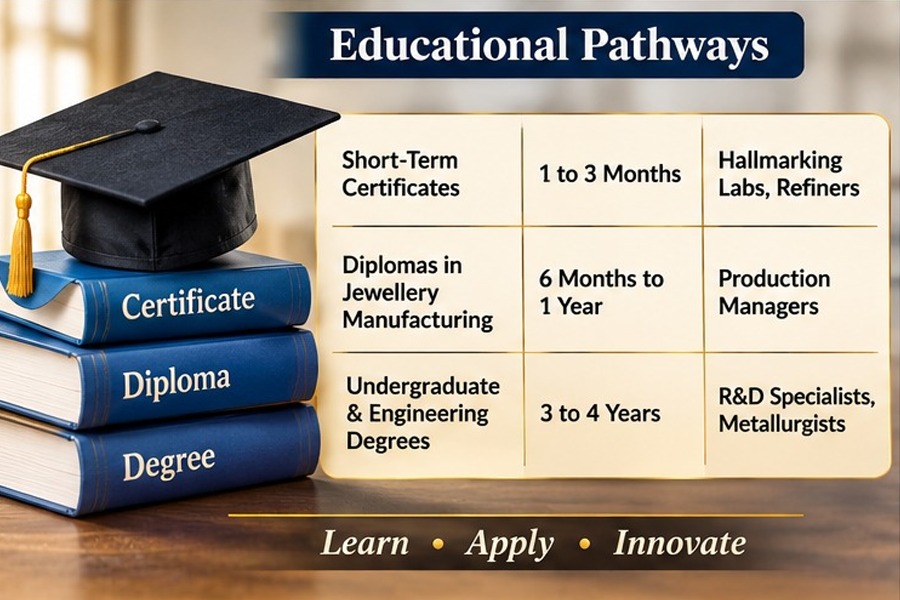
| Programme type | Duration | Ideal for | Key focus areas |
| Short-term certificates | 1 to 3 months | Hallmarking labs, refiners, bench workers | Gold assaying, refining techniques, electroplating and basic metallurgy |
| Diplomas in jewellery manufacturing | 6 months to 1 year | Production managers, factory entrepreneurs | Casting, alloy formulation, soldering, surface finishing and quality control |
| Undergraduate and engineering degrees | 3 to 4 years | R&D specialists, metallurgists | B.Sc. in Jewellery Design and Manufacturing, or B.Tech in Metallurgical Engineering followed by industry specialisation |
Choosing the Right Tier
- Short-term certificates suit those who need a specific, immediately applicable skill, such as an assayer joining a hallmarking centre or a refinery operator upgrading recovery practice.
- Diplomas suit people who run or supervise production and need an all-round grasp of the process, particularly family-business successors and factory managers.
- Degrees suit those who wish to develop new alloys, processes or testing methods, or to take on research and senior technical roles.
The tiers are not mutually exclusive. Many professionals begin with a certificate, gain industry experience and later return for a diploma or degree.
4. Industry Relevance and Career Outcomes
Technical graduates find roles across the value chain:
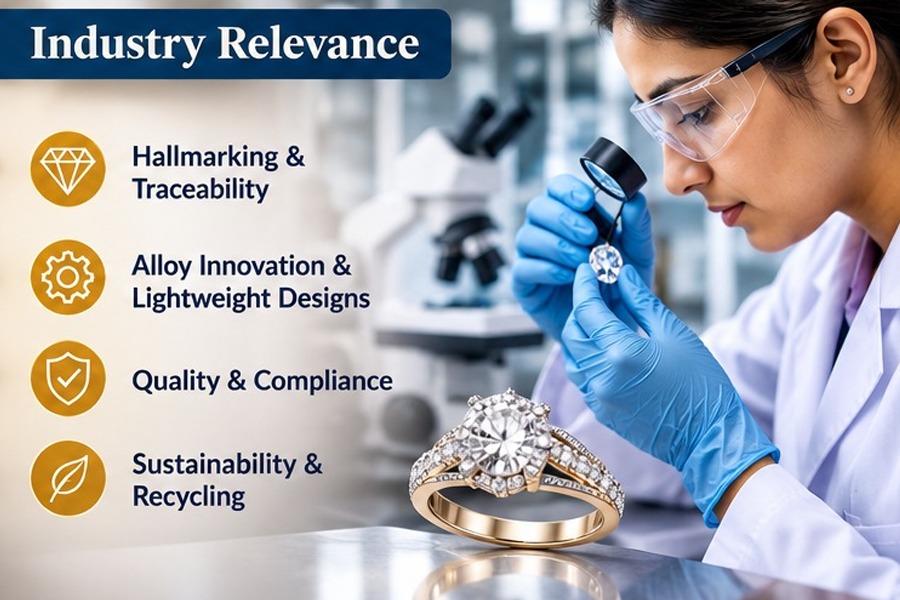
- Hallmarking and assay centres: assayers, lab technicians and quality officers.
- Refineries: process chemists, recovery specialists and plant supervisors.
- Manufacturing units: casting supervisors, production managers and quality-control heads.
- Surface finishing and plating units: process technicians and bath chemists.
- R&D and product development: alloy developers and materials specialists.
- Gem laboratories and trading houses: gemmologists and identification specialists.
- Family-owned businesses: next-generation owners who need to evaluate their own production and supply chain with technical confidence.
5. Key Trends Shaping Demand for Technical Skills
Hallmarking and traceability. Mandatory hallmarking in India has expanded the role of assaying and testing infrastructure and the people who run it.
- Lightweight and fashion jewellery. Thinner, hollow and intricate designs raise the technical bar for casting, joining and finishing.
- Alloy innovation. Demand for nickel-free white gold, new colour golds and higher-hardness 18K and 14K alloys requires genuine formulation expertise.
- Health and regulatory standards. Restrictions on nickel release and on hazardous solder components make chemical literacy a compliance issue, not only a quality one.
- Lab-grown diamonds. Identification and disclosure require trained gemmologists and well-equipped laboratories.
- Sustainability and recycling. Responsible sourcing and efficient metal recovery depend on sound refining chemistry.
- Automation and digital manufacturing. 3D printing and automated casting reward people who understand the underlying materials science, not just the machine settings.
6. Recommendations
For manufacturers and retailers
- Invest in at least one technically trained person per production unit rather than relying wholly on inherited experience.
- Use short-term certification to upskill existing bench and quality staff quickly.
- Treat defect analysis as a chemistry and metallurgy question first.
For students and career changers
- Match the programme tier to the intended role; a short certificate is a sensible starting point for those entering hallmarking or refining.
- Prioritise programmes with hands-on laboratory and workshop time.
For industry bodies and institutions
- Continue to expand accessible short-term programmes in assaying, refining and finishing.
- Build clearer progression routes from certificate to diploma to degree.
- Strengthen links between institutes and employers so that curricula reflect real production problems.
Conclusion
Design decides what a piece of jewellery looks like. Chemistry and metallurgy decide whether it can be made reliably, whether it is what it claims to be, and whether it lasts. As the Indian jewellery industry grows more regulated, more export-oriented and more technologically sophisticated, technical education in these disciplines will move from a specialist option to a strategic necessity.


Rhenium, Iridium In Gold Under Scrutiny; GJC Urges Industry To Stay Calm and Alert, BIS Assures Vigilance and Action

GJEPC Conducts IIJS Bharat Retailers’ Connect In Kozhikode

CaratLane’s Retail Network Reaches 400 Stores In India With Chennai’s 16th Store In Pallikaranai
CaratLane’s Retail Network Reaches 400 Stores In India With Chennai’s 16th Store In Pallikaranai

Bengaluru Based Inventor Claims To Turn Elements Into Gold & Silver Using GNT
Rhenium, Iridium In Gold Under Scrutiny; GJC Urges Industry To Stay Calm and Alert, BIS Assures Vigilance and Action
-
 New Premises11 hours ago
CaratLane’s Retail Network Reaches 400 Stores In India With Chennai’s 16th Store In Pallikaranai
-
 National News15 hours ago
Bengaluru Based Inventor Claims To Turn Elements Into Gold & Silver Using GNT
-
 National News8 hours ago
Rhenium, Iridium In Gold Under Scrutiny; GJC Urges Industry To Stay Calm and Alert, BIS Assures Vigilance and Action
-

 JB Insights1 day ago
Silver Wholesale Goes Digital: How India’s 925 Silver Trade Is Changing The Way It Buys and Sells