JB Insights
Gujarat’s Diamond-Cutting and Polishing Sector Sees Prolonged Crisis
The Immediate Priority For Policymakers and Industry Bodies Would Be Supporting Affected Workers, Easing Credit and Working-Capital Stress For Small Firms, and Helping Units Diversify Into Less Exposed Segments Of The Gem and Jewellery Value Chain.

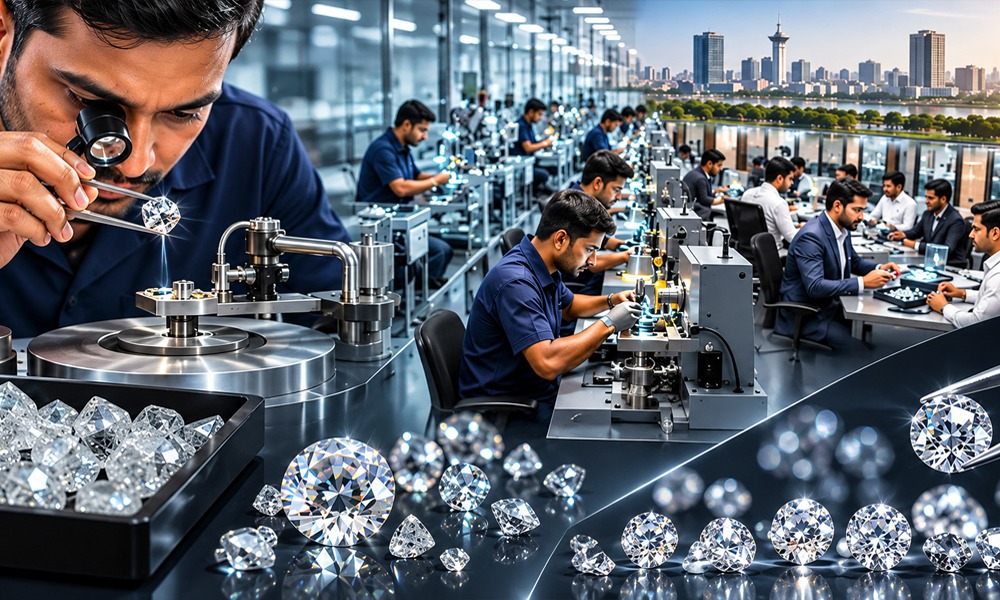
Gujarat’s diamond-cutting and polishing sector is facing a prolonged and uneven crisis. The most visible new pressure point is Bhavnagar, where hundreds of trading offices have closed and an estimated 100,000 people are reported to have lost livelihoods or shifted to other work.
Why the industry is struggling
| Pressure | Impact on Gujarat’s polishing trade |
| Russian rough-supply disruption | Western sanctions and restrictions on Russian-origin diamonds have reduced access to a major source of rough material; India historically imported about 30% of its rough diamonds from Russia. |
| Weak global demand | Lower consumer spending, particularly in key Western and Chinese markets, has reduced orders for polished diamonds. |
| Falling natural-diamond prices | Price declines have squeezed margins for cutters, polishers, traders and subcontractors. |
| US tariff uncertainty and duties | Tariffs on Indian goods have added cost and uncertainty to exports, worsening an already weak demand environment. |
| Laboratory-grown diamonds | Increased competition from lab-grown diamonds has contributed to weaker prices and demand for natural diamonds. |
The sanctions issue is especially consequential because restrictions extended beyond Russian-mined stones to polished diamonds and jewellery made using Russian rough, requiring sourcing certification and disrupting established export channels.
Surat remains the centre of gravity for India’s diamond-processing industry: it processes about 90% of the world’s diamonds and has historically employed more than 800,000 polishers across more than 5,000 units.
Surat has also suffered factory closures, layoffs and reduced activity, but its scale, infrastructure, financing networks and export linkages give it more capacity to absorb shocks. Smaller centres such as Bhavnagar and nearby Amreli are more exposed because many firms depend on orders and subcontracted work from larger manufacturers.
Human and local economic impact
The crisis is not confined to factory floors. Former cutters and factory managers in Bhavnagar are reportedly moving into farming, casual labour and small businessesThis occupational shift points to a broader local-economic effect: reduced incomes for workers, fewer business transactions for traders, and pressure on households that had relied on diamond polishing as a stable source of employment. Local reports also mention families migrating to Surat in search of work, underscoring how the downturn is reshaping livelihoods within Gujarat itself.
Without recovery in rough-material availability, global polished-diamond demand, or export-market conditions, smaller polishing hubs may continue to lose businesses and workers faster than Surat. The immediate priority for policymakers and industry bodies would be supporting affected workers, easing credit and working-capital stress for small firms, and helping units diversify into less exposed segments of the gem and jewellery value chain.





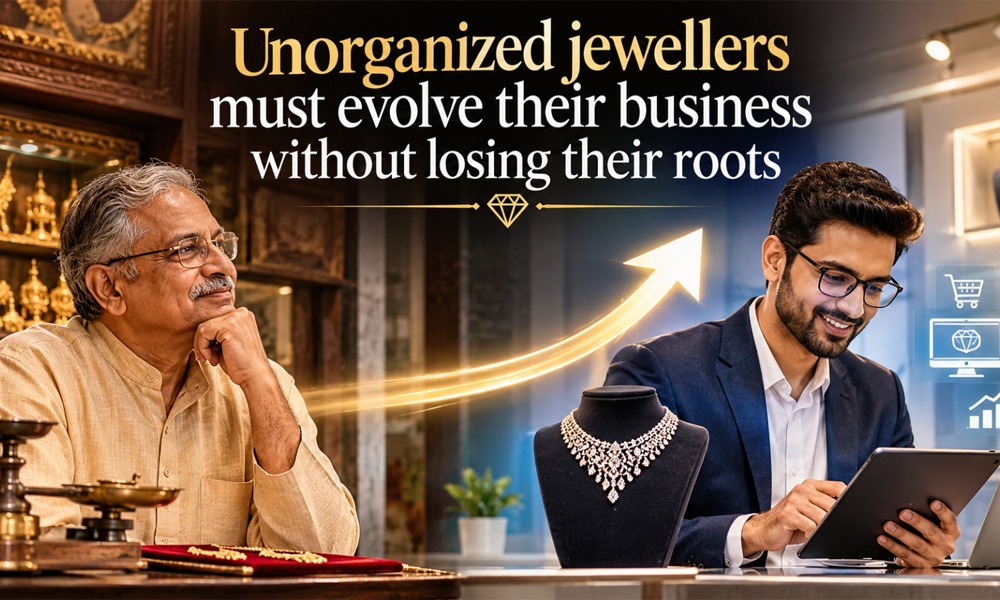
Nearly 65% of India’s jewellery market is still unorganised. This vast segment, run by local family jewellers, runs on inherited trust, community relationships and generations of craftsmanship. For decades it has been the backbone of the trade: resilient, adaptive and deeply customer-centric.
That backbone is now under strain. Higher gold prices are sapping demand, consumer preferences are drifting towards larger chain stores, and regulatory and cost pressures are rising together. Local jewellers and goldsmiths across the country report a 45% decline in volume, and many family-run businesses are facing a liquidity squeeze.
The central finding of this report is simple: the future does not demand that unorganised jewellers lose their identity. It demands that they evolve their business without losing their roots.
Context
The unorganised sector’s strength has never been scale. It has been proximity. The neighbourhood jeweller knows the family, the occasion, the budget and the history of every purchase. That relationship has sustained the trade through earlier cycles of price volatility, regulation and competition.
What has changed is the speed and the combination of pressures. Gold prices have risen sharply and remain volatile. Organised chains are scaling fast, with marketing budgets, standardised pricing and professional teams that individual family stores cannot match. Customers are better informed and compare prices before they walk in.
The human cost is visible on the shop floor. As one private jeweller from Mumbai put it, “Middle-class buyers cannot afford gold anymore. Their incomes are far too stretched to budget for such a purchase.” His shop in Worli, he says, rarely sees the footfall it once did.
Risks and Pressures
Five challenges define the sector today.
1. Increasing compliance and regulatory pressure. Hallmarking, tax documentation, reporting and record-keeping demand systems and skills that many traditional businesses were never built around. Compliance is no longer optional, and its cost falls hardest on the smallest players.
2. Price transparency and making-charge competition. When customers can compare gold rates and making charges across stores and apps in minutes, margins that once rested on relationships come under direct pressure.
3. Rising marketing and branding costs. Visibility now costs money. Organised players outspend local jewellers on advertising, digital presence and in-store experience, widening the awareness gap.
4. Talent retention and professional team-building. Skilled artisans, sales staff and managers are increasingly drawn to organised employers offering structure, training and career paths. Family businesses struggle to compete on all three.
5. Competition from fast-scaling organised players. Chains bring standardised pricing, schemes, assured quality and wide design choice, precisely the reassurances that unorganised jewellers have traditionally supplied through personal trust.
Taken together, these risks compound each other. A volume decline of 45% makes it harder to fund compliance, branding and talent, which in turn makes it harder to win back volume.
Insights
Trust is still the scarcest asset. Organised retail can copy design, pricing and schemes. It cannot easily copy a relationship built over generations. This remains the unorganised jeweller’s most defensible advantage, but only if it is made visible and backed by modern assurance such as transparent billing, hallmarked products and clear buyback terms.
The problem is rarely the product. It is the system around it. Most distressed family jewellers have strong customer relationships and sound craftsmanship. What they lack is process: inventory discipline, costing clarity, digital records, a defined brand and a trained team.
Transition is a spectrum, not a switch. Between a fully traditional shop and a corporate chain lies a wide middle ground. Semi-organised models allow a jeweller to adopt structure selectively while keeping family ownership, identity and customer relationships intact.
The next generation is the pivot. Heirs who combine inherited trust with modern management training are often the catalyst for change, which is why leadership development is as important as capital.
Strategy
With the right systems, strategy, branding and team, unorganised jewellers can improve profitability, build scalable operations, strengthen customer loyalty and move smoothly towards semi-organised or organised models. A practical roadmap:
Systems. Digitise billing, stock and customer records. Build compliance into daily operations rather than treating it as an annual scramble. Track margins by category so that making-charge decisions rest on data, not instinct.
Pricing. Move to transparent, explainable pricing. Compete on value, service and assurance rather than quietly matching the lowest making charge.
Branding. Turn heritage into a brand: the family story, the years of service, the craftsmanship. Low-cost digital presence, local community engagement and consistent in-store identity can close much of the visibility gap without chain-scale budgets.
People. Invest in training, clear roles and career growth for staff and artisans. Bring in professional managers where needed, and prepare the next generation for leadership early.
Pathway. Choose a deliberate direction: strengthen the traditional model, adopt a semi-organised structure, or build towards an organised format. Each path is legitimate. Drifting without a decision is the only wrong choice.
Conclusion
The unorganised jewellery sector is not a relic. It is a trust network that has carried Indian jewellery for generations, now facing a market that rewards structure, transparency and scale. The real winners will be those who combine traditional trust with modern business practices: keeping the relationship, upgrading the system.



Unorganized Jewellers Must Evolve Their Business Without Losing Their Roots

Malabar Gold & Diamonds Launches New Showroom At Pacific Mall, Jaipur

Gujarat’s Diamond-Cutting and Polishing Sector Sees Prolonged Crisis

Dhanteras Shopping Guide 2026:Gold, Silver, Diamonds & Festive Jewellery Trends To Watch

The Solenne Collection: A Celebration Of Diwali By Bharti Bangur Fine Jewels

From Diya Puja To Diwali Soirées: Jewellery Designed To Go Beyond The Festive Season
-
 JB Insights1 week ago
Dhanteras Shopping Guide 2026:Gold, Silver, Diamonds & Festive Jewellery Trends To Watch
-
 BrandBuzz1 week ago
The Solenne Collection: A Celebration Of Diwali By Bharti Bangur Fine Jewels
-
 BrandBuzz1 week ago
From Diya Puja To Diwali Soirées: Jewellery Designed To Go Beyond The Festive Season
-

 National News1 week ago
Indriya, Aditya Birla Jewellery Unveiled India’s Largest Sustainable Jewellery Rangavalli