
By Invitation
GSI teaches the art of selling jewellery, with training as unique as your brand
By Ramit Kapur, MD, GSI India


In jewelry retail, the real challenge isn’t having beautiful products, it’s getting customers to believe in them. Every day, sales teams face tough questions that reflect common consumer concerns: ‘How much of this piece is real gold, and how much is just Laakh behind the Polki?’ ‘Does a gemstone only hold value if it comes from a specific origin, like an emerald from Colombia versus one from Russia?’ ‘This diamond is SI clarity; why should I buy it when it’s not flawless?’ These are not small queries; they are make-or-break moments in the sales process.”
At GSI, we know that overcoming these objections requires more than product knowledge; it takes confidence, context, and the ability to tell the right story. That’s why our retail sales training programs such as the “Jewelry Excellence Program” are built not as cookie-cutter modules but as customized, brand-specific experiences designed to prepare teams for exactly these moments.
Customization is Key: Training Built Around What You Sell
The foundation of our approach lies in customization. Our training spans every aspect of the jewelry business; gemstones, diamonds, polki, metals, sales skills, jewelry care, and more. This journey begins by engaging with retailers to understand their unique goals and what they wish to achieve and communicate to their customers through their sales teams. Whether it’s improving customer engagement, boosting sales, or enhancing product knowledge, every program is tailored to align with those objectives.
We don’t walk in with a generic presentation. We start by studying the retailer’s various jewelry categories and their unique propositions in their collections. If your brand thrives on diamonds, we focus on teaching your team how to sell across different quality grades, highlighting factors beyond the 4Cs that influence value. If polki is central, we equip your staff to handle queries about its craftsmanship and value . If your store experiments with colored stones, we give your team the ability to sell a lesser-known garnet with the same conviction as a ruby.

This begins with a pre-program audit and mystery shopping : observing your store’s customer base, communication style, and brand personality. The result? A training program that is not only technically accurate but also culturally aligned with your business. No two retailers are the same, and no two GSI training programs are, either.
From Product to Pitches: Building Salespeople Who Sell Experiences
Knowledge alone doesn’t close sales. The ability to build rapport, handle hesitation, and guide customers to the “yes” does. GSI’s programs cover the full arc of retail selling, from product to pitches.
We use role-playing not as stale scripts but as live simulations of real scenarios your staff faces daily. Whether it’s explaining why a F-color diamond and a H-color diamond are both excellent buys, or learning how to turn a casual browser into a lifelong client, our methods prepare sales teams to create memorable experiences from the first hello to the final handshake and beyond.
Learning That Sticks: Continuous Assessment for Continuous Growth
Training is not a one-off exercise. At GSI, participants take an initial assessment, and then a follow-up assessment in the coming months. This ensures knowledge retention, highlights top performers, and shows management where to provide additional support. It also helps map future leaders, identifying which team members are ready for more responsibility.
The GSI Difference: Faculty, Data, and Industry Trust
Our edge comes from who we are. As a global gemological lab, we sit on real-time data, research, and trends that most firms simply don’t have access to. And our faculty isn’t made up of trainers-for-hire; they are seasoned experts who’ve graded and tested stones, advised brands, and shaped markets across continents. They bring that authority straight into the classroom.
This combination of scientific insight, retail acumen, and faculty expertise is why leading brands trust GSI to prepare their teams for the realities of modern jewelry retail.
Certification is the Last Point, Knowledge Comes First
Here’s a truth many overlook: certificates don’t sell jewelry, people do. A certificate may close the conversation, but it’s the sales team’s knowledge, confidence, and storytelling that open it. That’s why GSI puts human expertise ahead of paper credentials. We train teams to own the conversation, handle objections with authority, and make customers feel secure before the certificate even enters the discussion.
Because at the end of the day, selling jewelry is not just about the product in the box, it’s about the people behind the counter. And that’s where GSI makes the difference.





By Shivaram A
The Core Issue
The owner carries the entire risk of the business — investment, gold stock, working capital, loans, everything is in their name. The long-term asset also belongs to the owner — reputation, brand, the customer base built over years, often meant to pass to the next generation. But the moment that matters most — when the customer is standing at the counter, when trust is being built or broken — that moment is entirely controlled by the staff.
The person with the most risk is not present at the decisive moment. And the person with the least to lose holds the most power in that moment. This structural mismatch creates frustration on both sides — and it’s rarely discussed openly.
Making the Conflict Explicit
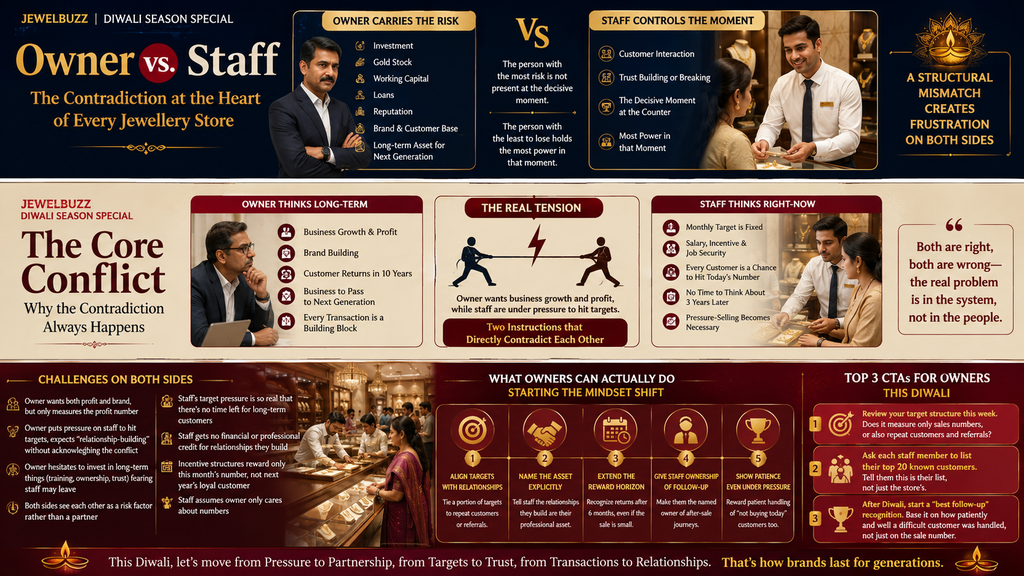
The real tension is this: the owner wants business growth and profit, while staff are under pressure to hit targets.
The owner thinks long-term — how does the brand grow, how does a customer come back after ten years, how does the business pass to the next generation. For the owner, every transaction is a building block toward something bigger.
The staff’s reality is completely different. Their monthly target is fixed. Their salary, incentive, and sometimes even job security depend on how much they sold this month, this Diwali. For staff, every customer is a chance to hit today’s number — right now, this moment. They cannot afford to think about whether this customer comes back in three years, because their performance is reviewed at month-end, not three years later.

So when the owner says “build the relationship, be patient,” and in the same breath increases the target by 20%, these two instructions directly contradict each other. Staff are not confused about what they should ideally do — they understand it perfectly. But they don’t have the choice. The target has to be met, so pressure-selling becomes necessary — even if it means pushing a customer slightly, or using lines like “buy today, rate will go up tomorrow” that create small cracks in trust.
These cracks don’t show up immediately. But after Diwali, when that customer doesn’t return a second time, the owner assumes it’s the staff’s fault. The staff believes the owner set an unrealistic target. Both are right, and both are wrong — because the real problem is in the system, not in the people.
The Challenges on Both Sides
- Owner wants both profit and brand, but only measures the profit number
- Owner puts pressure on staff to hit targets, then also expects “relationship-building” — without acknowledging the two often can’t coexist
- Owner hesitates to invest in long-term things (training, ownership, trust) due to fear that staff will leave anyway
- Staff’s target pressure is so real that there’s no time left to think about the long-term customer
- Staff gets no financial or professional credit for the relationships they build
- Incentive structures reward only this month’s number, not next year’s loyal customer
- Both sides see each other as a risk factor rather than a partner — the owner assumes staff will eventually leave, staff assumes the owner only cares about numbers
What Owners Can Actually Do — Starting the Mindset Shift
- Stop treating targets and relationships as separate — align them. Don’t set targets purely on sales numbers. Tie a small portion of the target to repeat customers or referrals, so staff know that long-term customers count too.
- Name the asset explicitly. Tell staff directly: the relationship you’re building with a customer is your professional asset, not just the store’s. This has to be shown in practice, not just said out loud.
- Extend the reward horizon. Don’t reward only Diwali-week sales — when a customer returns six months later and asks for that staff member by name, recognize that, even if the sale itself is small.
- Give staff ownership of the follow-up. Make each staff member the named owner of their customers’ after-sale journey — repairs, exchanges, the next occasion. This helps them feel the relationship is theirs, not just a transaction.
- Show patience even under pressure. If Diwali week only rewards closed sales, staff will only chase closing. If a staff member who handles a “not buying today” customer well is also appreciated, that’s when the mindset actually starts to shift — because staff notices what the owner actually rewards, not just what they say.
Top 3 CTAs for owners this Diwali
- Review your target structure this week. Does it only measure sales numbers, or does it also give weight to repeat customers and referrals? If not, try a small adjustment starting this Diwali.
- Ask each staff member to list their top 20 known customers. Tell them this is their list, not just the store’s. This builds a sense of ownership.
- After Diwali, start a “best follow-up” recognition. Base it not on the sale number, but on how patiently and well a difficult customer was handled. Staff need to see that patience is rewarded too, not just closing.
Shivaram A
Retail Gurukul



GGJS 2026 Concludes With High-Volume Trade and Strategic Focus On Next-Gen Leadership

The Solitaire Festival Of India Concludes; Bumper Prize Winner At Ranka Jewellers Wins XUV 7XO

GJEPC Promotes Key Trade Events At IGI Dubai Event
-

 National News3 days ago
P N Gadgil Jewellers Limited – Quarterly Update Q2FY27
-
 National News51 minutes ago
GGJS 2026 Concludes With High-Volume Trade and Strategic Focus On Next-Gen Leadership
-

 National News5 hours ago
MCX Gold Silver Futures See Dip
-

 National News6 hours ago
ABARAN Commemorates The 125th Birth Anniversary Of Founder Shri Burde Sadananda Kamath With Special Gold Coin Launch
