

International News
Gold Rush in Reverse: Dubai’s NRIs are cashing out as Middle East crisis deepens
Unbranded jewellers are absorbing upward of 100 seller visits per day, purchases at approximately 1kg daily.


The escalation of the Israel-Iran conflict has triggered a measurable behavioral shift among Indian expatriates in Dubai’s gold market. Rather than holding gold as a long-term store of value, a growing segment of NRI investors is liquidating positions — a response that reveals how geopolitical stress reshapes asset allocation decisions in real time.
Scale and Velocity of Selling Pressure
On-the-ground data from Dubai Gold Souk retailers points to sustained selling momentum. Unbranded jewellers are absorbing upward of 100 seller visits per day, with aggregate purchases running at approximately one kilogram daily. The sellers span both retail jewellery holders and those liquidating gold bars — a sign that the liquidation cuts across asset classes within the gold category, not just ornamental holdings.
Structural Drivers Behind the Sell-Off
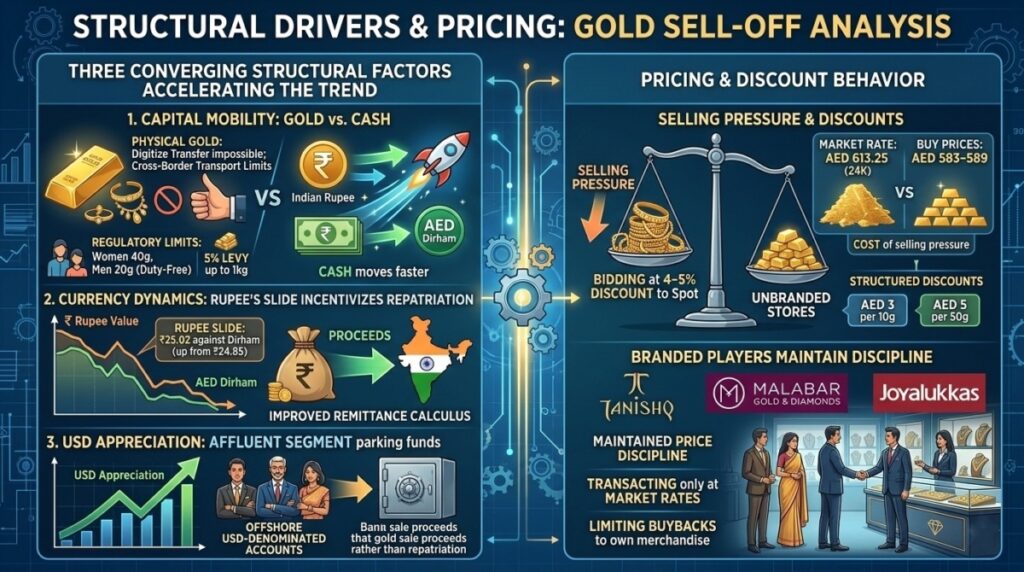
Three converging factors are accelerating the trend. First, capital mobility: unlike equities or bank deposits, physical gold cannot be digitally transferred, and cross-border transport faces hard regulatory limits — duty-free allowances cap at 40g for women and 20g for men, with a 5% levy on quantities up to one kilogram. In a flight-to-liquidity scenario, cash simply moves faster. Second, currency dynamics: the rupee’s slide to 25.02 against the dirham (from 24.85 days prior) is improving the remittance calculus, incentivizing NRIs to convert gold proceeds and repatriate funds to India. Third, USD appreciation is drawing the more affluent segment toward parking sale proceeds in offshore USD-denominated accounts rather than repatriating.
Pricing and Discount Behavior
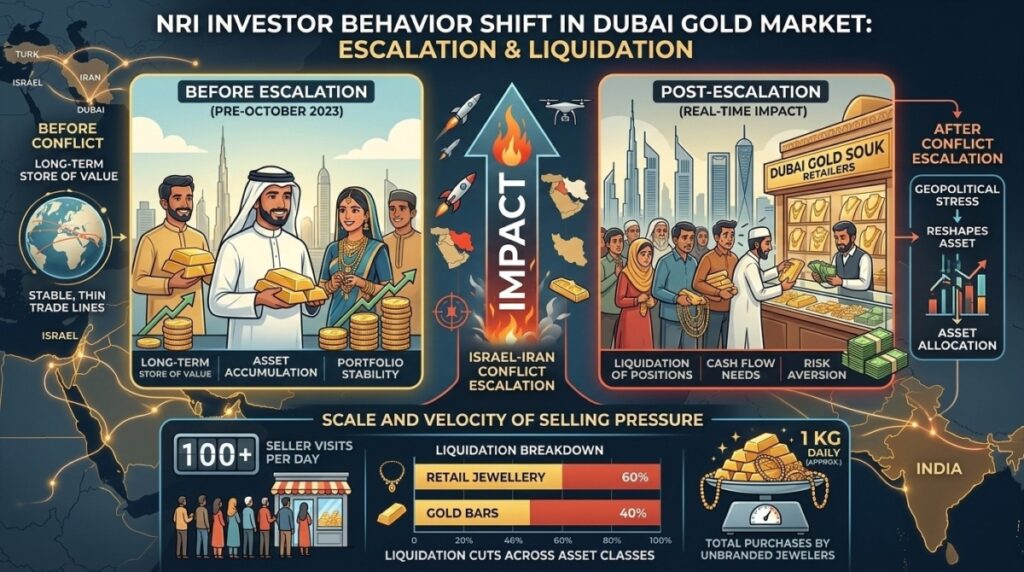
The selling pressure is exacting a cost. Unbranded stores are bidding at a 4–5% discount to spot, with buy prices running at AED 583–589 per gram against a market rate of AED 613.25 per gram for 24K gold. Some retailers are offering structured discounts — AED 3 per 10g and AED 5 per 50g. Branded players such as Tanishq, Malabar, and Joyalukkas have maintained price discipline, transacting only at prevailing market rates and limiting buybacks to their own merchandise.
Risk Management on the Buy Side
Jewellers absorbing this supply are not holding unhedged inventory. Given price volatility, most are simultaneously offsetting positions in the futures market — a rational response to the dual risk of further price correction and logistical constraints on physical gold movement.
Strategic Takeaway
This episode illustrates a well-documented pattern: in periods of acute geopolitical uncertainty, gold’s liquidity advantage over real estate or private holdings makes it the first asset sold, not the last. For NRI wealth managers and advisors, the key insight is that gold holdings in high-tension geographies require an explicit contingency liquidation strategy — one that accounts for discount risk, currency timing, and cross-border regulatory constraints before a crisis materializes.


DiamondBuzz
Diamonds shine brightest at Hong Kong Trade Shows
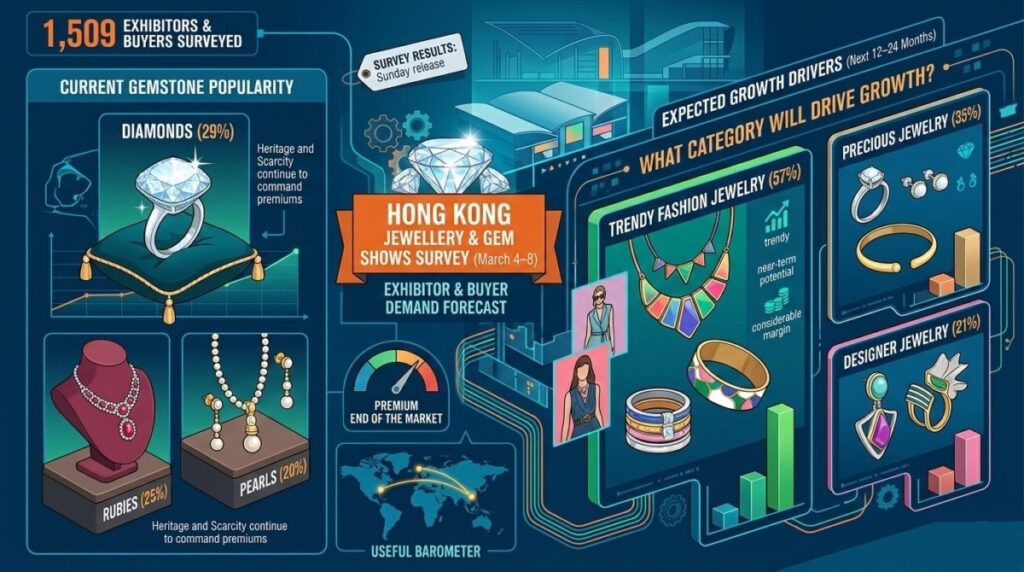
Diamonds led all gemstones in popularity at 29%, with rubies second at 25% and pearls third at 20%
Diamonds retained their crown as the jewelry industry’s most coveted stone at this year’s Hong Kong trade shows, but the broader market narrative that emerged from the events was one of measured confidence rather than exuberance — a reflection of an industry navigating uncertain global economic currents.
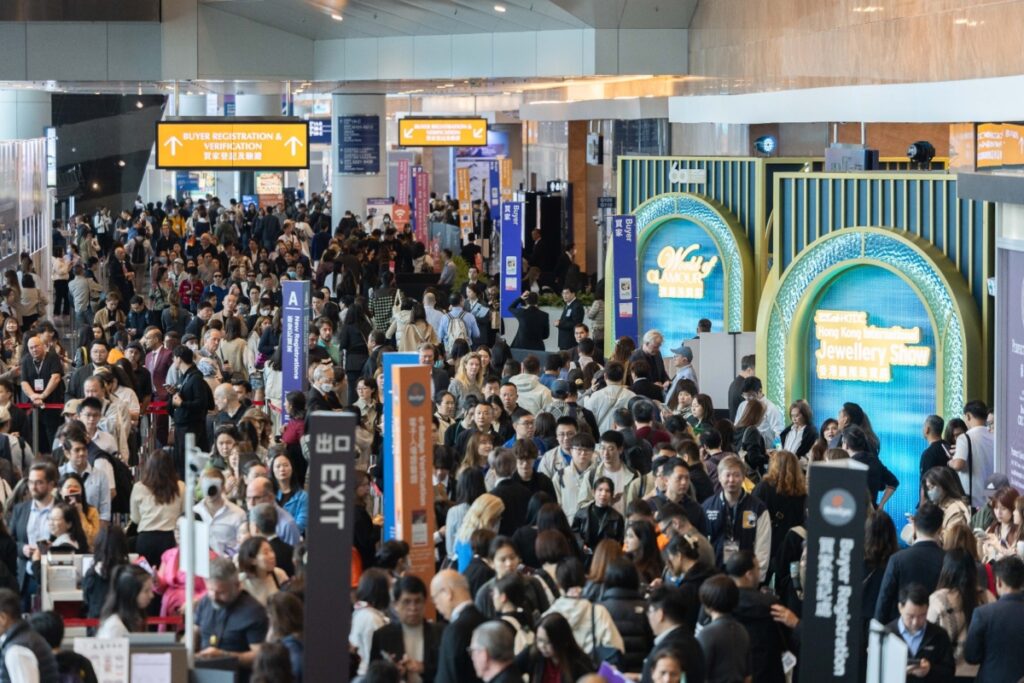
The Hong Kong Trade Development Council, which organizes the Hong Kong International Jewellery Show and the companion Diamond, Gem & Pearl Show, surveyed 1,509 exhibitors and buyers across the two events, held March 4–8. The results, released Sunday, offer a useful barometer of where the trade believes demand is heading.
Diamonds led all gemstones in popularity at 29%, with rubies second at 25% and pearls third at 20% — a ranking that broadly tracks with the premium end of the market, where heritage and scarcity continue to command premiums. Yet the more telling signal may lie in what category exhibitors expect to drive growth: trendy fashion jewelry, cited by 57% of respondents as having the strongest near-term potential, outpaced precious jewelry at 35% and designer jewelry at 21% by a considerable margin.
That gap matters. Fashion jewelry — typically lower price points, faster turnover, more accessible to younger consumers — suggests the industry is hedging, cultivating a broader customer base even as it maintains its traditional focus on high-value stones and metals. Yellow gold reinforced that theme, cited by 40% as the most popular precious metal, benefiting in part from sustained investor and consumer interest in gold as both adornment and store of value.
The Hong Kong government’s budget, released earlier this year, may lend additional support. Authorities outlined plans to strengthen the city’s position as an international gold-trading hub — a policy signal the HKTDC noted could add momentum to the local jewelry market at a time when the city is working to reassert its role as a premier commercial gateway.
On the demand side, respondents identified Korea, ASEAN countries, mainland China, Taiwan and Australia as markets with meaningful growth potential over the next two years — a geographic spread that underscores Asia’s continued centrality to the global jewelry trade even as Western luxury demand has shown signs of softening.
The mood among survey participants was cautious rather than buoyant. Nearly half — 49% — expected overall industry sales to hold steady, while 44% anticipated improvement over the next one to two years. That combination speaks to an industry that has absorbed recent shocks but is not yet prepared to declare a clear recovery. With roughly 80,000 buyers attending the two shows in total, the events themselves suggest the trade remains active and engaged, even if dealmakers are keeping their expectations grounded.



Diamonds shine brightest at Hong Kong Trade Shows

Gold Rush in Reverse: Dubai’s NRIs are cashing out as Middle East crisis deepens

Precious metals stabilize as dollar softens and war concerns ease AUGMONT BULLION REPORT
Diamonds shine brightest at Hong Kong Trade Shows
Gold Rush in Reverse: Dubai’s NRIs are cashing out as Middle East crisis deepens
Precious metals stabilize as dollar softens and war concerns ease AUGMONT BULLION REPORT
-
 DiamondBuzz57 minutes ago
Diamonds shine brightest at Hong Kong Trade Shows
-
 International News2 hours ago
Precious metals stabilize as dollar softens and war concerns ease AUGMONT BULLION REPORT
-
 International News19 hours ago
UAE retail gold prices dropped by Dh10 per gram within a single day
-
 National News1 day ago
From Pune’s Tech Corridors to Punjab’s Fashion Capital – Gargi by PNGS Marks a Landmark Double Debut
