
International News
Gold prices soar past the $3,200 mark on escalating trade tensions, weakening $

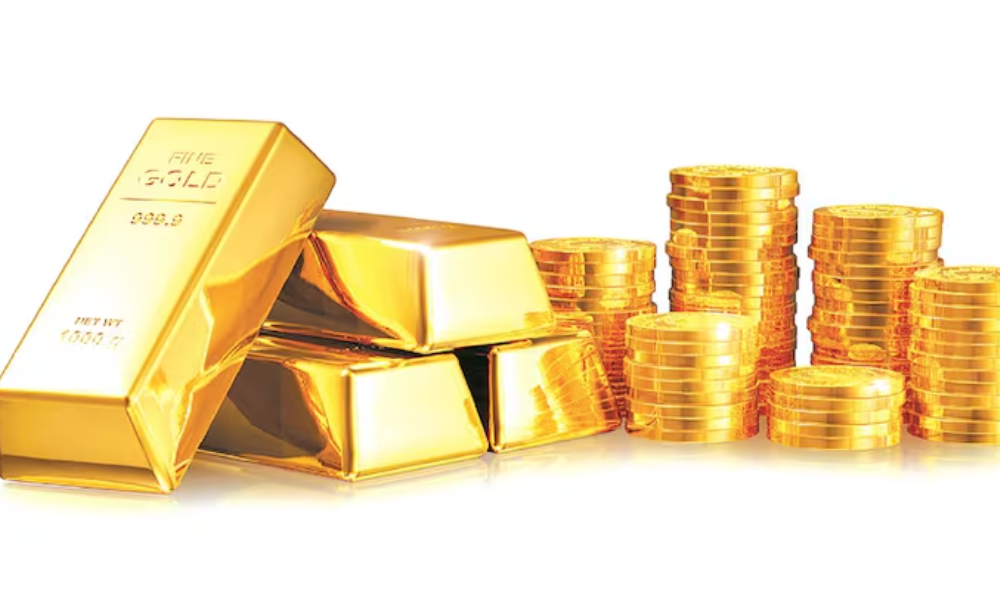
On Friday, April 11, 2025, gold prices soared past the $3,200 mark, reaching an unprecedented high of $3,245.28 per ounce. This significant surge is attributed to escalating trade tensions between the United States and China, a weakening U.S. dollar, and growing concerns over global economic stability.
The trade conflict between the U.S. and China intensified as President Donald Trump imposed a 145% tariff on Chinese imports, excluding China from a 90-day tariff pause. In retaliation, China levied a 125% tariff on U.S. goods. These aggressive measures have heightened market volatility and raised fears of a potential recession, prompting investors to seek the safety of gold .
The uncertainty stemming from the trade war has led to a substantial shift in investor behavior. Gold-backed exchange-traded funds (ETFs) experienced significant inflows, adding 226.5 metric tons worth $21.1 billion in the first quarter of 2025—the largest since early 2022 . Additionally, central banks, notably the People’s Bank of China, have been increasing their gold reserves, further driving demand.
The U.S. dollar’s decline to a three-year low has made gold more attractive to investors holding other currencies . Concurrently, inflation expectations have risen, with consumer sentiment deteriorating and concerns about rising unemployment . These factors contribute to the appeal of gold as a hedge against inflation and economic instability.
The impact of the trade war extends beyond the U.S. and China. In China, the premium for gold on the Shanghai Gold Exchange increased to 1.1% above the London benchmark, up from 0.15% the previous week. Physical gold premiums in China rose sharply to $24–$54 per ounce, compared to $6–$13 the previous week . These shifts indicate a growing demand for gold as a protective asset amid economic uncertainty.
Analysts suggest that if current trends continue, gold prices could reach between $3,400 and $3,500 per ounce . The combination of trade tensions, currency fluctuations, and inflation concerns underscores the metal’s role as a safe-haven asset in times of economic turmoil.







International News
Indian Consulate In New York Hosts India-USA Virtual Jewellery Exhibition; Facilitated By GJEPC
The Exhibition Brought Together 35 Indian Companies, Many Of Them Micro, Small and Medium Enterprises (MSMEs), Offering US Buyers An Opportunity To Explore Indian Jewellery Collections and Establish Direct Business Connections.


The Consulate General of India in New York, in collaboration with the Gem & Jewellery Export Promotion Council (GJEPC), organised the India-USA Virtual Exhibition on Gems & Jewellery on 23 October 2026, connecting Indian exporters with American buyers through a digital platform.
The inaugural ceremony featured welcome remarks by Ambassador HE . Binaya S. Pradhan, Consul General of India in New York, an inaugural address by Kirit Bhansali, Chairman, GJEPC, and closing remarks by Rajlakshmi Kadam, Consul (Trade), Consulate General of India, New York.
The exhibition brought together 35 Indian companies, many of them micro, small and medium enterprises (MSMEs), offering US buyers an opportunity to explore Indian jewellery collections and establish direct business connections. The event was designed to help exporters reach new customers and develop partnerships in one of India’s most important markets.
Addressing participants, Kirit Bhansali, Chairman, GJEPC, highlighted the importance of the US market, which accounted for around 30% of India’s gem and jewellery exports, worth nearly US$10 billion, in FY2024-25. He noted that tariff uncertainty had affected trade significantly, with India’s gem and jewellery exports to the US falling by more than 44% between April and December 2025.
However, trade has begun to recover. Between April and September 2026, India’s gem and jewellery exports to the US grew nearly 6% year-on-year to almost US$3 billion, compared with US$2.77 billion in the corresponding period of 2025.
Kirit Bhansali also referred to progress on the proposed India-US Bilateral Trade Agreement, expressing hope that it would provide greater clarity and predictability for exporters and buyers once its terms are finalised.
With the US holiday season approaching, followed by Valentine’s Day and retailers’ sourcing plans for 2027, he urged American buyers to explore India’s manufacturing capabilities across diamonds, coloured gemstones and gold jewellery. He also encouraged buyers to engage directly with participating MSMEs, highlighting their skills, flexibility and ability to meet varied sourcing requirements.



QWEEN Launches Its First Store In Noida With India’s First Self-Discovery Experiential Luxury Jewellery Format

India’s Festive Jewellery Market Eyes Growth As Consumers Shift Towards Lightweight Designs and Value-Led Purchases

Kicky & Perky Opens Its First Official Store At DLF Midtown Plaza, Marking A New Chapter In Its Retail Journey

Dhanteras Shopping Guide 2026:Gold, Silver, Diamonds & Festive Jewellery Trends To Watch

Indriya, Aditya Birla Jewellery Unveiled India’s Largest Sustainable Jewellery Rangavalli

From Diya Puja To Diwali Soirées: Jewellery Designed To Go Beyond The Festive Season
-
 JB Insights4 days ago
Dhanteras Shopping Guide 2026:Gold, Silver, Diamonds & Festive Jewellery Trends To Watch
-
 National News4 days ago
Indriya, Aditya Birla Jewellery Unveiled India’s Largest Sustainable Jewellery Rangavalli
-
 BrandBuzz4 days ago
From Diya Puja To Diwali Soirées: Jewellery Designed To Go Beyond The Festive Season
-

 BrandBuzz4 days ago
The Solenne Collection: A Celebration Of Diwali By Bharti Bangur Fine Jewels
