Connect with us

International News

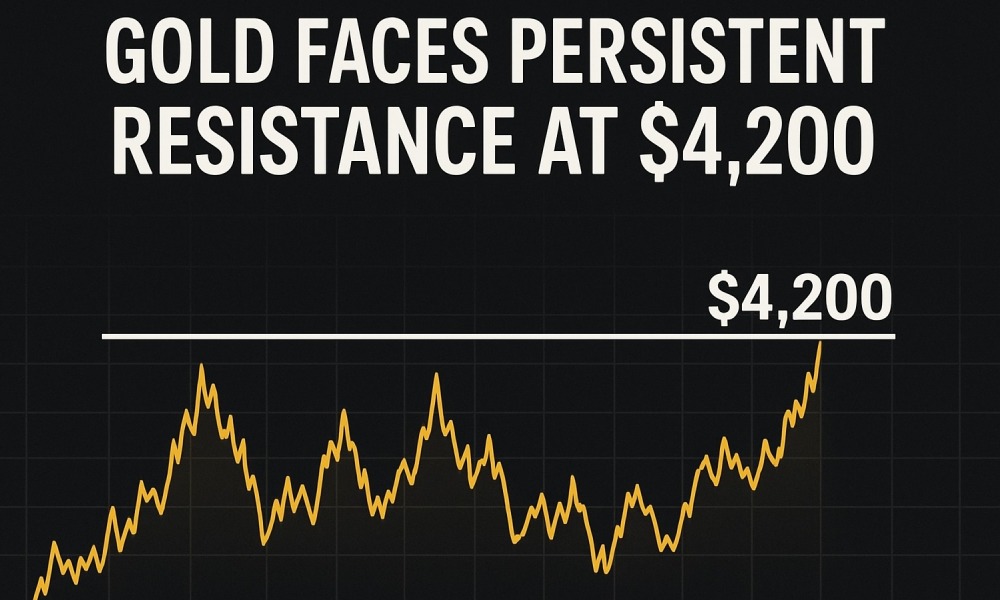
Gold faces persistent resistance at $4,200,  markets brace for potential Fed rate-cut signals, keeping sentiment cautious

Published

on

Gold hovered around the $4,200 level early Monday, staying confined within last week’s trading band. The US Dollar remains on the back foot as markets brace for potential Fed rate-cut signals, keeping sentiment cautious.


Technically, gold’s daily chart still shows resilient buying interest, suggesting bulls are not ready to step aside despite repeated failures to break above $4,200. The technical picture suggests gold buyers are still in the game, keeping the uptrend alive as the Fed takes center stage this week.

Gold’s consolidation near the $4,200 threshold reflects a market in transition, caught between strong underlying bullish momentum and immediate technical resistance. This price action pattern—characterized by repeated tests of resistance without significant pullbacks—typically indicates accumulation rather than exhaustion, though breakout confirmation remains elusive.

The persistence of buying interest at current elevated levels is noteworthy. In normal circumstances, such extended rallies would trigger profit-taking waves. Instead, the market appears to be absorbing supply at these heights, suggesting institutional conviction about gold’s value proposition extends well beyond $4,000.

The US Dollar’s continued softness provides critical support for gold’s elevated pricing. This weakness stems from market expectations that the Federal Reserve may signal accommodative policy shifts during this week’s meetings. When the dollar declines, gold becomes relatively cheaper for foreign buyers, mechanically supporting demand while also reflecting diminished confidence in dollar-denominated assets.

Analyst Tone

Gold Forecast: XAU/USD Stalls at $4,200 as Markets Shift Focus to the Fed

Gold is struggling once again to break decisively above the $4,200 mark, with prices moving sideways at the start of the week. A softer US Dollar—pressured by expectations of an upcoming Fed rate cut—offers some support, though market caution persists.
Daily technical indicators continue to highlight underlying bullish momentum, signalling that buyers remain active despite the ceiling at $4,200.

Market Commentary Style

XAU/USD Battles $4,200 Barrier as Fed Week Begins

Gold opened the week steady near $4,200, unable to push beyond the stubborn resistance that capped last week’s trade. The weakening US Dollar, weighed down by renewed Fed rate-cut speculation, provides a mild tailwind.


Continue Reading
Advertisement JewelBuzz Banner
Click to comment
Subscribe
Notify of
guest
0 Comments
Oldest
Newest Most Voted
Inline Feedbacks
View all comments

International News

WGC Gold Market Commentary: Hiking Up A Volcano

Gold Is Also Facing Near-Term Headwinds and Significant Oil Shock Could Prolong The Malaise.

Published

on

Gold fell 1% in May, on continued positive risk sentiment and modest global gold ETF outflows.

The Fed may need to hike rates as inflation pressures mount. We make the case for why it could – surprisingly – benefit gold. But gold also faces headwinds, which could be prolonged if the Hormuz standoff drags on.

Nothing to see here

Gold fell 1% in May, finishing the month at US$4,546/oz, and marginally lower in most major currencies. India and Turkey saw monthly gains

According to our Gold Return Attribution Model (GRAM), there were no stand out drivers for gold’s performance in May from the explicit variables in the model. Positive risk sentiment via equity inflows, less bond inflows, and a fall in implied volatility proved a minor drag, alongside gold ETF outflows from Asia and the US (US$2.3bn, 17.3t). US dollar weakness helped gold at the margin, as did momentum factors including European gold ETF inflows (US$0.3bn, 1.2t). Other opaque flows – possibly in the over-the-counter (OTC) market, not captured explicitly in our model – may have been a contributor to the negative residual.

COMEX managed money futures positioning continued to linger in neutral territory with a very modest gain of US$1.4bn (8t) in May.

Hiking up a volcano

The Fed may have to hike later this year and that could spell trouble for risk assets and the economy. History is mixed when it comes to hikes and gold’s response

Notable precedents show similarities to today and on those occasions gold responded positively to a hike

But gold is also facing near-term headwinds and significant oil shock could prolong the malaise.

Following a somewhat contentious US rate-cutting cycle that began in 2024, the market has pivoted to the strong possibility of rate hikes into year-end and beyond, with a firm economy facing pass-through inflation pressures. This could weigh on risk assets through discount rates, as well as increase borrowing costs for households and businesses.

Convention has it that higher policy rates pressure gold through higher real yields and a stronger US dollar. The evidence is mixed. Historically, rate hikes have not seen a uniform response from yields, the dollar or gold.

The data: Gold has positively surprised on hikes more than 50% of the time. It’s median one-month (21-day) return following hikes – adjusted for the long-run average 21-day return of 0.84% – has been positive.1

Context: What matters more than the policy rate itself is how markets interpret the implications of tightening for growth, inflation credibility, financial stability and the US dollar

This time may be different: In prior cycles, hikes often signalled policy credibility and economic normalisation. Today, however, hikes may increasingly signal:

Persistent inflation pressure as resource nationalism ramps up

Fiscal stress both in the US and abroad

Policy error risk on more divergent FOMC views, political pressure and the fear of getting it wrong (again).

Cue the US dollar: Historically the US dollar appeared more important to gold’s fortunes than to rates. Medium term growth and yield convergence, and a diversification push away from US assets, has set quite a clear path for a weaker dollar ahead, upon which consensus is agreed.

Other things matter: Demand from China, India and central banks is structurally less sensitive to US rates and could provide support beyond the current lull

Risk asset fragility: Higher rates may prove to be the last straw for equity markets. Aside from the mechanical repricing of discount rates, Vanda Research notes that even relatively modest rises in long-end Treasury yields have repeatedly destabilised short-term equity rallies over the past couple of years.2

When and why hikes benefited gold

There are notable historical precedents during which gold bucked expectations with a positive hike

29 June 2006: This was the final hike in a cycle; housing was slowing and growth concerns were mounting. Gold was also in an early innings of rate-insensitive buying from a recently liberated Chinese investment market, the advent of gold ETFs, and a commodity boom. In other words, the Fed was hiking into fragility and ‘other’ things mattered – as they do today

15 March 2017: The post-election reflation trade and long-dollar positioning had become crowded. The hike was interpreted as dovish relative to expectations and long-end yields declined.3 The case for a resumption of dollar weakness today is strong and widely held even as positioning is neutral

19 December 2018: Markets interpreted the hike as a policy error, resulting in a sharp equity sell off4 and long-end yields collapsed. The possibility today of a policy error with a more divided and potentially politicised Fed is non-zero

2 November 2022: An aggressive hiking cycle collided with growing market fragility. The UK LDI crisis had already destabilised bond markets and the US dollar subsequently peaked.5 Today long bond yields are rising across the G10 on fiscal fears and long-term inflation concerns. And gold has a decent track record of responding to geopolitical spikes

22 March 2023: The Fed tightened into acute banking stress. Long-end yields fell sharply as markets accelerated expectations of a pause and eventual easing.6 There are no clear signs of banking stress today, but concerns have grown over private credit.

What could go wrong?

Our argument is not that a hike is inherently bullish for gold.

Historically, hikes have tended to be negative for gold if they strengthen the US dollar, lift real yields and boost sentiment If a hiking cycle materially improves the market’s assessment of Fed credibility, gold could face additional pressure.

Some physical markets appear to have softened, with discounts in India, South Korea and anecdotal evidence of some selling in Japan. Global gold ETF flows have been lacklustre in May. The possibility of sporadic official-sector swaps or sales remains as the Hormuz Strait standoff continues. Technically, gold remains vulnerable – perched on its 200-day moving average, in what looks like a declining channel.

The largest near-term risk may come from energy markets. Oil is dominating headlines and inflation expectations, as well as driving bond yields. A sharp rise in energy prices driven by inventory depletion could initially push yields higher, strengthen the dollar and extend gold’s current malaise before the longer-term implications become apparent.7

Our main models generally associate rate rises with gold price falls, with price rises the exception rather than the rule. The argument here is simply that if hikes ultimately arrive, there is a reasonable case for the exception to occur. Rather than reinforcing confidence, markets may interpret them as evidence of underlying fragility.

Continue Reading

Trending

JewelBuzz is Asia’s First Digital Jewellery Media & India’s No.1 B2B Jewellery Magazine, published by AM Media House. Since 2016, we’ve been the trusted source for jewellery news, market trends, trade insights, exhibitions, podcasts, and brand stories, connecting jewellers, retailers, and industry professionals worldwide.

We would like to hear from you...

GET WHATSAPP NEWS ALERTS

0
Would love your thoughts, please comment.x
()
x