International News
Gold and Silver rebounds on bargain hunting and US partial shutdown AUGMONT BULLION REPORT


- Gold and silver have rebounded nearly 10% from recent lows as markets factor in the absence of key US economic data due to a partial government shutdown and renewed bargain hunting. The shutdown began after Congress failed to fund the Labor Department and other agencies, adding short-term uncertainty.
- The sharp correction—around 25% in gold and 45% in silver from recent highs—has attracted strong physical buying from investors who were waiting for meaningful price retracements to accumulate precious metals.
- Meanwhile, the US–India trade deal has supported the Indian rupee, with USD/INR appreciating toward 90.20, up nearly 1%. While tariff cuts to 18% improve trade relations, reduced uncertainty and a stronger rupee may temporarily cap domestic gold and silver prices by easing safe-haven demand and lowering import costs, despite supportive long-term fundamentals.
Technical Triggers
- Gold prices may extend the ongoing rebound toward $5,000 (~Rs.155,000), with strong support seen near $4,600 (~Rs.139,000).
- Silver is attempting to build a base and is expected to consolidate in the $72–$87 range (~Rs.225,000–Rs.270,000). A buy-on-dips and sell-on-rallies strategy is advisable within this range amid elevated volatility.
Support and Resistance
| Metal | Market | Support Level | Resistance Level |
|---|---|---|---|
| Gold | International | $4600 / oz | $5000 / oz |
| Gold | India | ₹139,000 / 10 gm | ₹155,000 / 10 gm |
| Silver | International | $72 / oz | $87 / oz |
| Silver | India | ₹225,000 / kg | ₹270,000 / kg |
source: AUGMONT BULLION REPORT


International News
Gold Prices On Track To Reach $4,900/oz By End 2026 :Goldman Sachs
Goldman’s $4,900/oz Forecast Assumes Central Bank Demand Averages 50 Tonnes Per Month In 2026 and 40 Tonnes Per Month In 2027

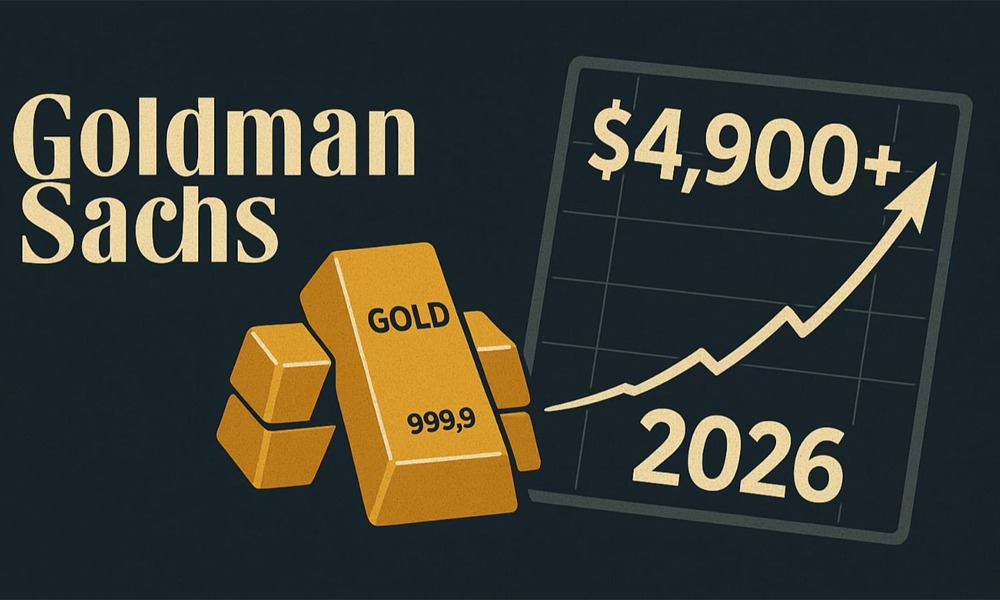
Gold prices are on track to reach $4,900 per ounce by the end of 2026, driven by aggressive central bank purchases—led by undisclosed buying from China—and recovering exchange-traded fund (ETF) demand, Goldman Sachs said in a research note.
The bank maintained its bullish base-case target for bullion while warning that positioning in options markets could amplify price volatility in both directions. Central banks accumulated an estimated 44 tonnes of gold in July, well above the pre-2022 monthly average of 17 tonnes, according to Goldman Sachs’ nowcast model. On a three-month seasonally adjusted basis, central bank buying stood at 91 tonnes per month.
China was the primary driver, with Goldman estimating the People’s Bank of China bought 35 tonnes in July—roughly 75% more than official public disclosures indicated.
To account for unreported sovereign purchases, Goldman’s model tracks physical bullion flows through London’s over-the-counter (OTC) market into custodian vaults. The Bank of England’s central bank holdings alone rose by 63 tonnes in July, exceeding outflows from the Federal Reserve Bank of New York.
Price Risks and Volatility
Goldman’s $4,900/oz forecast assumes central bank demand averages 50 tonnes per month in 2026 and 40 tonnes per month in 2027, alongside steady Federal Reserve policy and a rebound in private ETF inflows.
However, analysts noted that elevated demand for gold call options—used by investors to hedge against macroeconomic and geopolitical risks—creates mechanical upside and downside risks:
Bullish Case: Continued strong ETF inflows combined with existing call option positioning could force options dealers to buy underlying metal to hedge short exposure, pushing prices “well above” $4,900.
Bearish Case: If the Federal Reserve resumes interest rate hikes, unwinding hedge positions and triggering ETF outflows, gold could drop to $4,440/oz by end-2026. Goldman noted that ongoing central bank buying would limit further downside.
Goldman expects the Federal Reserve to remain on hold through 2026 as inflation cools, removing a key interest rate headwind for the non-yielding asset.



Place Images Of Silver Jewellery Stalls and Silver Jewellery and Overhead Shots Of SSI

NSPL Season 2 Launched At SSI DELHI 3rd Edition Featuring SSI As Title Sponsor Season 2 Builds Upon The Inaugural Edition’s Success By Bringing Together Sports, Youth Engagement, and Trade Community Networking

Growth of the 925 Sterling Silver Gifting Segment
NSPL Season 2 Launched At SSI DELHI 3rd Edition Featuring SSI As Title Sponsor Season 2 Builds Upon The Inaugural Edition’s Success By Bringing Together Sports, Youth Engagement, and Trade Community Networking
Place Images Of Silver Jewellery Stalls and Silver Jewellery and Overhead Shots Of SSI
Growth of the 925 Sterling Silver Gifting Segment
-
 JB Exclusive21 minutes ago
NSPL Season 2 Launched At SSI DELHI 3rd Edition Featuring SSI As Title Sponsor Season 2 Builds Upon The Inaugural Edition’s Success By Bringing Together Sports, Youth Engagement, and Trade Community Networking
-
 Special Reports10 minutes ago
Place Images Of Silver Jewellery Stalls and Silver Jewellery and Overhead Shots Of SSI
-
 Special Reports2 days ago
Growth of the 925 Sterling Silver Gifting Segment
-

 ShowBuzz2 days ago
TRENDS @ SSI DELHI 3RD EDITION