National News
GJC requests a reduction in GST to 1.25%

All India Gem & Jewellery Domestic Council (GJC), the premier body for jewellers, has urged the government to rationalize the Goods and Services Tax (GST) on bullion and precious ornaments, reducing it to 1.25% from the current 3% to ease the burden on consumers and boost sales.
GJC appreciates Honourable Finance Minister Smt Nirmala Sitharaman ji urging the GST council on rationalising and simplifying GST rates.
When GST was first introduced in July 2017, the price of 24-carat gold was hovering around ₹28,439 per 10 grams. Based on this price level, the GST Council set the GST incidence rate on bullion and precious ornaments at 3%, despite the earlier indirect tax structure (Excise + VAT) being effectively 1% and with Excise Duty implementation in 2016, with applicability on only those jewellers having turnover of 10 crores and above, giving ease to almost 80 to 85 % of the industry as they did not fall under the purview of Excise Duty. Hence, under this pretext, GJC believes the effective rate of GST should be 1.25%.
As of February 6, 2025, the price of 24-carat gold stands at ₹86,510 per 10 grams, marking a 204% increase over the past 7.5 years. Despite this significant spike, the GST rate has remained static at 3%, effectively increasing the tax burden on both consumers and jewellers. Consequently, there is an urgent need to reduce the GST rate to 1.25%, aligning taxation with industry realities, encouraging compliance, and achieving revenue neutrality.
A core principle of GST determination was revenue neutrality—ensuring that taxation levels remain equivalent to pre-GST rates. Based on the past indirect tax structure, the revenue-neutral rate for the gems and jewellery industry should be 1.25%, not the current 3%.
India is a global leader in jewellery craftsmanship and manufacturing. To support the ‘Make in India’ initiative, it is essential to establish a competitive taxation framework that fosters local production rather than driving demand toward unofficial or imported channels. Lowering the GST to 1.25% would encourage domestic manufacturers, boost job creation, and position India as a global hub for jewellery making, aligning with the Honourable Prime Minister Narendra Modi’s vision of ‘Make in India’.
Rajesh Rokde, Chairman of the All India Gem & Jewellery Domestic Council, said, “The Gems & Jewellery Industry (GJI) is a significant contributor to India’s economy, playing a crucial role in employment generation, exports, and overall economic growth. However, the sector has been burdened with high taxation rates, negatively impacting businesses and encouraging unregulated trade. We request the Hon’ble GST Council and concern authorities to reconsider and rationalize the GST rate to 1.25%, ensuring sustainable growth for the industry while maintaining a robust tax base.”
Avinash Gupta, Vice Chairman of the All India Gem & Jewellery Domestic Council, added, “Before GST, Central Excise Duty was levied at only 1%, along with a 1% Value Added Tax (VAT) imposed by most states, similarly based on Revenue Equivalence Ratio, and also considering the increase in Gold rates, the GST should be 1.25% for the Gems & Jewellery Industry. Hence, the industry urges the government to honour the revenue neutrality principle and revise the GST rate to 1.25%, ensuring fairness and sustainability.”








National News
IFSCA Notifies India Good Delivery Gold Framework
GJEPC Seeks Swift Rollout and Global Recognition. The Framework Is Expected To Strengthen Responsible Sourcing, Build Confidence In Indian-Refined Gold and Create Opportunities For Bullion Exports.

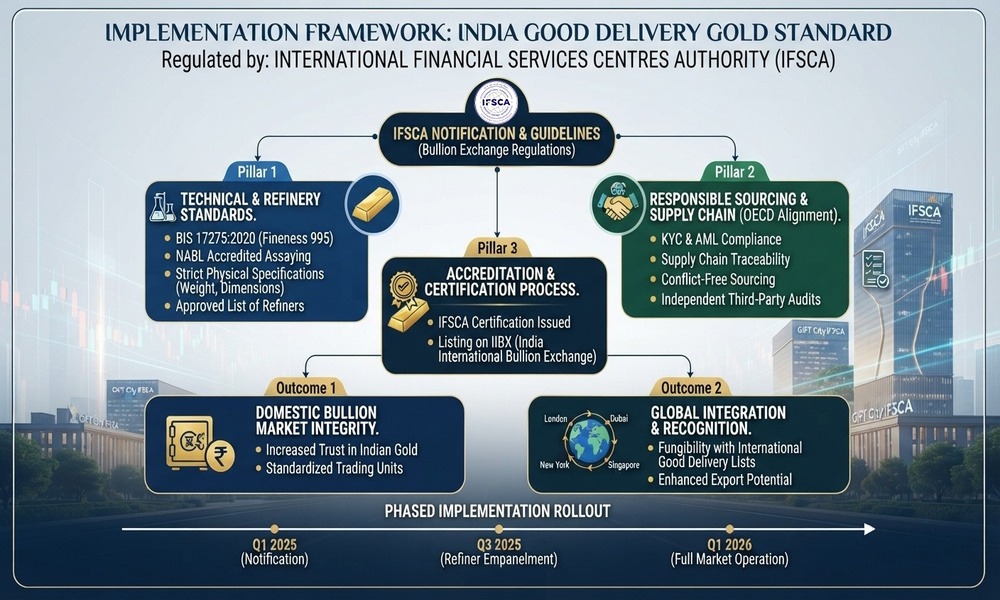
GJEPC has urged the Government to expedite international recognition and the implementation of the India Good Delivery Gold framework, following the notification of the International Financial Services Centres Authority (IFSCA) (Good Delivery) Guidelines, 2026. The framework is expected to strengthen responsible sourcing, build confidence in Indian-refined gold and create opportunities for bullion exports.
The guidelines establish a framework for quality assurance, responsible sourcing and traceability in gold refining. IFSCA, India’s unified regulator for financial products, services and institutions operating in International Financial Services Centres, will implement the framework through the Bullion Exchange in the IFSC. Gold from accredited refiners that meets the prescribed requirements can qualify for delivery on IFSC exchanges and for over-the-counter trading.
The framework extends beyond the purity and quality of gold bars to address their provenance. Refiners must trace raw gold to its source, assess supply-chain risks, verify suppliers and beneficial owners, and meet applicable responsible-sourcing requirements. Independent third-party audits will provide additional assurance.
The initiative follows the recommendations by NITI Aayog, a policy think tank, which had called for an India Good Delivery Standard and responsible-sourcing guidelines for refineries. The report highlighted the potential of domestic refining to retain more value within India, generate employment and support exports.


-

 TechBuzz2 days ago
K. Srinivasan Unveils Doit Coimbatore Experience Centre
-

 GlamBuzz2 days ago
Kalyan Jewellers’ Navratri Celebrations Bring Stars From All Industries To Thrissur
-
 National News2 days ago
IFSCA Notifies India Good Delivery Gold Framework
-

 National News2 days ago
World Gold Council Unveils Immersive Gold Experience At Phoenix Palladium, Lower Parel, Mumbai