
International News
Decline in the number of active US jewellery companies decelerated in Q2: JBT

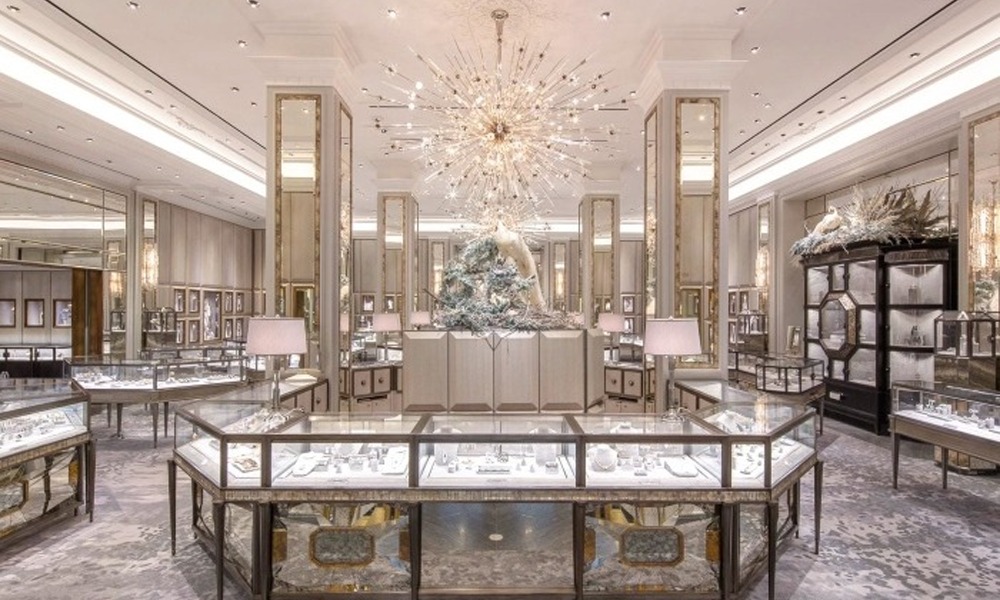
The United States jewelry industry, has recently shown a nuanced trend in its business landscape. While the overall number of active companies continues to decline, the pace of these closures has notably decelerated in the second quarter of 2025. This shift, as highlighted by the Jewelers Board of Trade (JBT) data, suggests a potential stabilization or a more gradual contraction within the sector, offering a glimmer of cautious optimism amidst ongoing adjustments.
During the three-month period ending June 30, 2025, a total of 174 US jewelry businesses ceased operations. This figure represents a significant 23% decrease in closures compared to the same quarter in the previous year, indicating a less volatile environment for existing firms. Despite this slowdown in closures, the total number of active jewelry companies in the US still stands at 22,218, a 3.1% reduction year-on-year and a marginal decrease of 112 firms from the preceding quarter. This suggests that while the industry is still contracting, the rate of this contraction is easing.
A closer examination of the reasons behind these discontinuations reveals a multifaceted picture. Mergers and takeovers accounted for 28 closures, pointing to a degree of consolidation within the industry as larger entities absorb smaller ones. Bankruptcies, often a stark indicator of severe financial distress, were responsible for only three closures, a relatively low number that might suggest underlying resilience or successful restructuring efforts by struggling businesses. The majority of closures, 143 to be precise, were attributed to “other reasons,” a broad category that could encompass factors such as retirement, strategic shifts, or simply a decision to exit the market without formal insolvency proceedings. Encouragingly, the period also saw the emergence of 97 new businesses, an increase from 83 in the prior year, indicating continued entrepreneurial activity and innovation within the sector.
The various segments of the jewelry industry experienced differing degrees of impact. Retailers, who form the largest component of the sector, saw their numbers decrease by 3% year-on-year, settling at 16,873 active businesses. This decline, while present, is in line with broader trends affecting brick-and-mortar retail across many industries. The wholesale trade also experienced a contraction, sliding 2.6% to 3,241 firms. The manufacturing sector, perhaps facing pressures from global supply chains and evolving production methods, recorded the steepest decline at 4.7%, reducing its count to 2,104 firms. These figures underscore the ongoing structural adjustments occurring across the entire value chain of the jewelry business.
Further insights into the financial health of the industry come from the JBT’s credit rating adjustments. During the second quarter, 561 companies across the US and Canada saw their credit ratings downgraded, an improvement from the 633 downgrades recorded a year earlier. More positively, 639 businesses received improved credit scores, and a substantial 663 companies experienced upgrades between April and June 2024. This trend in credit ratings suggests a stabilization, and in some cases, an improvement in the financial standing of many jewelry businesses, potentially reflecting better cash flow management, reduced debt, or stronger market positions for certain firms.
In conclusion, the latest JBT data paints a picture of an evolving US jewelry industry. While the sector continues to navigate a period of contraction, the marked deceleration in business closures, coupled with an increase in new entrants and an overall improvement in credit ratings for a significant number of firms, offers a more optimistic outlook. This suggests that the industry may be moving towards a more stable equilibrium, adapting to market dynamics, and potentially laying the groundwork for future growth, albeit with ongoing shifts in its composition and operational landscape.








International News
Precious Metals Bounce Back As Iran Ceasefire Hopes Rise, But Fed Rate Fears Loom: AUGMONT BULLION REPORT
Gold Remains Under Short-term Pressure from Expectations of Fed Tightening and a Strong Dollar. However, Investor Positioning in Gold Looks Relatively Light After Months of ETF Outflows.

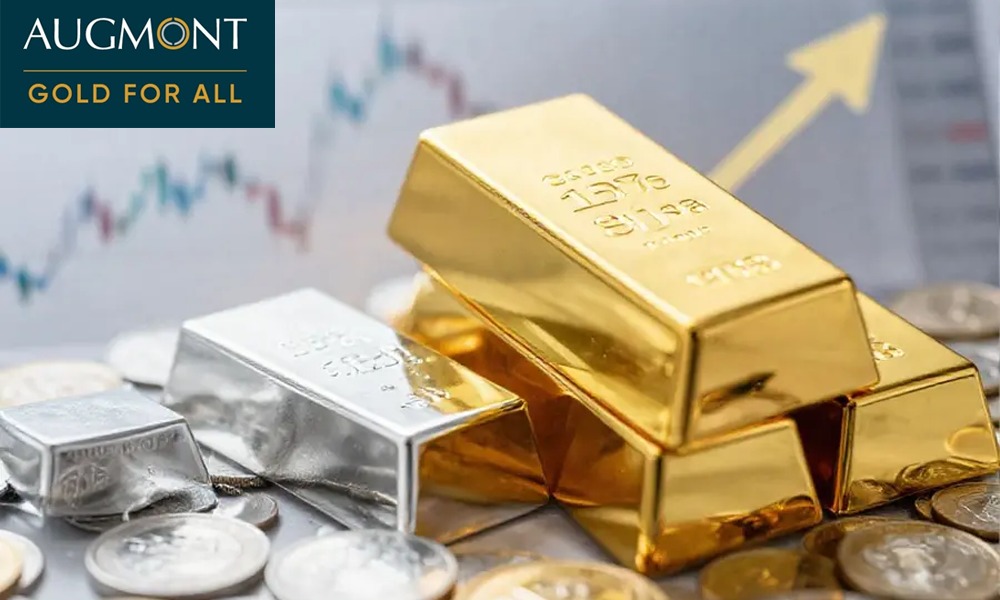
Price Movement – Gold has bounced back from its key support levels near $3960, and Silver has recovered from $55, after an Iranian official reportedly received a proposal for a 10-day ceasefire. The continuing US-Iran standoff has kept investors worried about energy-driven inflation and the possibility of further rate hikes. Markets are now pricing in an 83% chance of a US rate hike in December, up sharply from 73% just a week earlier, based on the CME FedWatch tool.
Geopolitical Tensions – Despite the Houthis announcing fresh military action, both Tehran and Washington appear keen to restart talks and stop the escalating attacks that have nearly destroyed a fragile interim agreement reached last month. A senior Iranian official told Reuters on Monday that mediators had proposed a 10-day ceasefire, aimed at rescuing the interim deal and eventually leading to a lasting peace agreement.
Macro-Economic Signals – Gold remains under short-term pressure from expectations of Fed tightening and a strong dollar. However, investor positioning in gold looks relatively light after months of ETF outflows, meaning further price drops may be limited. Strong physical demand, especially from China, along with continued central bank buying, is providing solid support to the gold market.
Technical Triggers
If Gold fails to hold above $4,000 (~Rs.1,41,000), it could slide further to $3,900 (~Rs.1,38,000). But if it manages to stay above $4,200, a fresh rally could take it toward $4,500 (~Rs.1,55,000).
For Silver, a strong move above $63 (~Rs.2,35,000) could push prices toward $70–71 (~Rs.2,51,000–2,55,000). On the other hand, a fall below $55 (~Rs.2,14,000) may drag it down to $50 (~Rs.2,00,000).
Support and Resistance
| International Gold Support Level International Gold Resistance Level Domestic Gold Support Level Domestic Gold Resistance Level | : $3900/oz : $4160/oz : Rs 137,000/10 gm : Rs 147,000/10 gm |
| International Silver Support Level International Silver Resistance Level Domestic Silver Support Level Domestic Silver Resistance Level | : $55/oz : $63/oz : Rs 214,000/kg : Rs 235,000/kg |



Precious Metals Bounce Back As Iran Ceasefire Hopes Rise, But Fed Rate Fears Loom: AUGMONT BULLION REPORT

Bvlgari Revives Its Iconic Gold & Steel Legacy With Bold New Jewellery Creations

Cosmos Diamonds Makes History With World’s First LGD Jewellery Launched Into Space

MCX Gold, Silver Futures For August Delivery Rise On Renewed Geopolitical Tensions
Precious Metals Bounce Back As Iran Ceasefire Hopes Rise, But Fed Rate Fears Loom: AUGMONT BULLION REPORT
Cosmos Diamonds Makes History With World’s First LGD Jewellery Launched Into Space
-
 National News11 hours ago
MCX Gold, Silver Futures For August Delivery Rise On Renewed Geopolitical Tensions
-
 International News7 hours ago
Precious Metals Bounce Back As Iran Ceasefire Hopes Rise, But Fed Rate Fears Loom: AUGMONT BULLION REPORT
-
 National News8 hours ago
Cosmos Diamonds Makes History With World’s First LGD Jewellery Launched Into Space
-

 International News11 hours ago
London Diamond Bourse Announces Launch Of Its New Coloured Gemstone Course
