
By Invitation
Change Management: Can You See Your Business In 2036?
By Shivaram A


A decade ago, the jewellery business was predictable.
Gold prices moved steadily upward. Customers trusted neighbourhood jewellers. Competition was manageable. Even ecommerce, which disrupted many industries, did not dramatically affect jewellery retail.
Most jewellers could run profitable businesses without changing much.
But that world is gone.
Today, change is coming faster, from more directions, and with greater intensity than ever before.
Gold price volatility. Lab-grown diamonds. 9kt jewellery. Artificial Intelligence.
Changing consumer behaviour. New-age competitors.
The jewellery retailer of 2036 will not survive on reputation alone.
The next decade will belong to businesses willing to evolve.
Pause for a Moment
Close your eyes for ten seconds and imagine yourself standing outside your store in 2036.
What do you see?
A larger showroom? A younger customer base? Multiple branches?
A stronger brand? A more modern retail experience?
Or do you see the same store, the same inventory, and the same systems — struggling to stay relevant?
Now come back to 2026.
Because the future is already arriving faster than most jewellers realize.
Your Market Has Already Changed
Walk around your market one evening.
Not from inside your car. Walk slowly.
Observe:
- The new stores opening changing fashion trends, the younger consumers, EV cars and scooters, cafés and lifestyle stores full of energy.
Visit stores you normally never enter — fashion outlets, electronics stores, sneaker shops, beauty retailers.
Look at the customer experience.
Then walk back into your own showroom and ask yourself honestly:
What has truly changed in my store over the last 10 years?
Many jewellers still operate with:
- The same interiors, similar merchandise, outdated displays, traditional sales approaches, and teams that are experienced but not future-ready.
Meanwhile, customers — especially younger customers — are changing rapidly.
If the younger generation is spending everywhere else but not inside your store, that is not a market problem.
It is a business signal.
And while many retailers were busy protecting existing customers, new competitors were busy attracting future customers.
The Biggest Battle is Mental
Every business transformation starts with mindset.
Most jewellers want growth.
Very few are prepared for the discomfort that growth demands.
For years, the jewellery business rewarded stability:
- Trusted relationships, steady demand, low marketing effort, and traditional business practices.
But modern retail no longer rewards comfort.
Today’s customer compares your showroom not only with another jeweller, but with every premium experience she encounters elsewhere.
Customers now expect:
- Better presentation, personalized service, modern communication, convenience, transparency, and memorable experiences.
One jewellery retailer even sends premium customers home in a Mercedes-Benz after purchase.
That may sound extreme — until you realize that experiences themselves are becoming competitive advantages.
The question is:
What experience are customers remembering after leaving your store?
Four Areas That Will Define Jewellery Success in 2036

1. Purpose
What exactly are you building for the future?
Do you want:
- Multiple stores, a younger customer base, premium positioning, stronger bridal leadership, or entry into newer categories?
And perhaps the toughest question:
If you are a natural diamond retailer, are you prepared to explore lab-grown diamonds?
The future may not wait for emotional resistance.
2. Marketing
One of the biggest mistakes traditional jewellers made was believing that reputation alone would guarantee future growth.
That era is ending.
I recently met the owner of a jewellery business doing nearly Rs. 100 crore annually. For years, he never invested seriously in marketing because business came naturally.
Now, with new competitors entering the market, growth has slowed and customer acquisition has become harder.
Meanwhile, marketing itself is changing rapidly.
Platforms like ChatGPT are changing how consumers discover businesses and information.
The question is no longer:
“Should I market?”
The real question is:
Will customers even notice your business if you do not?
3. Merchandising
Customers still come to jewellery stores for one reason — to buy jewellery.
But what they want is changing.
Young consumers increasingly prefer:
- Lighter jewellery, daily wear collections, lower ticket sizes, contemporary styling, 14kt categories, and fashion-led designs.
Yet many stores continue carrying large quantities of slow-moving traditional inventory.
Every jeweller should periodically ask:
How much of my inventory is actually productive?
Or has some of it become “golden furniture” — expensive stock silently occupying space?
Future-ready merchandising is not about buying more.
It is about buying smarter.
4. People
The old model of personally controlling everything from the cash counter cannot scale forever.
Growth requires strong teams.
Not just employees — but trained, motivated, accountable teams aligned with your business vision.
The retailers who dominate the next decade will invest heavily in:
- Staff training, leadership development, customer experience, incentives, and performance culture.
Because customers do not experience your intentions.
They experience your people.
The Final Question
The jewellery businesses that thrive in 2036 may not necessarily be the oldest businesses.
They may not even be the biggest businesses today.
But they will almost certainly be the businesses most willing to adapt.
So ask yourself honestly:
When customers stand in front of your showroom in 2036, what will they see?
A business that resisted change?
Or a business that transformed itself ahead of the market?
The future is already being built — one decision at a time.
The only question is whether you are participating in that future, or watching someone else build it.
What Does Your Jewellery Business Need to Look Like by 2036?
Across India, I meet jewellery retailers facing challenges around:
- Competition, declining footfalls, younger customers, marketing, inventory, and team performance.
If these questions are on your mind too, share your biggest business challenge with me directly on WhatsApp. I am offering a limited number of complimentary 30-minute strategy discussions for jewellery retailers serious about building a stronger and future-ready business.



By Shivaram A
The Core Issue
The owner carries the entire risk of the business — investment, gold stock, working capital, loans, everything is in their name. The long-term asset also belongs to the owner — reputation, brand, the customer base built over years, often meant to pass to the next generation. But the moment that matters most — when the customer is standing at the counter, when trust is being built or broken — that moment is entirely controlled by the staff.
The person with the most risk is not present at the decisive moment. And the person with the least to lose holds the most power in that moment. This structural mismatch creates frustration on both sides — and it’s rarely discussed openly.
Making the Conflict Explicit
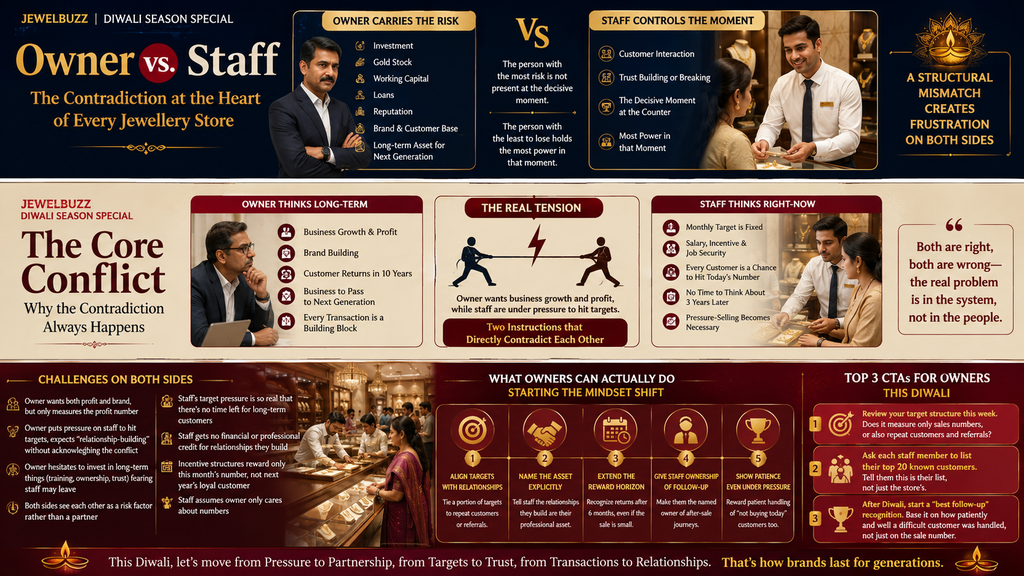
The real tension is this: the owner wants business growth and profit, while staff are under pressure to hit targets.
The owner thinks long-term — how does the brand grow, how does a customer come back after ten years, how does the business pass to the next generation. For the owner, every transaction is a building block toward something bigger.
The staff’s reality is completely different. Their monthly target is fixed. Their salary, incentive, and sometimes even job security depend on how much they sold this month, this Diwali. For staff, every customer is a chance to hit today’s number — right now, this moment. They cannot afford to think about whether this customer comes back in three years, because their performance is reviewed at month-end, not three years later.

So when the owner says “build the relationship, be patient,” and in the same breath increases the target by 20%, these two instructions directly contradict each other. Staff are not confused about what they should ideally do — they understand it perfectly. But they don’t have the choice. The target has to be met, so pressure-selling becomes necessary — even if it means pushing a customer slightly, or using lines like “buy today, rate will go up tomorrow” that create small cracks in trust.
These cracks don’t show up immediately. But after Diwali, when that customer doesn’t return a second time, the owner assumes it’s the staff’s fault. The staff believes the owner set an unrealistic target. Both are right, and both are wrong — because the real problem is in the system, not in the people.
The Challenges on Both Sides
- Owner wants both profit and brand, but only measures the profit number
- Owner puts pressure on staff to hit targets, then also expects “relationship-building” — without acknowledging the two often can’t coexist
- Owner hesitates to invest in long-term things (training, ownership, trust) due to fear that staff will leave anyway
- Staff’s target pressure is so real that there’s no time left to think about the long-term customer
- Staff gets no financial or professional credit for the relationships they build
- Incentive structures reward only this month’s number, not next year’s loyal customer
- Both sides see each other as a risk factor rather than a partner — the owner assumes staff will eventually leave, staff assumes the owner only cares about numbers
What Owners Can Actually Do — Starting the Mindset Shift
- Stop treating targets and relationships as separate — align them. Don’t set targets purely on sales numbers. Tie a small portion of the target to repeat customers or referrals, so staff know that long-term customers count too.
- Name the asset explicitly. Tell staff directly: the relationship you’re building with a customer is your professional asset, not just the store’s. This has to be shown in practice, not just said out loud.
- Extend the reward horizon. Don’t reward only Diwali-week sales — when a customer returns six months later and asks for that staff member by name, recognize that, even if the sale itself is small.
- Give staff ownership of the follow-up. Make each staff member the named owner of their customers’ after-sale journey — repairs, exchanges, the next occasion. This helps them feel the relationship is theirs, not just a transaction.
- Show patience even under pressure. If Diwali week only rewards closed sales, staff will only chase closing. If a staff member who handles a “not buying today” customer well is also appreciated, that’s when the mindset actually starts to shift — because staff notices what the owner actually rewards, not just what they say.
Top 3 CTAs for owners this Diwali
- Review your target structure this week. Does it only measure sales numbers, or does it also give weight to repeat customers and referrals? If not, try a small adjustment starting this Diwali.
- Ask each staff member to list their top 20 known customers. Tell them this is their list, not just the store’s. This builds a sense of ownership.
- After Diwali, start a “best follow-up” recognition. Base it not on the sale number, but on how patiently and well a difficult customer was handled. Staff need to see that patience is rewarded too, not just closing.
Shivaram A
Retail Gurukul


-

 TechBuzz20 hours ago
K. Srinivasan Unveils Doit Coimbatore Experience Centre
-

 GlamBuzz21 hours ago
Kalyan Jewellers’ Navratri Celebrations Bring Stars From All Industries To Thrissur
-

 National News20 hours ago
IFSCA Notifies India Good Delivery Gold Framework
-

 National News21 hours ago
World Gold Council Unveils Immersive Gold Experience At Phoenix Palladium, Lower Parel, Mumbai
