
By Invitation
AI, Rising Gold Prices, and The Changing Jewellery Customer
By Dr. Sandip P. Dhurat


Walk into a jewellery store today and the conversation feels different. Customers are more cautious, more informed, and far more selective than they were a few years ago. The reason is simple—gold is expensive, and every purchase now carries more weight, both emotionally and financially.
When gold prices were lower, buying jewellery was often more spontaneous. Customers explored more designs, made quicker decisions, and were less sensitive to small price differences. Today, the same customer walks in with sharper questions, tighter budgets, and higher expectations.
This is where the role of AI—and more importantly, the approach to customer experience—becomes critical.

AI is quietly reshaping how jewellers understand and engage with customers. From tracking buying patterns to recommending designs based on past preferences, it allows stores to move from generic selling to highly personalized interactions. A returning customer no longer has to start from scratch. With the right systems, a salesperson can already know their style preferences, past purchases, and even price comfort zones.
But technology alone is not enough. In a high gold price environment, sensitivity matters more than ever.
Customers today are not just buying jewellery—they are evaluating value. They want transparency in pricing, clarity on making charges, and confidence that what they are buying is worth the premium they are paying. AI can assist here by enabling real-time pricing, detailed breakdowns, and even comparison tools that build trust rather than suspicion.
Another noticeable shift is in decision time. Purchases are taking longer. Customers visit multiple times, compare options online and offline, and often involve family in the decision. This requires a different kind of patience and engagement from sales teams. The pressure to “close quickly” needs to be replaced with a focus on “build confidence.”
AI can support this journey by staying connected with the customer beyond the store visit—through personalized follow-ups, design suggestions, price alerts, and reminders. Instead of pushing a sale, it keeps the relationship warm until the customer is ready.
There is also a growing opportunity in offering alternatives. Lightweight jewellery, modular designs, and pieces that balance aesthetics with affordability are gaining attention. AI-driven insights can help retailers understand which products are resonating and adjust inventory accordingly.
At the same time, the in-store experience needs to evolve. When customers are spending more, they expect more. Not necessarily luxury in the traditional sense, but attention, honesty, and respect for their concerns. Simple things—like acknowledging budget constraints without judgment or explaining pricing clearly—go a long way in building loyalty.
What will increasingly separate one jeweller from another is not just design or pricing, but how well their teams are equipped to handle this new kind of customer. Forward-looking retailers are beginning to invest in structured training led by AI experts—helping their staff understand customer data, use recommendation tools effectively, and communicate insights in a way that feels natural, not mechanical. When sales teams are trained to combine technology with empathy, the difference is immediately visible to customers.
In many ways, high gold prices are forcing the industry to become more customer-centric. The easy sales are gone. What remains is the need to earn trust.

AI gives jewellers the tools to do this at scale, but the real difference will come from how those tools are used. The combination of data-driven insight and human empathy is what will define successful businesses in this environment.
Because ultimately, the question is not just about whether customers can afford to buy—it is about whether they feel confident enough to do so.
And that raises an important question for the industry:
Have we actually improved our customer experience as gold prices have increased—or are we still selling the same way, just at a higher price?



By Shivaram A
The Core Issue
The owner carries the entire risk of the business — investment, gold stock, working capital, loans, everything is in their name. The long-term asset also belongs to the owner — reputation, brand, the customer base built over years, often meant to pass to the next generation. But the moment that matters most — when the customer is standing at the counter, when trust is being built or broken — that moment is entirely controlled by the staff.
The person with the most risk is not present at the decisive moment. And the person with the least to lose holds the most power in that moment. This structural mismatch creates frustration on both sides — and it’s rarely discussed openly.
Making the Conflict Explicit
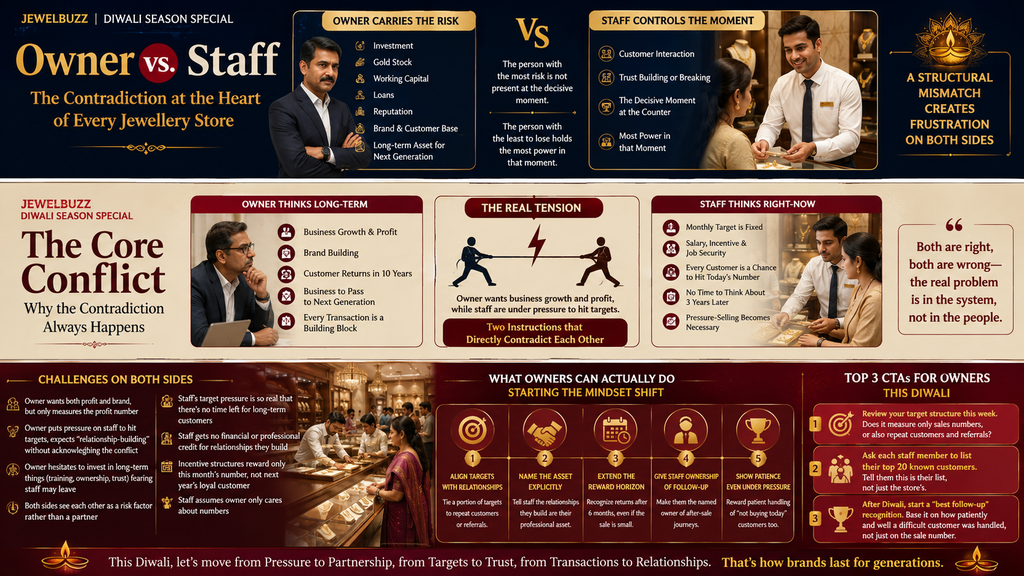
The real tension is this: the owner wants business growth and profit, while staff are under pressure to hit targets.
The owner thinks long-term — how does the brand grow, how does a customer come back after ten years, how does the business pass to the next generation. For the owner, every transaction is a building block toward something bigger.
The staff’s reality is completely different. Their monthly target is fixed. Their salary, incentive, and sometimes even job security depend on how much they sold this month, this Diwali. For staff, every customer is a chance to hit today’s number — right now, this moment. They cannot afford to think about whether this customer comes back in three years, because their performance is reviewed at month-end, not three years later.

So when the owner says “build the relationship, be patient,” and in the same breath increases the target by 20%, these two instructions directly contradict each other. Staff are not confused about what they should ideally do — they understand it perfectly. But they don’t have the choice. The target has to be met, so pressure-selling becomes necessary — even if it means pushing a customer slightly, or using lines like “buy today, rate will go up tomorrow” that create small cracks in trust.
These cracks don’t show up immediately. But after Diwali, when that customer doesn’t return a second time, the owner assumes it’s the staff’s fault. The staff believes the owner set an unrealistic target. Both are right, and both are wrong — because the real problem is in the system, not in the people.
The Challenges on Both Sides
- Owner wants both profit and brand, but only measures the profit number
- Owner puts pressure on staff to hit targets, then also expects “relationship-building” — without acknowledging the two often can’t coexist
- Owner hesitates to invest in long-term things (training, ownership, trust) due to fear that staff will leave anyway
- Staff’s target pressure is so real that there’s no time left to think about the long-term customer
- Staff gets no financial or professional credit for the relationships they build
- Incentive structures reward only this month’s number, not next year’s loyal customer
- Both sides see each other as a risk factor rather than a partner — the owner assumes staff will eventually leave, staff assumes the owner only cares about numbers
What Owners Can Actually Do — Starting the Mindset Shift
- Stop treating targets and relationships as separate — align them. Don’t set targets purely on sales numbers. Tie a small portion of the target to repeat customers or referrals, so staff know that long-term customers count too.
- Name the asset explicitly. Tell staff directly: the relationship you’re building with a customer is your professional asset, not just the store’s. This has to be shown in practice, not just said out loud.
- Extend the reward horizon. Don’t reward only Diwali-week sales — when a customer returns six months later and asks for that staff member by name, recognize that, even if the sale itself is small.
- Give staff ownership of the follow-up. Make each staff member the named owner of their customers’ after-sale journey — repairs, exchanges, the next occasion. This helps them feel the relationship is theirs, not just a transaction.
- Show patience even under pressure. If Diwali week only rewards closed sales, staff will only chase closing. If a staff member who handles a “not buying today” customer well is also appreciated, that’s when the mindset actually starts to shift — because staff notices what the owner actually rewards, not just what they say.
Top 3 CTAs for owners this Diwali
- Review your target structure this week. Does it only measure sales numbers, or does it also give weight to repeat customers and referrals? If not, try a small adjustment starting this Diwali.
- Ask each staff member to list their top 20 known customers. Tell them this is their list, not just the store’s. This builds a sense of ownership.
- After Diwali, start a “best follow-up” recognition. Base it not on the sale number, but on how patiently and well a difficult customer was handled. Staff need to see that patience is rewarded too, not just closing.
Shivaram A
Retail Gurukul


-

 TechBuzz19 hours ago
K. Srinivasan Unveils Doit Coimbatore Experience Centre
-

 GlamBuzz20 hours ago
Kalyan Jewellers’ Navratri Celebrations Bring Stars From All Industries To Thrissur
-

 National News19 hours ago
IFSCA Notifies India Good Delivery Gold Framework
-

 National News20 hours ago
World Gold Council Unveils Immersive Gold Experience At Phoenix Palladium, Lower Parel, Mumbai
