
By Invitation
Why It’s Time for a New Jewellery Category -By Dr. Sandip Dhurat
Dr. Sandip Dhurat is an innovator, researcher, and thought leader in the luxury and wellness space. With over two decades of experience in consumer behaviour, product design, and IP strategy, he is the inventor of a patent-protected jewellery category designed for the next generation of wearers.

For over a century, the jewellery industry has thrived on tradition — a blend of craftsmanship, heritage, and symbolism. Yet in this reverence for the past lies our present challenge: we haven’t created a fundamentally new jewellery category in over 100 years.
We’ve seen stylistic evolutions, material innovations, and digital integrations — yes. But a category shift? A new space that redefines how people interact with jewellery? That’s long overdue. And now, it’s not just a creative opportunity — it’s a strategic necessity.
Why No New Jewellery Categories Have Emerged in 100 Years
Jewellery has historically been classified into three primary categories:
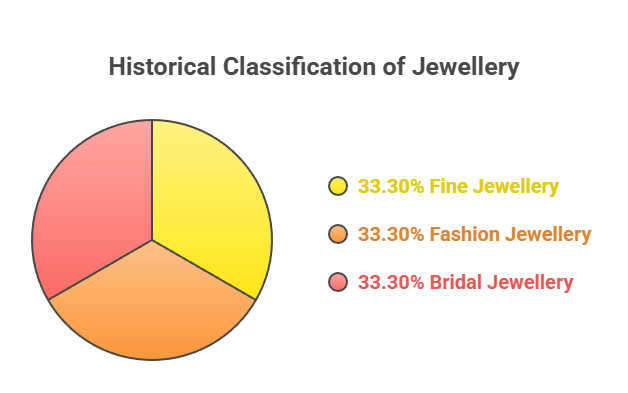
- Fine Jewellery (luxury, precious metals and stones),
- Fashion Jewellery (trend-driven, accessible, lower-cost),
- Bridal Jewellery (cultural, ceremonial, often one-time use).
These categories are deeply entrenched, both in consumer perception and retail structure. Most industry innovation has focused on design and marketing — not on rethinking the category itself.
But innovation in other lifestyle industries — fashion, wellness, technology — shows us the power of category creation. Think athleisure in apparel or smartwatches in accessories. Why hasn’t jewellery made a comparable leap?
The answer lies in a mix of legacy inertia and market comfort — until now.
How Gen Z’s Mindset is Widening the Chasm Between Offering and Demand
Gen Z is rewriting the rulebook for consumption. Their jewellery choices are less about tradition and more about expression, functionality, and alignment with personal values.
This generation doesn’t just buy jewellery to “own gold” or “look elegant.” They look for:
- Purpose: What does this piece do or represent?
- Identity: Does it align with my story, gender fluidity, or wellness goals?
- Interactivity: Can I connect with it digitally, physically, or emotionally?
In short, Gen Z wants jewellery to do more than sit pretty. They want it to mean more, offer more, and adapt with them. Traditional categories simply aren’t built for this expectation — and it’s leading to a growing disconnect between what we offer and what they demand.
Introducing a New Jewellery Category — Conceptually
Without revealing proprietary details, I can share that this new category of jewellery redefines its role in the wearer’s life.
It is:
- Purpose-driven: Beyond aesthetics, it serves a functional, emotional, or physiological role. Identity-focused: It adapts to evolving self-expression, body types, and life stages. Patent-protected: A novel mechanism or form factor underpins the concept.
- Culturally agnostic yet deeply personal: It transcends tradition while inviting intimacy.
This category doesn’t replace fine, fashion, or bridal jewellery — it adds a new layer. A fourth category, if you will, that aligns more closely with 21st-century values: adaptability, inclusivity, and innovation.
How Brands Can License, Adopt, and Lead This Future
Innovation without scale is a missed opportunity. That’s why this category has been designed with licensing and collaborative development in mind.
Brands can:
- License the core concept or IP to develop within their design language.
- Co-develop sublines or capsule collections under this new category.
- Educate consumers through content, storytelling, and experiential retail.
- Lead the shift by positioning themselves as pioneers — not just producers.
The future of jewellery won’t be built by a single creator. It will be shaped by forward-thinking brands willing to step beyond tradition and explore untapped human needs.
Conclusion
We stand at a rare inflection point: where market stagnation meets cultural acceleration. The jewellery industry has a choice — continue refining the old, or pioneer the new.
For those ready to lead, the next decade offers a blank slate. A new jewellery category isn’t just an idea — it’s an inevitability. The only question is: who will bring it to the world first?



By Shivaram A
The Core Issue
The owner carries the entire risk of the business — investment, gold stock, working capital, loans, everything is in their name. The long-term asset also belongs to the owner — reputation, brand, the customer base built over years, often meant to pass to the next generation. But the moment that matters most — when the customer is standing at the counter, when trust is being built or broken — that moment is entirely controlled by the staff.
The person with the most risk is not present at the decisive moment. And the person with the least to lose holds the most power in that moment. This structural mismatch creates frustration on both sides — and it’s rarely discussed openly.
Making the Conflict Explicit
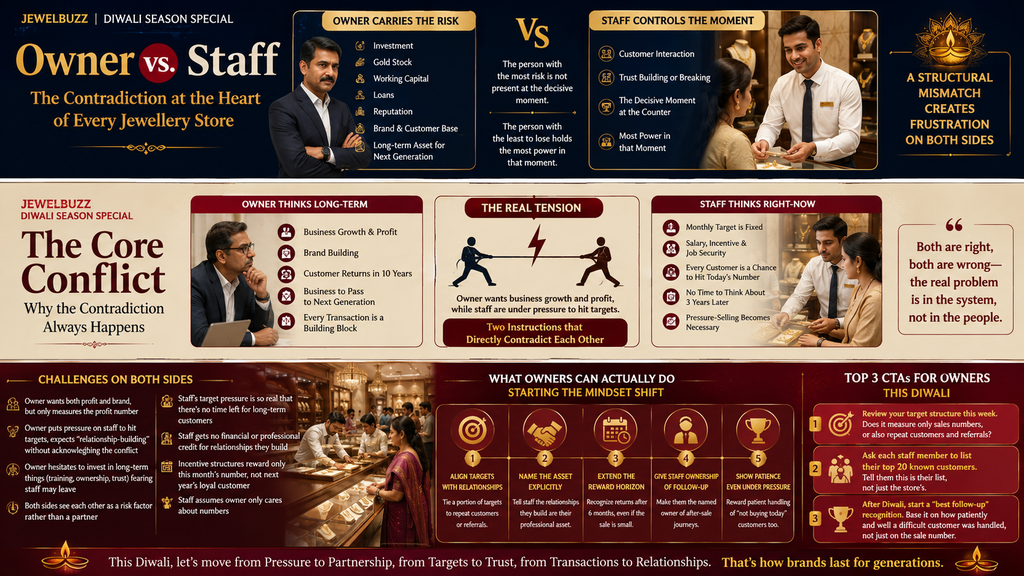
The real tension is this: the owner wants business growth and profit, while staff are under pressure to hit targets.
The owner thinks long-term — how does the brand grow, how does a customer come back after ten years, how does the business pass to the next generation. For the owner, every transaction is a building block toward something bigger.
The staff’s reality is completely different. Their monthly target is fixed. Their salary, incentive, and sometimes even job security depend on how much they sold this month, this Diwali. For staff, every customer is a chance to hit today’s number — right now, this moment. They cannot afford to think about whether this customer comes back in three years, because their performance is reviewed at month-end, not three years later.

So when the owner says “build the relationship, be patient,” and in the same breath increases the target by 20%, these two instructions directly contradict each other. Staff are not confused about what they should ideally do — they understand it perfectly. But they don’t have the choice. The target has to be met, so pressure-selling becomes necessary — even if it means pushing a customer slightly, or using lines like “buy today, rate will go up tomorrow” that create small cracks in trust.
These cracks don’t show up immediately. But after Diwali, when that customer doesn’t return a second time, the owner assumes it’s the staff’s fault. The staff believes the owner set an unrealistic target. Both are right, and both are wrong — because the real problem is in the system, not in the people.
The Challenges on Both Sides
- Owner wants both profit and brand, but only measures the profit number
- Owner puts pressure on staff to hit targets, then also expects “relationship-building” — without acknowledging the two often can’t coexist
- Owner hesitates to invest in long-term things (training, ownership, trust) due to fear that staff will leave anyway
- Staff’s target pressure is so real that there’s no time left to think about the long-term customer
- Staff gets no financial or professional credit for the relationships they build
- Incentive structures reward only this month’s number, not next year’s loyal customer
- Both sides see each other as a risk factor rather than a partner — the owner assumes staff will eventually leave, staff assumes the owner only cares about numbers
What Owners Can Actually Do — Starting the Mindset Shift
- Stop treating targets and relationships as separate — align them. Don’t set targets purely on sales numbers. Tie a small portion of the target to repeat customers or referrals, so staff know that long-term customers count too.
- Name the asset explicitly. Tell staff directly: the relationship you’re building with a customer is your professional asset, not just the store’s. This has to be shown in practice, not just said out loud.
- Extend the reward horizon. Don’t reward only Diwali-week sales — when a customer returns six months later and asks for that staff member by name, recognize that, even if the sale itself is small.
- Give staff ownership of the follow-up. Make each staff member the named owner of their customers’ after-sale journey — repairs, exchanges, the next occasion. This helps them feel the relationship is theirs, not just a transaction.
- Show patience even under pressure. If Diwali week only rewards closed sales, staff will only chase closing. If a staff member who handles a “not buying today” customer well is also appreciated, that’s when the mindset actually starts to shift — because staff notices what the owner actually rewards, not just what they say.
Top 3 CTAs for owners this Diwali
- Review your target structure this week. Does it only measure sales numbers, or does it also give weight to repeat customers and referrals? If not, try a small adjustment starting this Diwali.
- Ask each staff member to list their top 20 known customers. Tell them this is their list, not just the store’s. This builds a sense of ownership.
- After Diwali, start a “best follow-up” recognition. Base it not on the sale number, but on how patiently and well a difficult customer was handled. Staff need to see that patience is rewarded too, not just closing.
Shivaram A
Retail Gurukul



Belgian Consul General H. E. Mr. Pierre Stverlynck Graces BDB Annual Day

Limelight Lab Grown Diamonds Crosses 100 Stores Milestone This Dussehra: Targets 200 In 2027

Joyalukkas Opens Its 2nd Bengaluru Showroom in Jayanagar

US Holiday Shopping Expected To Top $1 Trillion For The First Time: NRF
Belgian Consul General H. E. Mr. Pierre Stverlynck Graces BDB Annual Day
Limelight Lab Grown Diamonds Crosses 100 Stores Milestone This Dussehra: Targets 200 In 2027
-
 International News14 hours ago
US Holiday Shopping Expected To Top $1 Trillion For The First Time: NRF
-
 National News8 hours ago
Belgian Consul General H. E. Mr. Pierre Stverlynck Graces BDB Annual Day
-
 National News9 hours ago
Limelight Lab Grown Diamonds Crosses 100 Stores Milestone This Dussehra: Targets 200 In 2027
-
 New Premises10 hours ago
Joyalukkas Opens Its 2nd Bengaluru Showroom in Jayanagar
