
By Invitation
The Great Jewellery Retail Reset: Are You Ready for What’s Coming Next?
By Shivaram A,Retail Business Mentor


As gold prices fluctuate and customer mindsets evolve, the jewellery retail business stands at a turning point. Those who adapt with guidance will thrive — others may struggle to stay relevant.
Over the last year, jewellers across India have been living through a storm of uncertainty. Gold rates have risen, fallen, and risen again — shaking customer confidence and confusing buying behaviour. While many stores reported higher sales values during festive months, the actual number of pieces sold told a different story.
Customers were walking in — but walking out with fewer items. The same budgets, smaller volumes. The emotional connect with gold remained, but the buying intent was changing quietly beneath the surface.
A Shift in Buying Behaviour: Lighter, Smarter, More Selective
Jewellery, once seen as a long-term investment, is now also viewed through the lens of practicality and personal style. The younger buyer isn’t chasing weight anymore; they’re chasing meaning, design, and comfort.
Heavy necklaces and bangle sets have become slower movers, while rings, earrings, and lightweight chains are finding quick takers. Even as the “value” of inventory rises with gold prices, the “velocity” of sales — how quickly products move — has slowed down.
This creates an illusion of growth on paper but a challenge in reality: slower rotation, tighter margins, and customers whose expectations are changing faster than most jewellers are prepared for.
Two Customers, Two Worlds
At one end are traditional families — loyal, price-conscious, and deeply rooted in their relationship with their family jeweller. At the other end stands the new-age urban customer — salaried, educated, and brand-aware.
This second group is the real disruptor. They don’t see gold as an emergency asset but as an accessory that defines lifestyle. They browse online, compare designs across stores, and choose convenience over custom.
For them, jewellery is fashion — not finance. And that single shift is rewriting the rules of the game.

Competition Is Heating Up
As independent jewellers fight to maintain margins, larger chains are expanding quietly — opening new showrooms, entering Tier 2 and Tier 3 towns, and capturing the very customers smaller stores once depended on.
Adding to the mix are non-jewellery investors and new entrants drawn by the industry’s steady performance compared to other sectors. With over 10,000 new stores expected to open in the next few years, competition will only intensify.
This means the traditional family jeweller can no longer depend solely on legacy, relationships, or word-of-mouth. What’s needed now is strategy, structure, and smarter decision-making — powered by data, training, and mentorship.

Change Is Hard — But Help Is Available
Transitioning from a legacy business model to a modern retail approach isn’t easy. It involves rethinking everything from sales processes to staff mindset, from customer experience to inventory strategy.
But the good news is — you don’t have to do it alone.
Every successful transformation begins with one conversation — a discussion about where you are, what’s changing, and how to move forward one step at a time.
That’s where mentorship makes the difference. A seasoned guide can help you see patterns others miss, avoid expensive mistakes, and build a roadmap that’s realistic and sustainable.

Jewellery retail is evolving — and those who evolve with it will shine brighter in the years ahead.
While change is always tough, it is also necessary. The key is to take it step by step, guided by experience and insight.
If you’re wondering where to start or how to navigate the next phase of your business transformation — let’s talk.




By Shivaram A
The Core Issue
The owner carries the entire risk of the business — investment, gold stock, working capital, loans, everything is in their name. The long-term asset also belongs to the owner — reputation, brand, the customer base built over years, often meant to pass to the next generation. But the moment that matters most — when the customer is standing at the counter, when trust is being built or broken — that moment is entirely controlled by the staff.
The person with the most risk is not present at the decisive moment. And the person with the least to lose holds the most power in that moment. This structural mismatch creates frustration on both sides — and it’s rarely discussed openly.
Making the Conflict Explicit
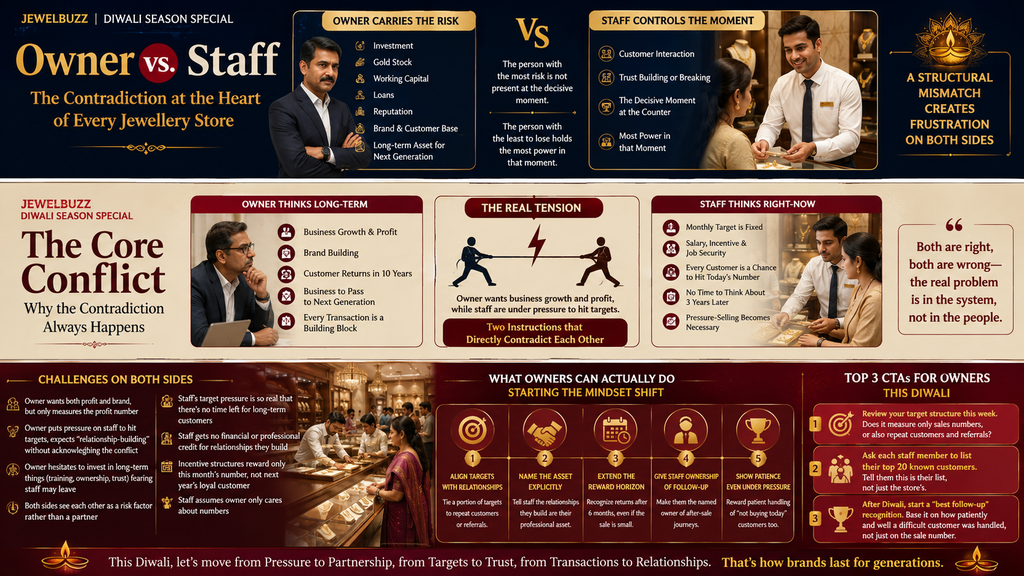
The real tension is this: the owner wants business growth and profit, while staff are under pressure to hit targets.
The owner thinks long-term — how does the brand grow, how does a customer come back after ten years, how does the business pass to the next generation. For the owner, every transaction is a building block toward something bigger.
The staff’s reality is completely different. Their monthly target is fixed. Their salary, incentive, and sometimes even job security depend on how much they sold this month, this Diwali. For staff, every customer is a chance to hit today’s number — right now, this moment. They cannot afford to think about whether this customer comes back in three years, because their performance is reviewed at month-end, not three years later.

So when the owner says “build the relationship, be patient,” and in the same breath increases the target by 20%, these two instructions directly contradict each other. Staff are not confused about what they should ideally do — they understand it perfectly. But they don’t have the choice. The target has to be met, so pressure-selling becomes necessary — even if it means pushing a customer slightly, or using lines like “buy today, rate will go up tomorrow” that create small cracks in trust.
These cracks don’t show up immediately. But after Diwali, when that customer doesn’t return a second time, the owner assumes it’s the staff’s fault. The staff believes the owner set an unrealistic target. Both are right, and both are wrong — because the real problem is in the system, not in the people.
The Challenges on Both Sides
- Owner wants both profit and brand, but only measures the profit number
- Owner puts pressure on staff to hit targets, then also expects “relationship-building” — without acknowledging the two often can’t coexist
- Owner hesitates to invest in long-term things (training, ownership, trust) due to fear that staff will leave anyway
- Staff’s target pressure is so real that there’s no time left to think about the long-term customer
- Staff gets no financial or professional credit for the relationships they build
- Incentive structures reward only this month’s number, not next year’s loyal customer
- Both sides see each other as a risk factor rather than a partner — the owner assumes staff will eventually leave, staff assumes the owner only cares about numbers
What Owners Can Actually Do — Starting the Mindset Shift
- Stop treating targets and relationships as separate — align them. Don’t set targets purely on sales numbers. Tie a small portion of the target to repeat customers or referrals, so staff know that long-term customers count too.
- Name the asset explicitly. Tell staff directly: the relationship you’re building with a customer is your professional asset, not just the store’s. This has to be shown in practice, not just said out loud.
- Extend the reward horizon. Don’t reward only Diwali-week sales — when a customer returns six months later and asks for that staff member by name, recognize that, even if the sale itself is small.
- Give staff ownership of the follow-up. Make each staff member the named owner of their customers’ after-sale journey — repairs, exchanges, the next occasion. This helps them feel the relationship is theirs, not just a transaction.
- Show patience even under pressure. If Diwali week only rewards closed sales, staff will only chase closing. If a staff member who handles a “not buying today” customer well is also appreciated, that’s when the mindset actually starts to shift — because staff notices what the owner actually rewards, not just what they say.
Top 3 CTAs for owners this Diwali
- Review your target structure this week. Does it only measure sales numbers, or does it also give weight to repeat customers and referrals? If not, try a small adjustment starting this Diwali.
- Ask each staff member to list their top 20 known customers. Tell them this is their list, not just the store’s. This builds a sense of ownership.
- After Diwali, start a “best follow-up” recognition. Base it not on the sale number, but on how patiently and well a difficult customer was handled. Staff need to see that patience is rewarded too, not just closing.
Shivaram A
Retail Gurukul


-

 BrandBuzz23 minutes ago
Madanji Meghraj Jewellers Presents ‘Diwali Luxe’, Celebrating Tradition and Modern Elegance
-

 National News3 hours ago
Precious Metal Futures Continued Their Downward Momentum
-

 JB Insights3 hours ago
India’s Major Retail Jewelers See Double Digit Revenue Growth
-

 DiamondBuzz3 hours ago
De Beers Cuts Diamond Production But Sees Sales Rise
