
JB Insights
WGC REPORT: India gold market update: Seasonal strength


Highlights
- Gold prices soften from record highs yet remain supported
- Domestic prices slide back into discount
- Gold demand, led by investment buying, strengthened during the festive period, but softened thereafter
- Gold ETFs continue strong momentum in October with record inflows and new investors
- Gold imports soar in October, despite the price rally
Looking ahead
- The busy wedding season over the coming months (November–March), with a high number of anticipated weddings, is expected to support jewellery demand.
- Investment interest in gold is likely to persist amid broadly bullish sentiment around gold.
Prices retreat from peak, but maintain firm trend

International gold price1 recorded a sharp rally in October, hitting its 50th record high of the year during the month. Although price eased by about 7% from the peak, it still ended October 5% higher at US$4,011.5/oz. The momentum carried into November, with price up nearly 3% m-t-d as of 19 November. This sustained performance has lifted gold’s y-t-d gains to 58%.
Our Gold Return Attribution Model (GRAM) suggests that recent movements in international gold prices have been driven by geopolitical risk, higher implied volatility, a stronger US dollar, as well as momentum and evolving interest-rate expectations.
Domestic gold prices have largely tracked the international trend but have delivered even stronger returns, recording 63% y-t-d growth. The higher domestic gains are attributed to the 3.3% depreciation of the Indian rupee. Domestic gold prices, which had mostly traded at par with, or at a premium to, the international price over the past two months, shifted to a discount following the peak festive demand period (Chart 2), with the m-t-d2 discount averaging US$18/oz.
Festive demand shines, tapers after

Festive demand around Diwali and Dhanteras3 – India’s peak gold-buying occasions – was reportedly strong despite record-high prices, according to feedback from industry stakeholders. Market participants consistently highlighted that the strength was driven primarily by investment-oriented buying, particularly bars and coins, with some noting volume nearly doubling from a year ago. E-commerce platforms also saw solid sales,4 and digital gold purchases rose too. Unified Payments Interface (UPI) data shows digital gold purchases increasing 62% m/m to INR22bn (US$259mn) in October.5 In tonnage terms, the volume rose 45% m/m to 1.8t.
Jewellery sales also held up well during the festive period, with retailers reporting healthy sales across both single-store and large multi-store formats, the latter benefitting from brand trust and promotional initiatives. Although jewellery volumes were softer due to elevated prices, the overall value of sales remained healthy, reportedly up by around a quarter y/y for many, reflecting resilient festive buying sentiment.
Post-Diwali, demand has reportedly softened. Industry feedback suggests market activity in November has been subdued, despite the onset of the wedding season. Jewellery buying is largely wedding-driven, while investment demand persists. Supply of old gold into the market has reportedly moderated. Trade participants attribute this to consumers having exhausted surplus gold for immediate needs and now choosing to hold onto jewellery in expectation of further price gains. Jewellers remain cautiously optimistic that the ongoing wedding season (November–March) will boost jewellery sales, given the expected large number of weddings.
ETFs: persistent strong inflows

October marked the sixth consecutive month of strong inflows into Indian gold ETFs, emphasising the growing appeal of gold as an investment asset in various forms.
Net inflows for the month were INR77bn (US$876mn), a modest 8% decline from the previous month, largely in line with our estimates.7 Despite this moderation, the figure remained significantly higher than the y-t-d average of INR28bn (US$315mn). The dip was primarily due to a sharp rise in redemptions, which hit a record INR21bn (US$244mn). This surge in redemptions was likely driven by profit-taking following the rally in gold prices. Gross inflows for the month, however, set a record at INR99bn (US$11bn). The exceptional rise in gold prices likely drew investor attention, contributing to the strong inflows, while ongoing safe-haven demand further reinforced this trend. Net inflows have continued into November, reaching INR24bn (US$269mn) during the first 17 days of the month.8
The first 10 months of 2025 have been particularly strong for gold ETFs, with cumulative inflows totalling INR276bn (US$3.1bn) – the highest annual inflows on record. This surpasses the total inflows from March 2020 to December 2024. This unprecedented demand has propelled the assets of these funds to historic levels. As per AMFI data, as of end October, the assets under management (AUM) of gold ETFs climbed to a record INR1,021bn (US$11.5bn) and gold holdings rose to 83.5t,9 nearly a third of which were added in 2025 alone.
The growing interest in gold ETFs was further evidenced by the increase in new investors. In October, a record 911,000 new accounts (folios) were added, bringing the total number of folios to 9.57mn, reflecting a 49% increase y-t-d.
In addition to the strong performance of existing gold ETFs, the market saw the launch of a new gold ETF in October,10 bringing the total number of gold ETFs in India to 23.
Imports surge to new peak in October despite price rally
Gold imports registered a sharp surge in October, marking the fourth consecutive month of growth in both value and volume terms. Notably, the increase occurred despite domestic gold prices touching record highs – rising 60% y/y and 11% m/m11 – indicating resilient domestic demand. In value terms, imports climbed to US$14.7bn, the highest on record, translating into a ~200% y/y and 53% m/m increase. Import volumes also rose substantially, with inflows estimated at 137–142t, compared with 102t in September and 61t a year earlier. The October surge was largely driven by seasonal factors, i.e. the Diwali festivities and the onset of the wedding season.
On a y-t-d basis, gold imports have totalled US$51bn, an increase of 16% y/y. In contrast, the import volumes, estimated at around 559t, are down 12% from a year ago, reflecting the impact of elevated gold prices.


JB Insights
India–UK FTA: Opening A New Chapter For Indian Jewellery
By Darshan Chauhan, Wholetime Director- Sky Gold and Diamonds Ltd..

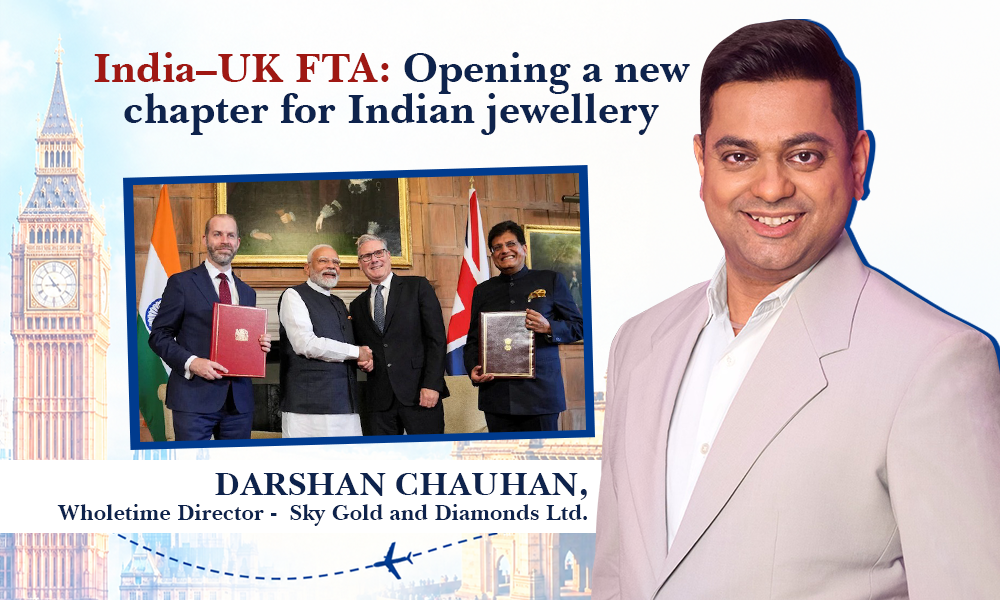
Trade agreements are often discussed in terms of tariffs, trade volumes and market access. But their real significance lies in what they enable businesses to do next. The India–UK Comprehensive Economic and Trade Agreement (CETA), which came into force on 15 July 2026, has the potential to create a stronger platform for Indian businesses to compete, collaborate and grow in one of the world’s most important markets.
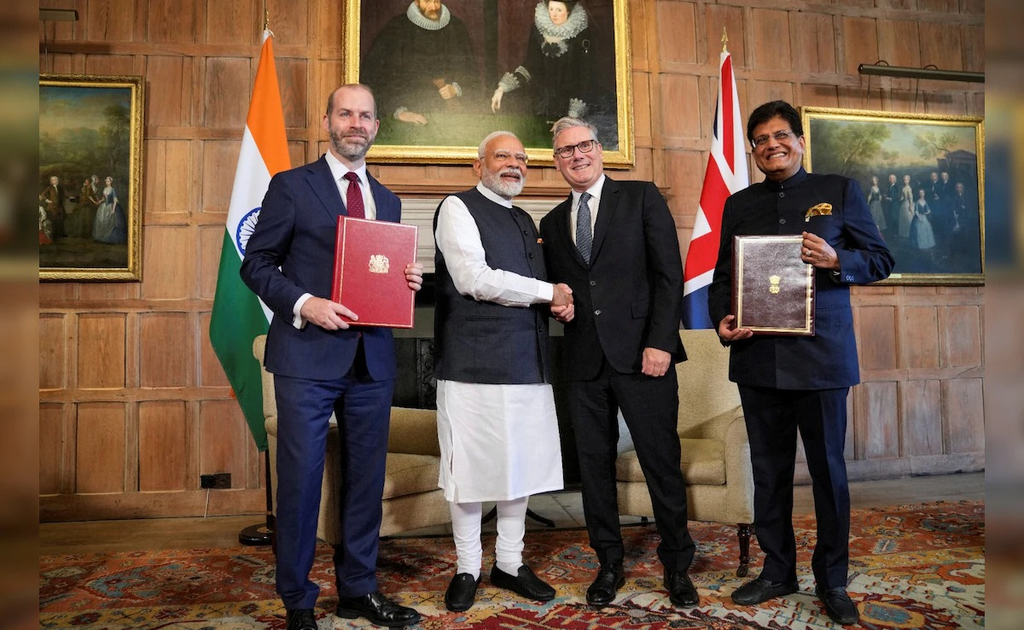
The agreement provides duty-free access to almost 99% of India’s exports to the UK, covering nearly the entire value of India’s trade with the country. For sectors such as gems and jewellery, this is particularly significant. India’s gems and jewellery exports to the UK currently stand at around US$1.03 billion, while the UK imports approximately US$4 billion worth of jewellery annually. This gap represents a substantial opportunity for Indian manufacturers and exporters to expand their presence and build stronger relationships in the market.
A meaningful opportunity for Indian jewellery

India has long been recognised globally for its jewellery craftsmanship. However, the country’s competitive strength today extends well beyond traditional artistry. Over the years, India has developed a sophisticated manufacturing ecosystem that combines skilled craftsmanship with CAD, CNC technology, advanced production processes, organised quality systems, design capabilities and professional merchandising.
The FTA can give this ecosystem greater global reach
Lower trade barriers can improve the competitiveness of Indian jewellery in the UK and create new opportunities across the value chain, from manufacturers and exporters to designers and artisans. Government estimates indicate that tariff relaxations could potentially double India’s gems and jewellery exports to the UK over the next two to three years.
However, market access alone will not determine who succeeds.
From supplier to strategic partner
The global jewellery business is moving beyond traditional supplier relationships towards strategic partnerships built around consumer insight, design, innovation and speed-to-market. India’s manufacturing strength offers a significant opportunity to move up the value chain—from production to design, product development, merchandising and market intelligence. Quality, flexibility, faster development, consistent replenishment and knowledge of international markets can position Indian manufacturers as indispensable growth partners.
The FTA provides market access; the next opportunity is for Indian jewellery companies to deliver greater value.
Trust remains the foundation
Jewellery is built on trust, with quality, purity, craftsmanship and reliability forming the foundation of every transaction. As Indian companies expand into international markets, sustaining these standards will be essential. Global growth must go beyond tariff benefits, supported by transparent processes, dependable supply chains and consistent quality. The UK opportunity lies not merely in increasing sales, but in building lasting relationships with customers and retail partners. Ultimately, trust and reliability will be key to establishing Indian jewellery as a respected global offering.
Positive sentiment after IIJS Bharat Premiere 2026
The timing of the FTA has also been encouraging from an industry perspective. The sentiment following IIJS Premiere reflected growing confidence across the jewellery trade, with conversations increasingly focused on international opportunities, new collections, product innovation and long-term business relationships.
For many businesses, international markets are no longer being viewed simply as additional export destinations. They are becoming an integral part of long-term growth strategies.
That optimism matters. A trade agreement can create favourable economic conditions, but it is the willingness of businesses to invest, innovate and pursue new opportunities that ultimately converts policy into growth.
The first day of the agreement itself provided an encouraging signal, with more than 50 export consignments worth over US$140 million reportedly flagged off under the preferential tariff regime, including gems and jewellery shipments.
Looking beyond tariffs
The India–UK FTA represents more than a tariff reduction; it offers Indian jewellery an opportunity to strengthen its position in global supply chains and expand its international footprint. With skilled craftsmanship, manufacturing expertise, design capabilities and an increasingly organized ecosystem, India is well placed to leverage this opportunity. Manufacturers must focus on innovation, technology, talent and quality, while exporters need to understand evolving consumer preferences, strengthen distribution and build long-term partnerships.
Catalyst for sustained expansion,
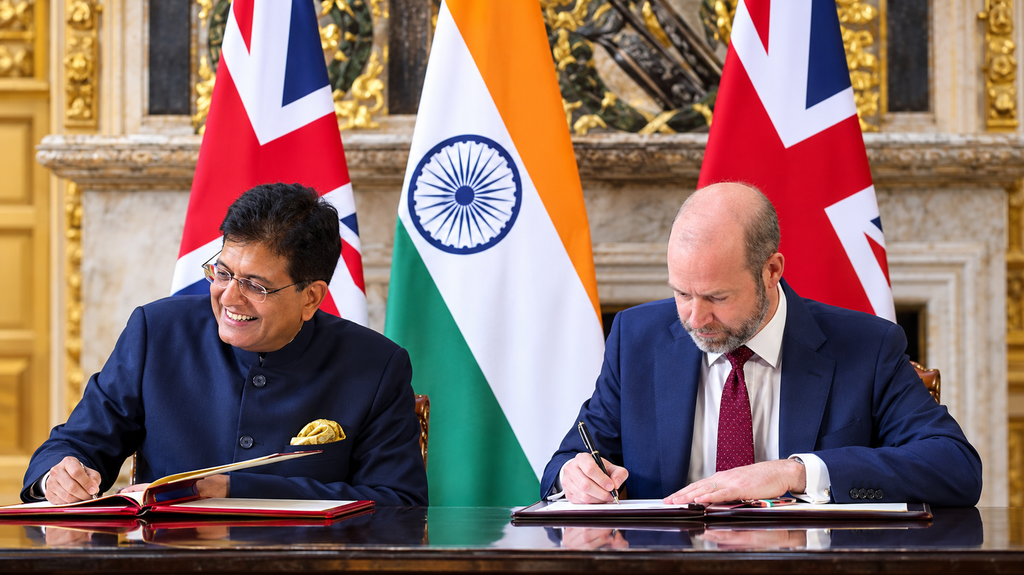
The agreement can help Indian jewellery gain greater recognition for its craftsmanship, design and reliability in the UK market. As global ambitions grow, the FTA could become a catalyst for sustained expansion, encouraging the industry to move beyond short-term exports and establish India as a trusted and influential global jewellery powerhouse.


-

 JB Insights1 hour ago
India–UK FTA: Opening A New Chapter For Indian Jewellery
-

 National News1 hour ago
Navigating Gold Loans During Repo Rate Hikes
-

 National News21 hours ago
GGJS 2026 Concludes With High-Volume Trade and Strategic Focus On Next-Gen Leadership
-
 National News2 hours ago
GJEPC Conducts Industry Knowledge Session In Meerut
