
JB Insights
SEBI red-flags unregulated digital gold market

SEBI’s November 8, 2025 circular on digital gold investment exposes a critical gap in India’s financial regulatory framework. Digital gold platforms—which have attracted millions of retail investors with their low entry barriers and convenience—operate in a regulatory no-man’s land. They are neither securities under SEBI’s jurisdiction nor commodity derivatives, creating what regulators call a “shadow gold market.”
This is particularly concerning because these platforms have democratized gold investment for young, first-time investors who may lack awareness of traditional investment risks, let alone unregulated product risks.
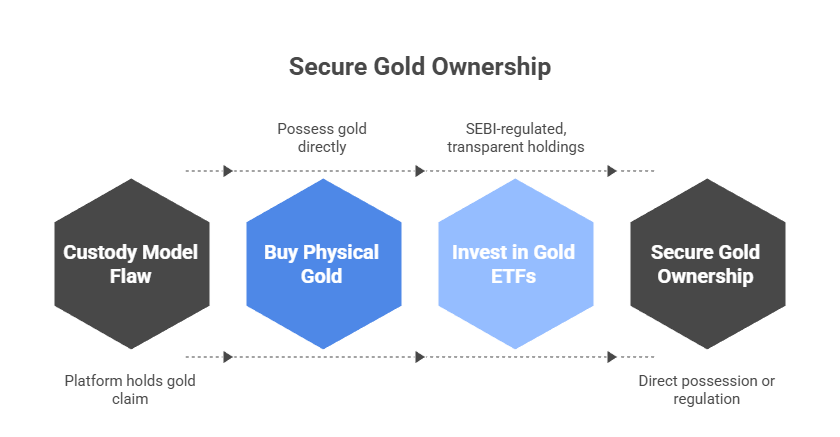
The fundamental flaw in digital gold products lies in the custody model. When you buy digital gold:
- You don’t own gold directly — you own a claim against the platform
- The platform promises to hold equivalent physical gold somewhere
- No regulatory authority verifies this claim in real-time
- If the platform collapses, you’re an unsecured creditor with no regulatory recourse
This differs sharply from buying physical gold (you possess it) or Gold ETFs (SEBI-regulated, transparent holdings).
SEBI’s timing suggests growing concerns about:
- Market penetration: Digital gold apps have scaled rapidly through fintech partnerships and micro-investment features
- Systemic risk: If multiple platforms face liquidity crunches simultaneously, millions of small investors could face losses
- Regulatory arbitrage: Companies exploiting the gap between RBI (payment systems) and SEBI (securities) oversight
Traditional SEBI-regulated products provide:
- Mandatory disclosures and periodic audits
- Net Asset Value (NAV) transparency
- Investor grievance mechanisms
- Capital adequacy norms for intermediaries
- Insurance or investor protection funds
Digital gold platforms face none of these requirements, creating asymmetric risk for retail investors.
SEBI’s Recommended Alternatives
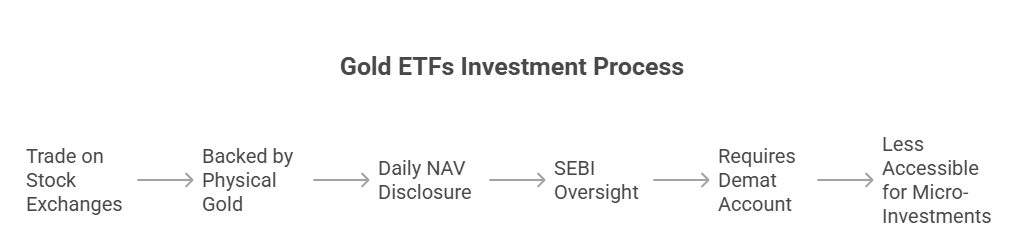
1. Gold ETFs (Exchange Traded Funds)
- Trade on stock exchanges like stocks
- Backed by physical gold held by custodians
- Daily NAV disclosure, SEBI oversight
- Limitation: Requires demat account, less accessible for micro-investments
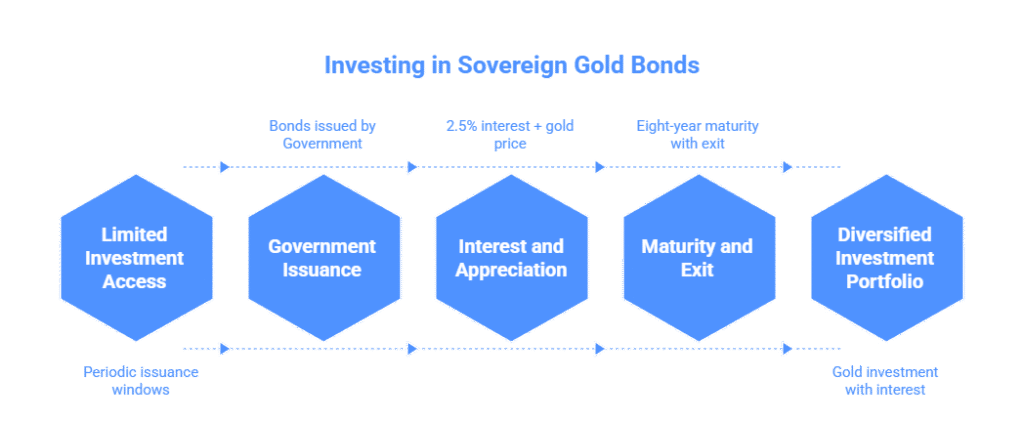
2. Sovereign Gold Bonds (SGBs)
- Issued by Government of India
- 2.5% annual interest + gold price appreciation
- Eight-year maturity with exit options
- Limitation: Periodic issuance windows, lock-in considerations
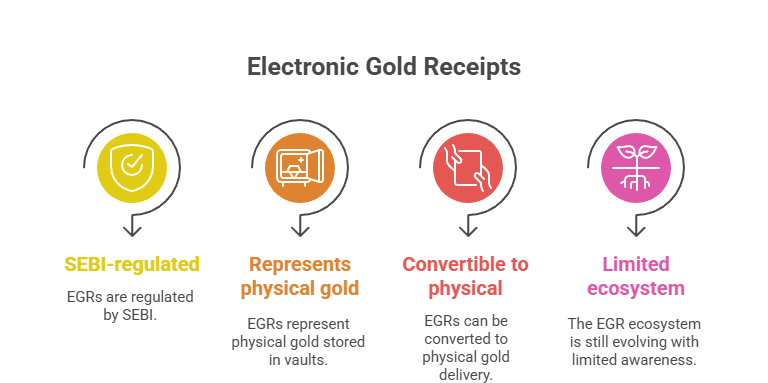
3. Electronic Gold Receipts (EGRs)
- Recently introduced, SEBI-regulated
- Represents physical gold in vaults
- Can be converted to physical delivery
- Limitation: Still evolving ecosystem, limited awareness
How Investors Are Encouraged to Buy Gold ETFs
SEBI’s clear preference for Gold ETFs as the primary alternative to digital gold reflects the regulator’s confidence in this mature, transparent investment vehicle. Here’s how investors are being encouraged to transition:
The Gold ETF Value Proposition
Regulatory Comfort: SEBI emphasizes that Gold ETFs operate under the same stringent framework as equity mutual funds—with Asset Management Companies (AMCs), custodians, and trustees all operating under regulatory oversight. Every unit of a Gold ETF represents physical gold (typically 99.5% purity or higher) stored in insured vaults.
Transparency That Digital Gold Lacks: Unlike digital gold platforms where you trust the company’s word, Gold ETFs publish daily NAV, disclose exact holdings, and undergo mandatory audits. You can verify on the NSE/BSE that your investment genuinely corresponds to physical gold.
Liquidity Without Platform Risk: Gold ETFs trade during market hours at prices reflecting real-time gold rates. You’re not dependent on a single platform’s “buyback” mechanism—you can sell on the exchange to any willing buyer. This eliminates counterparty risk entirely.
Addressing the Accessibility Gap
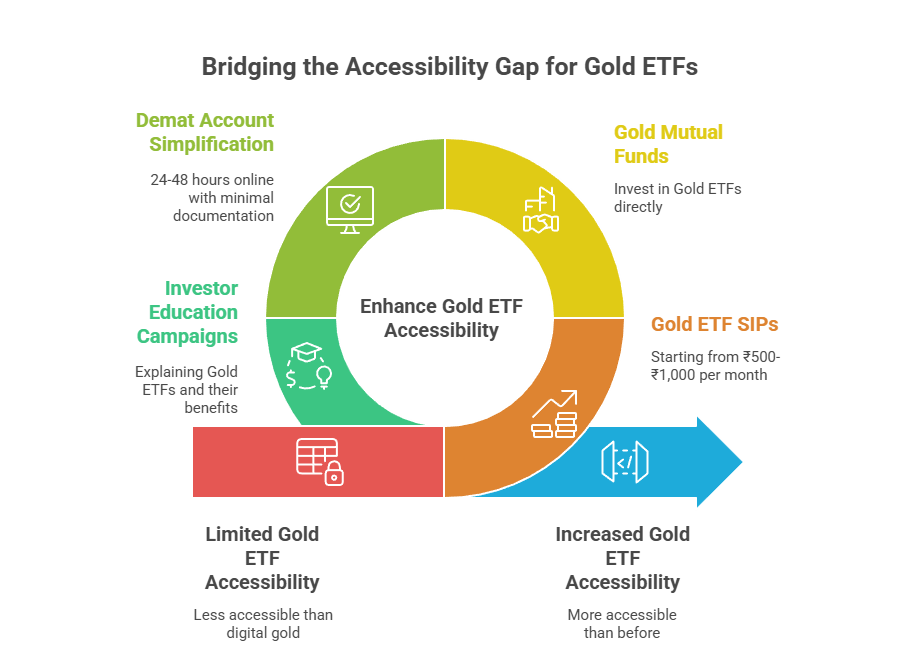
SEBI and market participants recognize that Gold ETFs have historically been less accessible than digital gold apps. Efforts to bridge this gap include:
1. Systematic Investment Plans (SIPs) in Gold ETFs: While not as seamless as digital gold’s micro-investment features, many AMCs now offer Gold ETF SIPs starting from ₹500-₹1,000 per month through mutual fund platforms.
2. Gold Mutual Funds (Fund-of-Funds): For investors without demat accounts, Gold Mutual Funds invest in Gold ETFs and can be purchased directly through AMC websites or distributor apps—combining ETF safety with mutual fund accessibility.
3. Demat Account Simplification: With digital account opening processes maturing, opening a demat account now takes 24-48 hours online with minimal documentation. Discount brokers offer zero annual maintenance charges, removing cost barriers.
4. Investor Education Campaigns: SEBI, along with stock exchanges and AMCs, has launched awareness campaigns explaining:
- How to open demat accounts
- How to place Gold ETF buy orders
- Cost comparison between digital gold and ETFs (showing ETFs often have lower expense ratios of 0.5-1% versus digital gold’s 2-3% spreads)
Addressing Behavioral Patterns
SEBI understands that digital gold succeeded because it tapped into micro-saving behaviors—auto-investing spare change, rounding up transactions, gamified savings. To compete, the regulator encourages:
Fintech-Broker Partnerships: Companies like Groww, Zerodha, and ET Money now offer simplified Gold ETF investing with:
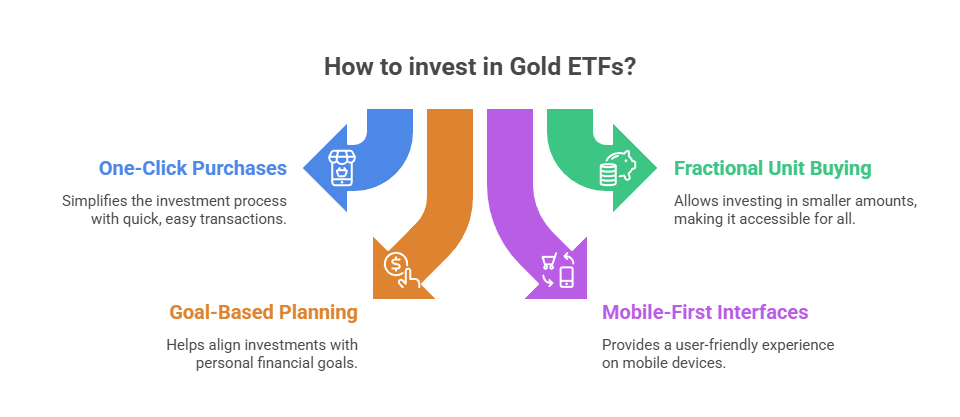
- One-click purchases
- Fractional unit buying (through mutual fund route)
- Goal-based planning tools
- Mobile-first interfaces matching digital gold apps
Employer-Sponsored Investments: Encouraging corporates to offer Gold ETF SIPs through payroll deductions, similar to PPF/NPS contributions.
Financial Literacy Integration: Making Gold ETF awareness part of SEBI’s broader investor education mandate, especially targeting young investors who form digital gold’s core demographic.
The Trust Message
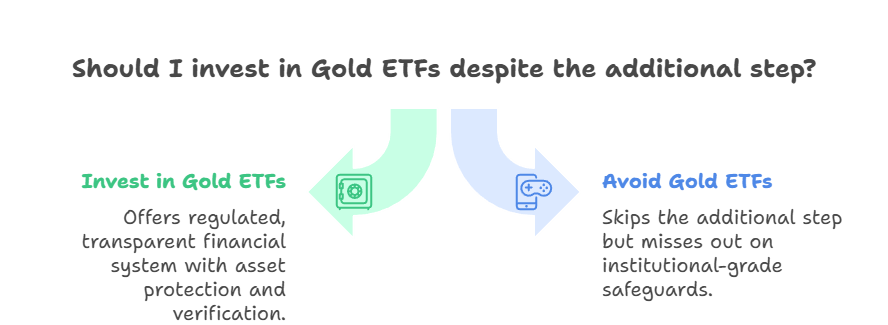
SEBI’s communication strategy essentially says: “Yes, Gold ETFs require one additional step (demat account), but that step connects you to the regulated, transparent financial system where your rights are protected and your assets are verifiable.”
The regulator positions this not as inconvenience but as investing maturity—moving from app-based gamified savings to serious wealth building with institutional-grade safeguards.
The Behavioral Shift Required
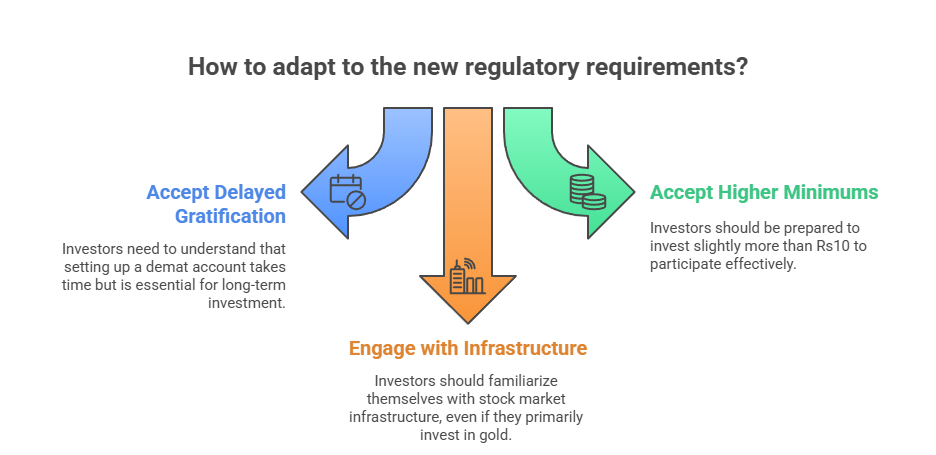
The regulator acknowledges the transition requires investors to:
- Move from instant gratification to slightly delayed gratification (demat setup)
- Accept minimum investment amounts slightly higher than Rs10
- Engage with stock market infrastructure (even if just as gold investors)
But SEBI’s message is clear: this small friction is the price of financial safety and regulatory protection—a trade-off mature investors should willingly make.
What Existing Digital Gold Investors Should Do

SEBI’s warning doesn’t mandate immediate exit but demands informed vigilance:
Immediate Due Diligence
- Verify vault partner credentials: Are they internationally certified (LBMA-approved) and India-registered?
- Check for third-party audits: Platforms like SafeGold and MMTC-PAMP publish Bureau Veritas audit reports
- Review terms of service: What happens in platform insolvency? Are you a secured creditor?
Risk Mitigation Strategies
- Diversify holdings: Don’t concentrate gold savings in one unregulated platform
- Consider gradual exit: If holding significant amounts, systematically shift to regulated alternatives
- Keep documentation: Maintain screenshots, receipts, and transaction records
Red Flags to Watch
- Platforms offering unusually high buyback premiums
- Lack of transparency about vault location or gold purity standards
- Absence of insurance coverage on stored gold
- Unclear fee structures or hidden charges
The Bottom Line
SEBI’s message is unambiguous: convenience doesn’t equal safety. While digital gold platforms offer accessibility and fractional ownership, they lack the regulatory architecture that protects investors in traditional financial products.
The push toward Gold ETFs represents SEBI’s vision of democratized yet protected gold investment—combining the transparency of regulated markets with increasingly accessible entry points. The regulator is betting that as investors become aware of the risks in unregulated platforms and the improving accessibility of ETFs, market forces will naturally drive capital toward safer alternatives.
For investors, the choice isn’t necessarily between digital gold and regulated alternatives, but rather understanding that with unregulated products, you are accepting risks that no authority will help mitigate. That’s not inherently wrong—it’s just a decision that should be made with eyes wide open.
The market will likely bifurcate: platforms that voluntarily adopt higher standards (third-party audits, insurance, transparent custody) may survive and thrive, while those operating opaquely face increasing investor skepticism and eventual regulatory pressure. Meanwhile, Gold ETFs are positioned to capture the quality-conscious segment of gold investors who value regulatory oversight over marginal convenience.
Key Takeaway: In India’s gold investment landscape, regulatory oversight isn’t just bureaucratic red tape—it’s the difference between an investment and a gamble on platform solvency. SEBI is making the case that Gold ETFs offer the best of both worlds—the convenience of modern financial infrastructure with the safety of regulatory supervision.


JB Insights
India–UK FTA: Opening A New Chapter For Indian Jewellery
By Darshan Chauhan, Wholetime Director- Sky Gold and Diamonds Ltd..


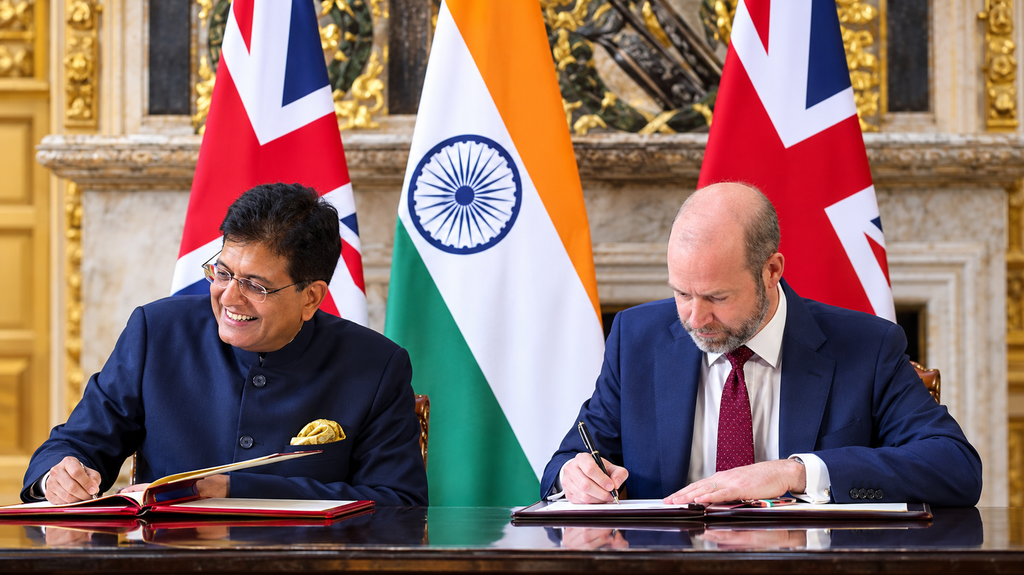
Trade agreements are often discussed in terms of tariffs, trade volumes and market access. But their real significance lies in what they enable businesses to do next. The India–UK Comprehensive Economic and Trade Agreement (CETA), which came into force on 15 July 2026, has the potential to create a stronger platform for Indian businesses to compete, collaborate and grow in one of the world’s most important markets.
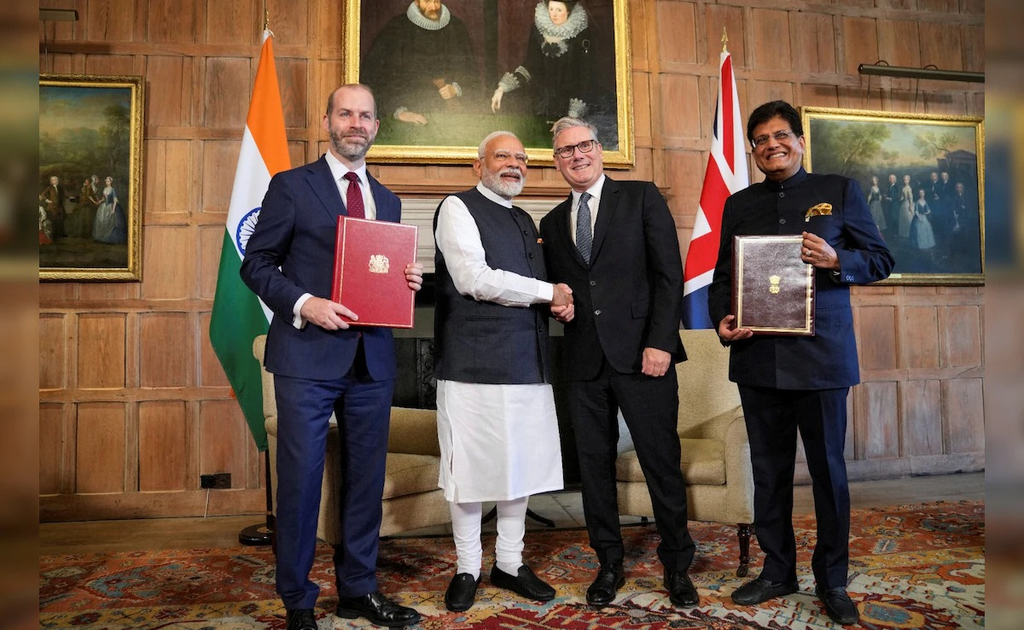
The agreement provides duty-free access to almost 99% of India’s exports to the UK, covering nearly the entire value of India’s trade with the country. For sectors such as gems and jewellery, this is particularly significant. India’s gems and jewellery exports to the UK currently stand at around US$1.03 billion, while the UK imports approximately US$4 billion worth of jewellery annually. This gap represents a substantial opportunity for Indian manufacturers and exporters to expand their presence and build stronger relationships in the market.
A meaningful opportunity for Indian jewellery

India has long been recognised globally for its jewellery craftsmanship. However, the country’s competitive strength today extends well beyond traditional artistry. Over the years, India has developed a sophisticated manufacturing ecosystem that combines skilled craftsmanship with CAD, CNC technology, advanced production processes, organised quality systems, design capabilities and professional merchandising.
The FTA can give this ecosystem greater global reach
Lower trade barriers can improve the competitiveness of Indian jewellery in the UK and create new opportunities across the value chain, from manufacturers and exporters to designers and artisans. Government estimates indicate that tariff relaxations could potentially double India’s gems and jewellery exports to the UK over the next two to three years.
However, market access alone will not determine who succeeds.
From supplier to strategic partner
The global jewellery business is moving beyond traditional supplier relationships towards strategic partnerships built around consumer insight, design, innovation and speed-to-market. India’s manufacturing strength offers a significant opportunity to move up the value chain—from production to design, product development, merchandising and market intelligence. Quality, flexibility, faster development, consistent replenishment and knowledge of international markets can position Indian manufacturers as indispensable growth partners.
The FTA provides market access; the next opportunity is for Indian jewellery companies to deliver greater value.
Trust remains the foundation
Jewellery is built on trust, with quality, purity, craftsmanship and reliability forming the foundation of every transaction. As Indian companies expand into international markets, sustaining these standards will be essential. Global growth must go beyond tariff benefits, supported by transparent processes, dependable supply chains and consistent quality. The UK opportunity lies not merely in increasing sales, but in building lasting relationships with customers and retail partners. Ultimately, trust and reliability will be key to establishing Indian jewellery as a respected global offering.
Positive sentiment after IIJS Bharat Premiere 2026
The timing of the FTA has also been encouraging from an industry perspective. The sentiment following IIJS Premiere reflected growing confidence across the jewellery trade, with conversations increasingly focused on international opportunities, new collections, product innovation and long-term business relationships.
For many businesses, international markets are no longer being viewed simply as additional export destinations. They are becoming an integral part of long-term growth strategies.
That optimism matters. A trade agreement can create favourable economic conditions, but it is the willingness of businesses to invest, innovate and pursue new opportunities that ultimately converts policy into growth.
The first day of the agreement itself provided an encouraging signal, with more than 50 export consignments worth over US$140 million reportedly flagged off under the preferential tariff regime, including gems and jewellery shipments.
Looking beyond tariffs
The India–UK FTA represents more than a tariff reduction; it offers Indian jewellery an opportunity to strengthen its position in global supply chains and expand its international footprint. With skilled craftsmanship, manufacturing expertise, design capabilities and an increasingly organized ecosystem, India is well placed to leverage this opportunity. Manufacturers must focus on innovation, technology, talent and quality, while exporters need to understand evolving consumer preferences, strengthen distribution and build long-term partnerships.
Catalyst for sustained expansion,
The agreement can help Indian jewellery gain greater recognition for its craftsmanship, design and reliability in the UK market. As global ambitions grow, the FTA could become a catalyst for sustained expansion, encouraging the industry to move beyond short-term exports and establish India as a trusted and influential global jewellery powerhouse.



Focus Should Remain On Price Stability, Consumer Confidence and Healthy Jewellery Demand: GJC Comment On RBI Rate Hike Impact On Gold Prices

Natural Diamond Brand ZOORI Unveils Ambitious National Expansion Plan, Targets 25 Stores In A Year!

India–UK FTA: Opening A New Chapter For Indian Jewellery
Natural Diamond Brand ZOORI Unveils Ambitious National Expansion Plan, Targets 25 Stores In A Year!
Focus Should Remain On Price Stability, Consumer Confidence and Healthy Jewellery Demand: GJC Comment On RBI Rate Hike Impact On Gold Prices
India–UK FTA: Opening A New Chapter For Indian Jewellery
-
 National News39 minutes ago
Natural Diamond Brand ZOORI Unveils Ambitious National Expansion Plan, Targets 25 Stores In A Year!
-
 National News22 minutes ago
Focus Should Remain On Price Stability, Consumer Confidence and Healthy Jewellery Demand: GJC Comment On RBI Rate Hike Impact On Gold Prices
-
 JB Insights2 hours ago
India–UK FTA: Opening A New Chapter For Indian Jewellery
-

 National News3 hours ago
GJEPC Conducts Industry Knowledge Session In Meerut
