
International News
WGC Gold Demand Trends: Gold sets new records in Q3 2025

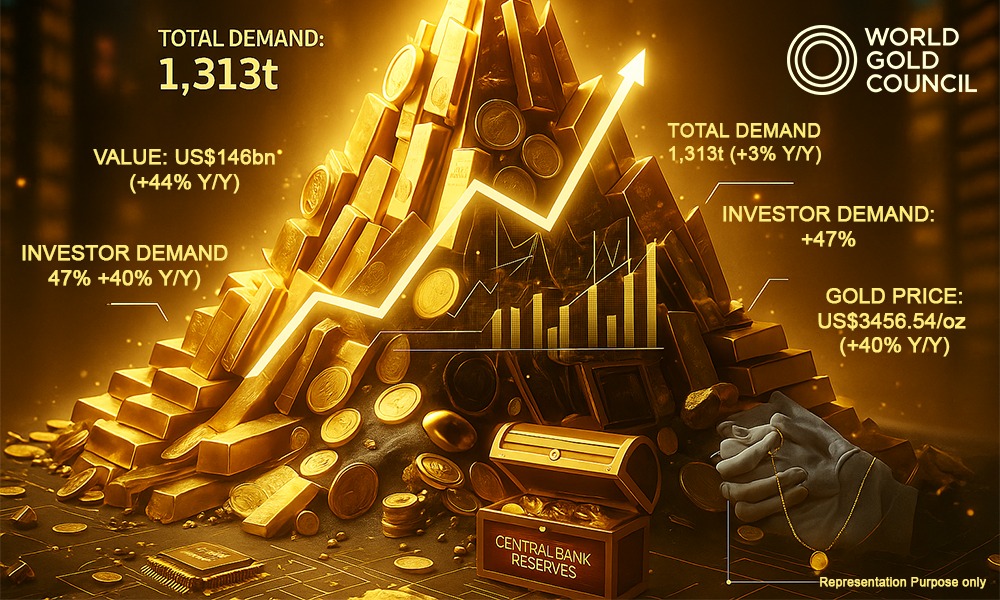
Total gold demand, including OTC, grew 3% y/y to 1,313t, the highest quarterly total in our data series. Yet this was eclipsed by the value measure of demand, which jumped 44% y/y to a record of US$146bn in Q3.
Year-to-date demand is 1% higher at 3,717t, equating to US$384bn in value, up 41% y/y.
Investors remained firmly in the driving seat in Q3. Huge ETF buying (+222t), accompanied by a fourth successive quarter of bar and coin demand above 300t (316t) fuelled the rise in overall demand.
Central bank buying remained elevated at 220t, 28% up on the prior quarter, albeit that y-t-d buying of 634t has been at a slower pace than the 724t bought in the first three quarters of last year.
Jewellery consumption in Q3 posted a double-digit y/y decline (the sixth in succession) to 371t, as volumes remained under pressure in the record price environment. This contrasts with a 13% y/y increase in value to US$41bn.
Technology demand was fractionally weaker compared with Q3’24. Support from growing AI demand met with headwinds from US tariff policy and the surging gold price.
Highlights
- The LBMA (PM) gold price hit 13 new all-time highs in the quarter.
The price rose 16% during Q3 and generated an average quarterly price of US$3456.54/oz, up 40% y/y and 5% q/q. - Total gold supply rose 3% y/y to a quarterly record of 1,313t.
Mine production, which typically sees seasonal growth in Q3, was up 2% y/y to 977t. - The supply of recycled gold remained elevated but stable at 344t: up 6% y/y, down 1% q/q.
Recycling activity was restrained to some degree by expectations of further price gains and generally supportive economic conditions. - OTC investment added 55t to Q3 demand.
This measure captures continued widespread global interest from institutions and high net worth individuals, particularly in September. - old investment demand continued to fuel solid growth in the third quarter of 2025, reflected in robust quarterly figures across multiple market sectors. According to data compiled by ICE Benchmark Administration, Metals Focus, and the World Gold Council, total gold demand reached 1,313.1 tonnes in Q3 2025, a 7% increase quarter-on-quarter and 3% higher year-on-year.
- Supply levels were lifted primarily by mine production, which rose to 976.6 tonnes in Q3 2025 from 904.3 tonnes in the previous quarter, reflecting both an 8% quarterly and 2% annual growth. The additional supply from recycled gold, however, remained steady at 344.4 tonnes, marking a slight 1% quarterly drop but a 6% increase compared to the previous year.
- Demand patterns revealed a notable shift: jewellery consumption rebounded to 371.3 tonnes in Q3, up 9% from Q2 but still 19% lower year-on-year, indicating the sector’s cautious recovery. Jewellery fabrication also posted strong quarterly growth of 18% but saw a 23% decline from last year. Technology-related demand, including electronics and other industrial applications, hovered close to 82 tonnes, with only modest changes across subsectors.
- Investment demand, however, remained the strongest growth driver, surging 13% quarter-on-quarter and an impressive 47% year-on-year to reach 537.2 tonnes. Exchange-traded funds (ETFs) saw a 30% rise compared to Q2 and more than doubled year-on-year. Central banks also ramped up gold purchases, acquiring 219.9 tonnes in Q3 2025, 28% more than the previous quarter and 10% ahead of last year’s levels.
- The average LBMA gold price continued its upward momentum, reaching $3,456.5 per ounce in Q3 2025, a 5% quarter-on-quarter increase and a striking 40% year-on-year surge, highlighting gold’s persistent appeal as a store of value in a volatile macroeconomic climate.
- For further details and sector definitions, readers can refer to the World Gold Council’s resources and explanatory notes.


International News
US Holiday Shopping Expected To Top $1 Trillion For The First Time: NRF
While Overall Buying Power Remains High, Ongoing Inflation and Rising Household Costs Mean Some Families Will Have To Watch Their Spending More Carefully Than Others

The National Retail Federation (NRF) predicts Americans will spend $1.01 trillion on holiday shopping in November and December. That is a 4.2% jump from $972 billion last year.
NRF said its forecast was based on economic modeling that incorporates consumer spending, employment, wages and historical retail sales data. It excludes automobile, gasoline and restaurant sales
Extra Hiring: To handle the surge in shoppers, stores plan to hire 325,000 to 375,000 temporary holiday workers.
Mixed Budget Impact: Higher gas prices and inflation could still strain some family budgets, affecting low- and high-income shoppers differently.
Retailers expect a strong shopping season because people continue to make holiday spending a priority.
Store owners are ready to attract shoppers by offering competitive prices, deals, and choices for every budget.
While overall buying power remains high, ongoing inflation and rising household costs mean some families will have to watch their spending more carefully than others.


-

 International News12 hours ago
US Holiday Shopping Expected To Top $1 Trillion For The First Time: NRF
-

 National News6 hours ago
Belgian Consul General H. E. Mr. Pierre Stverlynck Graces BDB Annual Day
-

 New Premises8 hours ago
Joyalukkas Opens Its 2nd Bengaluru Showroom in Jayanagar
-

 National News7 hours ago
Limelight Lab Grown Diamonds Crosses 100 Stores Milestone This Dussehra: Targets 200 In 2027
