
National News
US hits India with 25% tariffs; GJ sector to be adversely affected


US President Donald Trump has imposed a 25% tariff on a wide range of goods from India, effective August 1, 2025, triggering alarm across the export sector and raising the spectre of a broader economic fallout. The sweeping measure, aimed at correcting what Trump described as “obnoxious” non-tariff barriers, is being seen as both a protectionist move and a pointed diplomatic signal.
Trump accused India of imposing higher tariffs on US imports and also having the “most strenuous” trade barriers.
The Indian gem and jewellery sector, in particular, stands to be severely impacted. The United States is India’s single largest market, accounting for over $10 billion in exports—nearly 30% of GJ industry’s total global trade.
The increase in tariff from Aug 1 would be 19 percentage points in the case of gold and silver jewellery (plain or studded).
These tariffs could have far-reaching repercussions across India’s economy, disrupting critical supply chains, stalling exports, and threatening thousands of livelihoods.








National News
IFSCA Notifies India Good Delivery Gold Framework
GJEPC Seeks Swift Rollout and Global Recognition. The Framework Is Expected To Strengthen Responsible Sourcing, Build Confidence In Indian-Refined Gold and Create Opportunities For Bullion Exports.

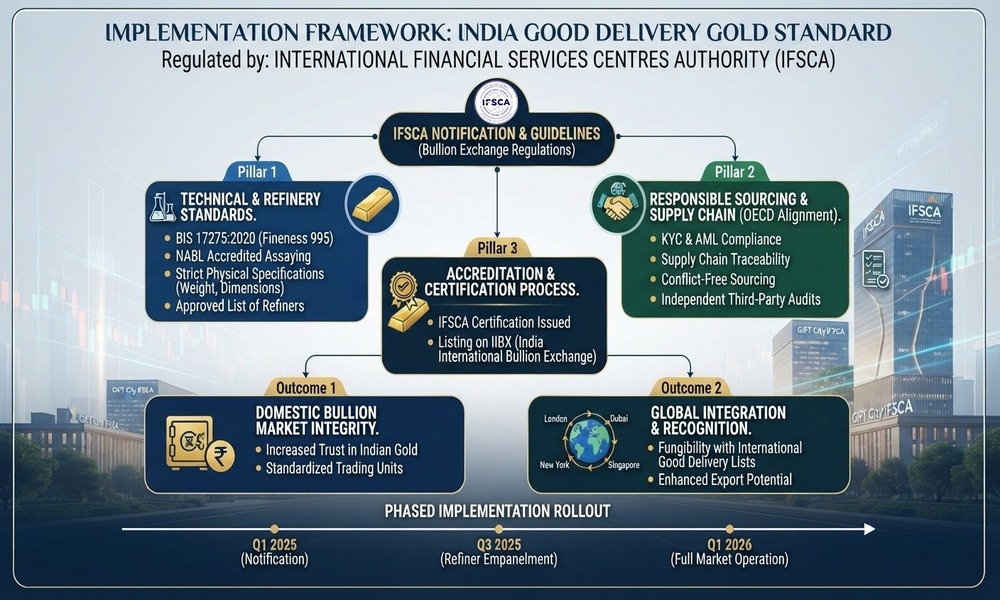
GJEPC has urged the Government to expedite international recognition and the implementation of the India Good Delivery Gold framework, following the notification of the International Financial Services Centres Authority (IFSCA) (Good Delivery) Guidelines, 2026. The framework is expected to strengthen responsible sourcing, build confidence in Indian-refined gold and create opportunities for bullion exports.
The guidelines establish a framework for quality assurance, responsible sourcing and traceability in gold refining. IFSCA, India’s unified regulator for financial products, services and institutions operating in International Financial Services Centres, will implement the framework through the Bullion Exchange in the IFSC. Gold from accredited refiners that meets the prescribed requirements can qualify for delivery on IFSC exchanges and for over-the-counter trading.
The framework extends beyond the purity and quality of gold bars to address their provenance. Refiners must trace raw gold to its source, assess supply-chain risks, verify suppliers and beneficial owners, and meet applicable responsible-sourcing requirements. Independent third-party audits will provide additional assurance.
The initiative follows the recommendations by NITI Aayog, a policy think tank, which had called for an India Good Delivery Standard and responsible-sourcing guidelines for refineries. The report highlighted the potential of domestic refining to retain more value within India, generate employment and support exports.


-

 TechBuzz17 hours ago
K. Srinivasan Unveils Doit Coimbatore Experience Centre
-

 GlamBuzz17 hours ago
Kalyan Jewellers’ Navratri Celebrations Bring Stars From All Industries To Thrissur
-
 National News17 hours ago
IFSCA Notifies India Good Delivery Gold Framework
-

 National News18 hours ago
World Gold Council Unveils Immersive Gold Experience At Phoenix Palladium, Lower Parel, Mumbai
