
DiamondBuzz
US diamond importers can self-certify mining Source: JVC


Importers will not need to submit proof of a diamond’s country of mining when registering shipments to the US but should keep the right documentation for inspection, according to guidance the Jewelers Vigilance Committee (JVC) released last week.
In January, US Customs and Border Protection (CBP) announced a requirement to state the “country of mining” for all imports of diamonds and diamond jewelry entering the country. Earlier this month, the government agency told industry members these declarations “should be verifiable with the documentation provided with the entry.”
However, these papers will not be mandatory when filing shipments in the Automated Customs Environment (ACE) processing system, the JVC explained in a member alert last Thursday.
“We’ve been told that the additional documentation (proof of origin) isn’t going to be required by the ACE system,” Sara Yood, the JVC’s CEO and general counsel, clarified in a separate email to Rapaport News on Tuesday. “An importer can choose to upload it with an entry, or they can leave it out but will need to provide it when shipments are spot-checked at customs.”
CBP continues to require self-certification statements for applicable diamond imports to verify they do not contain Russian inputs, the legal guidance group said in the member alert. The new rules, which will go into effect in April, apply to loose diamonds and finished jewelry, but not to lab-grown diamonds, the JVC explained. CBP has “acknowledged” certain provisions for “grandfathered” goods — diamonds that predate sanctions on Russia — but has not confirmed how entry will work, the committee pointed out.








DiamondBuzz
Richemont and Signet Jewelers Could Join Global Diamond Consortium In Bid For De Beers
Richemont, Signet Would Connect The Consortium To Key Global Growth Vectors Spanning Luxury High Jewelry and Mass-Market Retail.


The Global Diamond Consortium (GDC)
Richemont and Signet Jewelers are reported to be in talks about joining the Global Diamond Consortium (GDC), the preferred bidder for De Beers according to a Bloomberg News report.
GDC was selected in July 2026 as one of Anglo American’s preferred bidders for De Beers as part of Anglo American’s ongoing corporate restructuring.
The potential inclusion of Richemont—owner of luxury Maisons including Cartier and Van Cleef & Arpels—and Signet Jewelers—the world’s largest retailer of diamond jewelry, operating brands such as Kay Jewelers, Zales, and Jared—would connect the consortium to key global growth vectors spanning luxury high jewelry and mass-market retail.
Strengthening the Natural Diamond Ecosystem: Participation by major luxury brands and global retail leaders reinforces commitment across the entire value chain—from responsible mining and manufacturing to consumer engagement.
Balanced Governance Structure: Discussions center on potential minority equity positions that would support long-term category growth while maintaining appropriate separation between ownership and commercial strategy.
Broad Stakeholder Participation: The consortium continues to advance talks with host governments, including discussions with the Government of Botswana regarding a potential increase in its equity share in De Beers from 15% to approximately 25%, alongside participation from private investors and southern African host nations.
Discussions between GDC, Richemont, Signet, and participating government stakeholders remain ongoing. Terms of any potential participation, including the size of equity interests, have not been finalized and remain subject to regulatory approvals and definitive documentation.



Belgian Consul General H. E. Mr. Pierre Stverlynck Graces BDB Annual Day

Limelight Lab Grown Diamonds Crosses 100 Stores Milestone This Dussehra: Targets 200 In 2027

Joyalukkas Opens Its 2nd Bengaluru Showroom in Jayanagar

US Holiday Shopping Expected To Top $1 Trillion For The First Time: NRF
Belgian Consul General H. E. Mr. Pierre Stverlynck Graces BDB Annual Day
Limelight Lab Grown Diamonds Crosses 100 Stores Milestone This Dussehra: Targets 200 In 2027
-
 International News14 hours ago
US Holiday Shopping Expected To Top $1 Trillion For The First Time: NRF
-
 National News8 hours ago
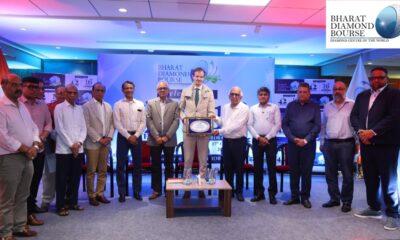
Belgian Consul General H. E. Mr. Pierre Stverlynck Graces BDB Annual Day
-
 National News9 hours ago
Limelight Lab Grown Diamonds Crosses 100 Stores Milestone This Dussehra: Targets 200 In 2027
-
 New Premises10 hours ago
Joyalukkas Opens Its 2nd Bengaluru Showroom in Jayanagar
