By Invitation
Solitaires – An indulgence or an asset?
Since the iconic Marylin Monroe sang Diamond’s are a Girl’s Best Friend in 1953 film Gentlemen Prefer Blondes, popular culture has seen diamonds as an ultimate adornment for women the world over.


But diamonds were always coveted by the rich and powerful, especially the royalty in India – for a long time the only source of diamonds – as well as in Europe and Americas. But it took a giant corporation and a monopoly, which had recently found huge deposits in Africa, to popularize it with the masses. And by design or otherwise, Hollywood and popular culture played a great role in helping establish diamonds as prima donna of gemstones and most coveted of them all.
Diamonds are rare and expensive, and their allure is as much in their brilliance and beauty as it is in their exclusivity. But it is complex and non-trivial to grade and value and often customers find themselves at a loss to comprehend what they are buying and at what price. And worse they have no clue if at all it will retain its value over time and will they ever be able to bank on them as their life’s assets. The way diamond jewellery, especially solitaire jewellery is sold and marketed, especially in India has also not helped the cause. With perpetual discounts and opaque pricing and exchange / buyback policies, jewellery brands and large stores have adversely impacted consumer confidence and turned diamonds into commodity, belying the great amount of skill and craftsmanship that goes into each solitaire diamond. It has led to erosion of long-term value of purchased jewellery in the hands of the consumer and consequently sowed confusion, doubts and sometimes cynicism in them about quality and value of solitaire diamond jewellery.

In this melee. one brand has stood out and swam against the tide. Divine Solitaires has understood the unfulfilled need of Indian buyers and created a brand that is known for its integrity – one that never compromises on quality and transparency. For more than 15 years Divine Solitaires has built this reputation by delivering to its customers what it promised and with 98% customer satisfaction and repeat purchase rate, it has proved that honesty and transparency pays in the long run.
Jignesh Mehta and his brother Shailen Mehta knew that vast majority of Indian consumers are aspirational and seek to grow their wealth and consider jewellery as not just an indulgent luxury but an asset of life’s savings. So, they created a brand that would bring the same amount of confidence in diamonds that is in gold. With Divine Solitaires it did this in three ways – First, they curated and standardized on 123 quality parameters that impact the beauty and value of a diamond and mandated that only those finely crafted diamonds that score 10/10 on these parameters qualify to be branded as Divine, thus assuring that customers always get the best quality.
Secondly, they backed each product with this unprecedented 123-parameters Quality Guarantee Certificate, in a market where no one offers any sort of guarantee on diamonds or diamond jewellery. And finally, third and most important step, they created a One India – One Price system for their high quality diamonds with their Nationwide Standard and Transparent Prices, which is updated every month, month after month for the last 15 years. There is even a Solitaire Price Index that shows the trends for customer awareness.
This is why Divine Solitaires is becoming the preferred choice for Indians to elevate their life’s milestone moments. Be it getting engaged or married or celebrating years of togetherness on anniversaries, only the best is worthy for the moment. Available at 200+ partner jewellers in more than 100 cities, buyers in Jammu or in Ernakulam, in Guwahati or in Ahmedabad – across India, have expressed confidence and trust in the brand and have come back for more. Consumers get to choose from the largest collection designs specially crafted to elevate the beauty and brilliance of the solitaire and get the confidence of a national brand which they can buy from or get service from almost anywhere in India.
It also helps that though the brand never discounts its products, once a year it rewards its customers with generous gifts and lucky draws in Solitaire Festival of India, which recently concluded in August. Customers look forward to it and it generates a lot of excitement with weekly prizes of lucky draw winners and assured gifts on every purchase. It also brings in a lot of new customers to the stores and helps independent, mostly family owned, partner jewellers to offer superior quality and brand experience to brand conscious solitaire customers and capture a larger market share in their area.
Natural diamonds are rare and God gifted and its allure shall remain forever, notwithstanding many simulants and alternates that vie its position in the minds of the consumer. Vast majority of Indian consumers consider solitaires as the ultimate gift and place great emphasis on asset accumulation; therefore, solitaire diamond jewellery from Divine Solitaires is perfect for their aspirations.









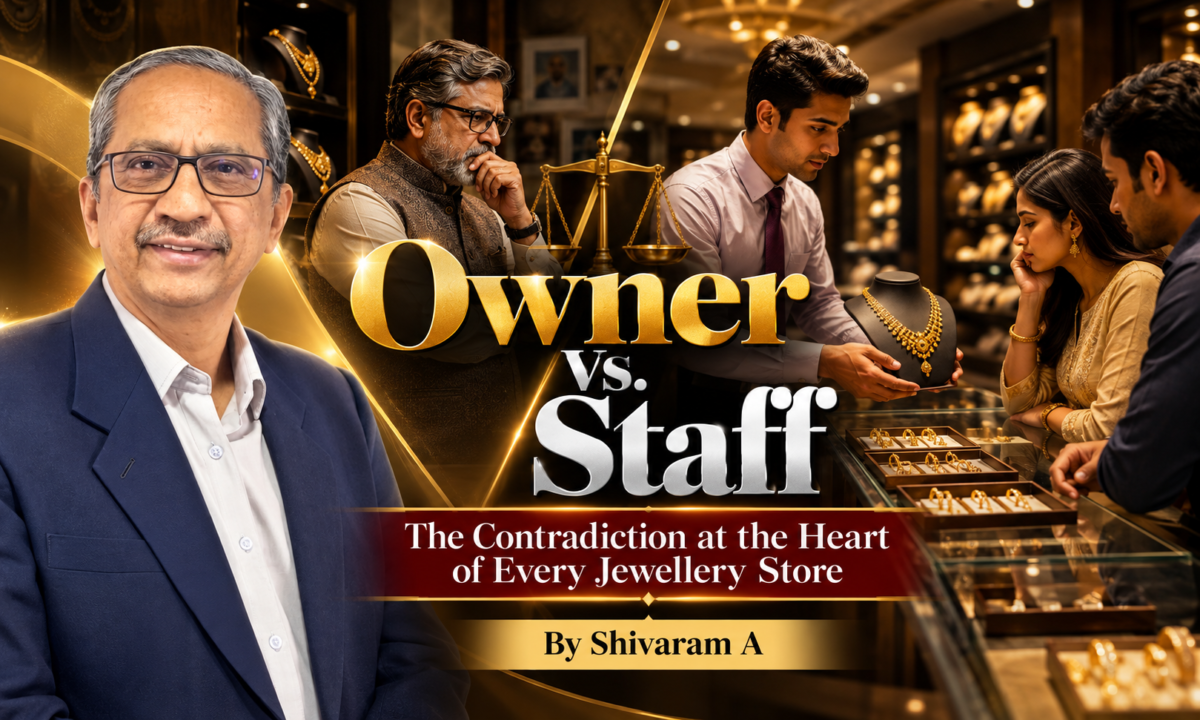
By Shivaram A
The Core Issue
The owner carries the entire risk of the business — investment, gold stock, working capital, loans, everything is in their name. The long-term asset also belongs to the owner — reputation, brand, the customer base built over years, often meant to pass to the next generation. But the moment that matters most — when the customer is standing at the counter, when trust is being built or broken — that moment is entirely controlled by the staff.
The person with the most risk is not present at the decisive moment. And the person with the least to lose holds the most power in that moment. This structural mismatch creates frustration on both sides — and it’s rarely discussed openly.
Making the Conflict Explicit
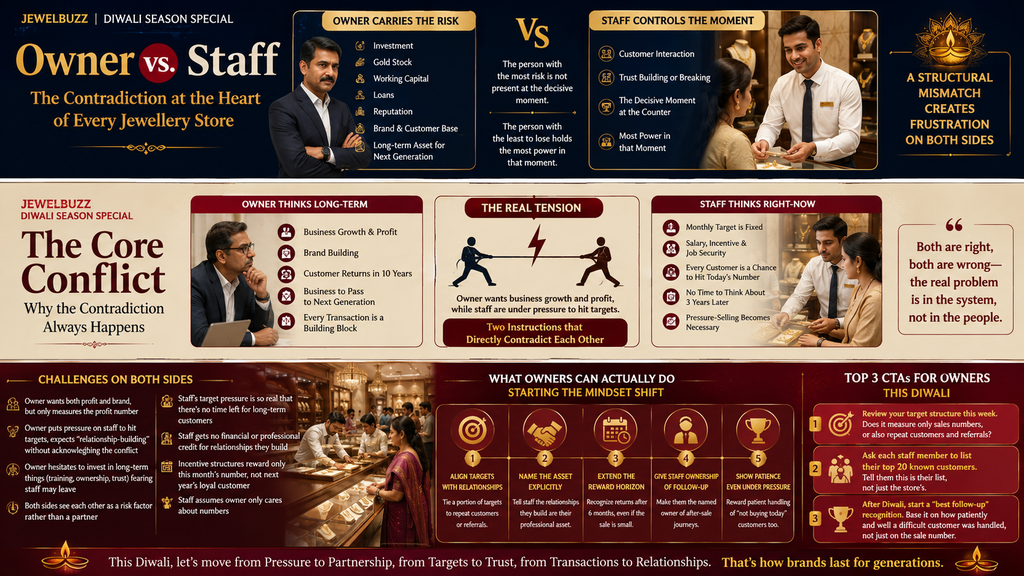
The real tension is this: the owner wants business growth and profit, while staff are under pressure to hit targets.
The owner thinks long-term — how does the brand grow, how does a customer come back after ten years, how does the business pass to the next generation. For the owner, every transaction is a building block toward something bigger.
The staff’s reality is completely different. Their monthly target is fixed. Their salary, incentive, and sometimes even job security depend on how much they sold this month, this Diwali. For staff, every customer is a chance to hit today’s number — right now, this moment. They cannot afford to think about whether this customer comes back in three years, because their performance is reviewed at month-end, not three years later.

So when the owner says “build the relationship, be patient,” and in the same breath increases the target by 20%, these two instructions directly contradict each other. Staff are not confused about what they should ideally do — they understand it perfectly. But they don’t have the choice. The target has to be met, so pressure-selling becomes necessary — even if it means pushing a customer slightly, or using lines like “buy today, rate will go up tomorrow” that create small cracks in trust.
These cracks don’t show up immediately. But after Diwali, when that customer doesn’t return a second time, the owner assumes it’s the staff’s fault. The staff believes the owner set an unrealistic target. Both are right, and both are wrong — because the real problem is in the system, not in the people.
The Challenges on Both Sides
- Owner wants both profit and brand, but only measures the profit number
- Owner puts pressure on staff to hit targets, then also expects “relationship-building” — without acknowledging the two often can’t coexist
- Owner hesitates to invest in long-term things (training, ownership, trust) due to fear that staff will leave anyway
- Staff’s target pressure is so real that there’s no time left to think about the long-term customer
- Staff gets no financial or professional credit for the relationships they build
- Incentive structures reward only this month’s number, not next year’s loyal customer
- Both sides see each other as a risk factor rather than a partner — the owner assumes staff will eventually leave, staff assumes the owner only cares about numbers
What Owners Can Actually Do — Starting the Mindset Shift
- Stop treating targets and relationships as separate — align them. Don’t set targets purely on sales numbers. Tie a small portion of the target to repeat customers or referrals, so staff know that long-term customers count too.
- Name the asset explicitly. Tell staff directly: the relationship you’re building with a customer is your professional asset, not just the store’s. This has to be shown in practice, not just said out loud.
- Extend the reward horizon. Don’t reward only Diwali-week sales — when a customer returns six months later and asks for that staff member by name, recognize that, even if the sale itself is small.
- Give staff ownership of the follow-up. Make each staff member the named owner of their customers’ after-sale journey — repairs, exchanges, the next occasion. This helps them feel the relationship is theirs, not just a transaction.
- Show patience even under pressure. If Diwali week only rewards closed sales, staff will only chase closing. If a staff member who handles a “not buying today” customer well is also appreciated, that’s when the mindset actually starts to shift — because staff notices what the owner actually rewards, not just what they say.
Top 3 CTAs for owners this Diwali
- Review your target structure this week. Does it only measure sales numbers, or does it also give weight to repeat customers and referrals? If not, try a small adjustment starting this Diwali.
- Ask each staff member to list their top 20 known customers. Tell them this is their list, not just the store’s. This builds a sense of ownership.
- After Diwali, start a “best follow-up” recognition. Base it not on the sale number, but on how patiently and well a difficult customer was handled. Staff need to see that patience is rewarded too, not just closing.
Shivaram A
Retail Gurukul



Aisshpra Gems & Jewels Opens Four Stores in One Day, Takes Network to 20; Targets 30 Stores by March 2028

The Met Goes Desi: Inside Sabyasachi’s Showstopping Diwali Dhamaka in New York

Jewellers Expect Healthy Festive and Wedding Demand Amid Evolving Consumer Preferences

Dhanteras Shopping Guide 2026:Gold, Silver, Diamonds & Festive Jewellery Trends To Watch

Indriya, Aditya Birla Jewellery Unveiled India’s Largest Sustainable Jewellery Rangavalli

From Diya Puja To Diwali Soirées: Jewellery Designed To Go Beyond The Festive Season
-
 JB Insights1 day ago
Dhanteras Shopping Guide 2026:Gold, Silver, Diamonds & Festive Jewellery Trends To Watch
-
 National News1 day ago
Indriya, Aditya Birla Jewellery Unveiled India’s Largest Sustainable Jewellery Rangavalli
-
 BrandBuzz1 day ago
From Diya Puja To Diwali Soirées: Jewellery Designed To Go Beyond The Festive Season
-

 BrandBuzz1 day ago
The Solenne Collection: A Celebration Of Diwali By Bharti Bangur Fine Jewels