By Invitation
SAPPHIRE – THE OBSESSION OF THE ROYALS
Sapphire since ancient ages has been a gemstone which has wooed many kings and royals and the aristocrats seeing its rarity and its intrinsic valuve in the person’s life who owns it.

sapphire may be a mineral having different colors however to some it has reference to occult and magical properties of well being and angel luck. To emach on its own. To realize the potential of any gemstones magical properties one must connect to its roots of origination.

The word sapphire has different connotations in different places, field and time. Sapphire in Indian market refers particularly to yellow sapphire and its reference to the planet Jupiter. Sapphire in the international market has its reference to blue sapphire and the beauty it holds. Sometimes it also reminds the national of the country Sri Lanka where many sapphires are found with its blue saturation.
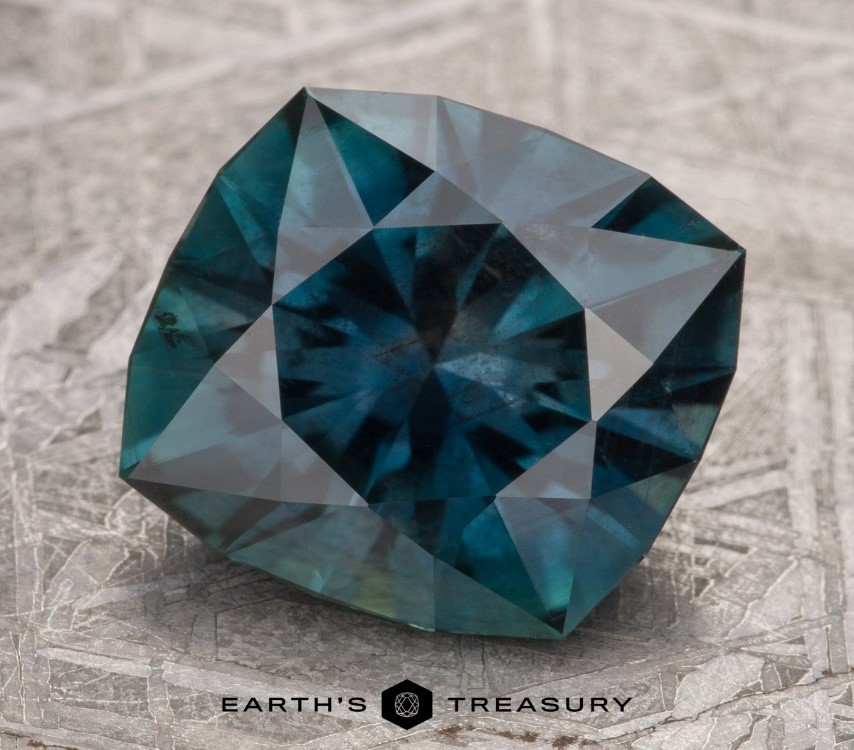
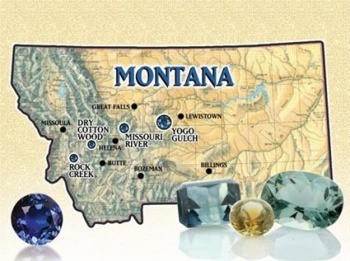
Sapphires are found in many colors and is demanded in different places based on its hue tone and saturation. Sapphires in United states mainly refer to the Montana sapphires which has a peculiar greenish overtone on the blue ones.
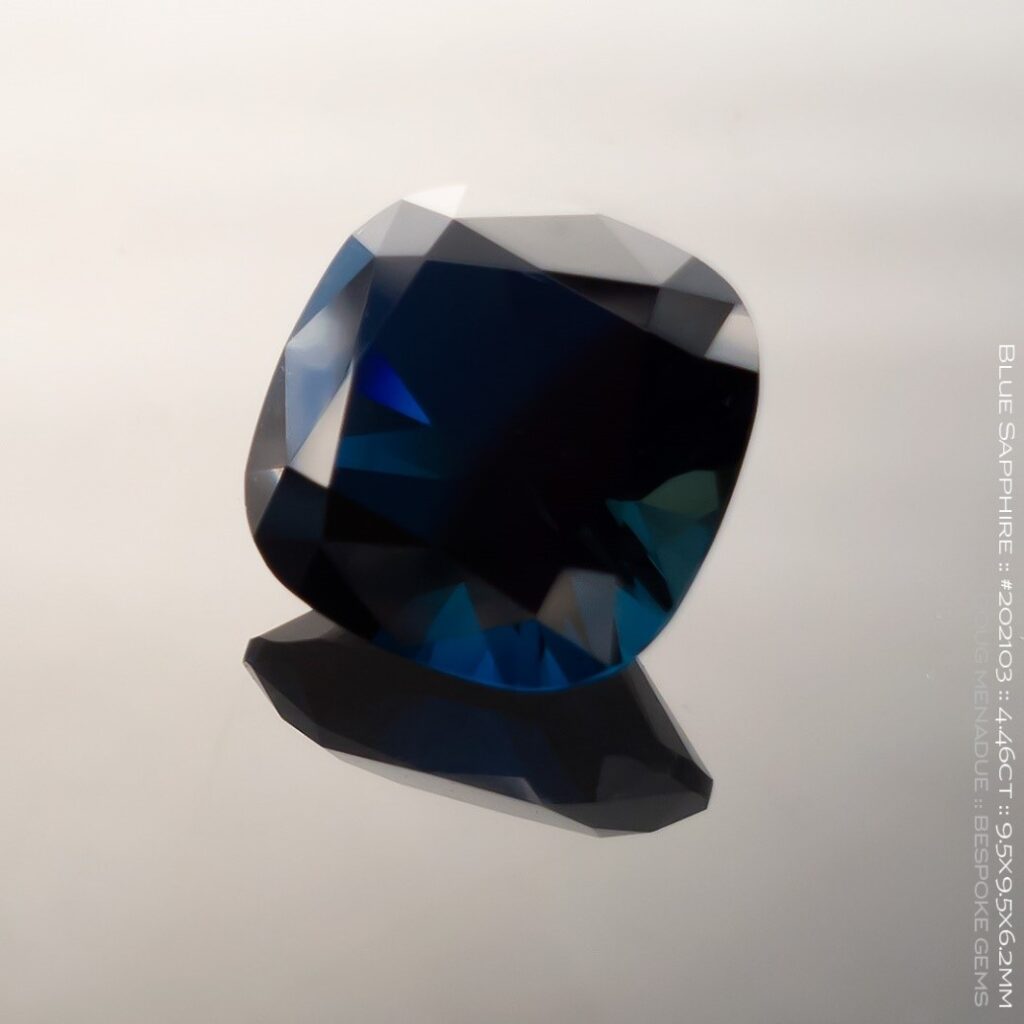
The Australian sapphire has more on dark pigmentation which refers to blackish blue sapphire or the extremely dark blue sapphires. It has sometimes been in demand in Australia and in the neighboring country.

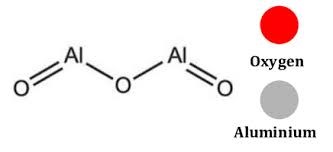
Sapphire according to the gemological perspective refers to the mineral Aluminum Oxide Al2O3. It is a precious gemstone falling under the corundum family having trace elements of Iron, titanium, cobalt, lead, chromium, vanadium, magnesium, boron, and silicon.
The word sapphire has originated from the word sapphiros, which is
of Greek origin and had once referred to lapis’ lazuli but later had its
reference to Blue sapphire. Fancy sapphire also occurs in yellow, purple, orange, and green colors. Parti sapphires show two or more colors. Red corundum also occurs which based on the pigmentation of chromium which results in Pink sapphire or if it meets the coloration criteria it will be called as ruby. Other branded sapphires include the padparadscha , and the star sapphire.
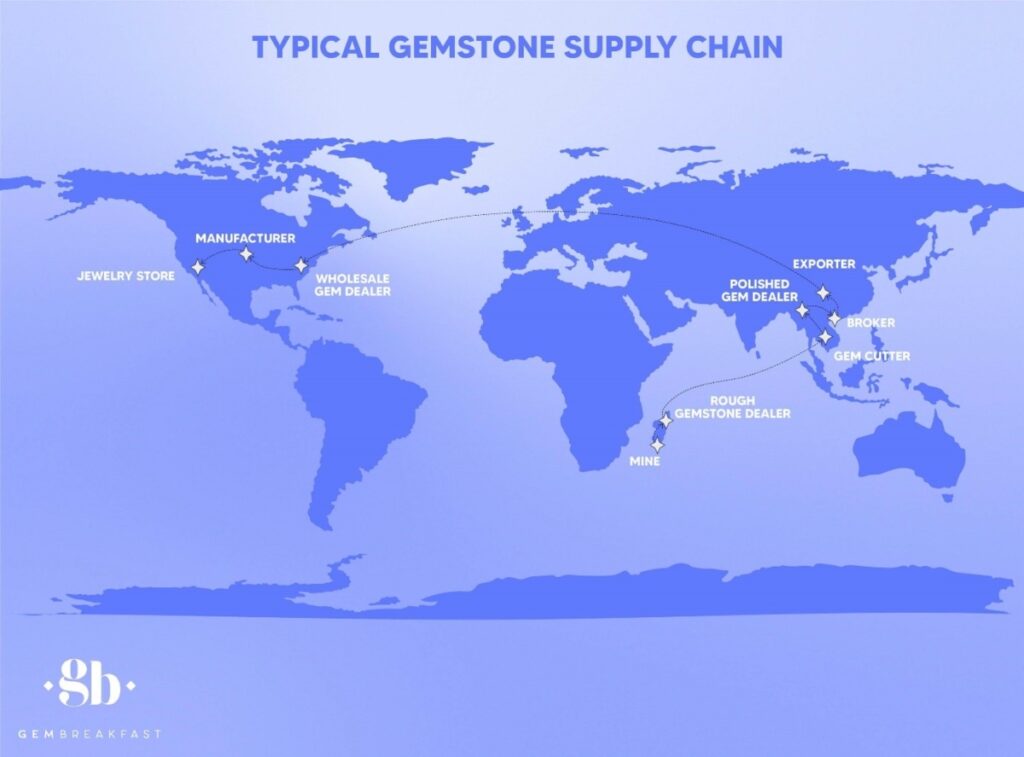
Sapphires minerals are found in countries such as Australia, Afghanistan, Cambodia, Cameroon, Kenya, Laos, Madagascar, Malawi, Mozambique, Myanmar, Nigeria, Rwanda, Srilanka, Tanzania, Thailand, United states, Vietnam, and Colombia. Every region produces different quality of blue sapphire however the sapphire which are coming from Kashmir’s has its highest value due to its rarity and due to its velvety blue and indigo color.
Apart from Blue sapphire there are also Indigo or Purple sapphire which are rare and are in highest demand and highly prized.
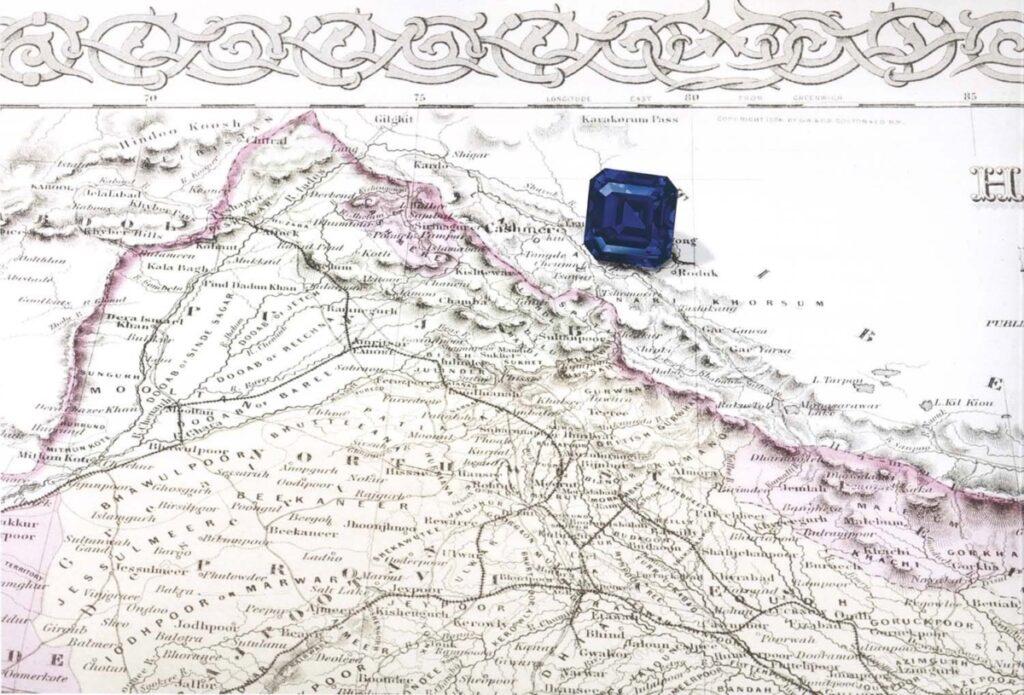
The Kashmir sapphires legacy
Kashmir has its significance in the Himalayan ranges which holds scenic natural beauty and a place where many gems are found. One such rare glorified and most sought-after stone is the Kashmir sapphire which is found in the Zanskar range and at the controversial Gilgit Baltistan district of Chumkar lake. The mines in the Zanskar range are widely known to produce bright blue sapphire with many collector enthusiasts visiting the place from Eurasian country.
The maharaja of Kashmir did try his best to protect the sight by keeping his guards as soon as he heard in the year 1882 and 1887. The Kashmir sapphire is the most famous type of sapphire in the world. They are near to perfect sapphires with accurate overtones etc. They have a superior cornflower blue hue to them with a mysterious quality in them. Some of the gem enthusiast describe them as velvet blue color. Some of the sapphires which come close
to Kashmir sapphire are the Burmese blue and the Ceylonese sapphire with similar hue tone and saturation.

However, this beautiful sapphire lore has been in history after the year 1888, where La touches survey has shown that the old mine is exhausted of its resources. They decided to mine the floor valley where they found some sapphires.
Kashmir sapphires still exist and has its importance till date but the sellers are very rare.
The new mine Kashmir’s were of two different types. Both types were coated in a white clay. Each type featured a blue outer edge, especially around the tips. Almost all sapphires found in the new mines are of a hexagonal pyramid shape.
The Logan sapphires

The Logan sapphire is one of the famous sapphire in the world. It is a 422.98 carat sapphire from Srilanka. One of the largest blue faceted sapphires owned by Mr. Victor Sassoon. It was natural and had not undergone any treatments. It fluoresces in reddish orange color when exposed to ultra violet radiation. Rutile inclusions are also found inside the stone. This particular gem originated from Rathnapura which is also called as the city of gems.
The Logan sapphire is named after Mrs. Pally Logan who donated this sapphire to the Smithsonian museum.
The star of Adam
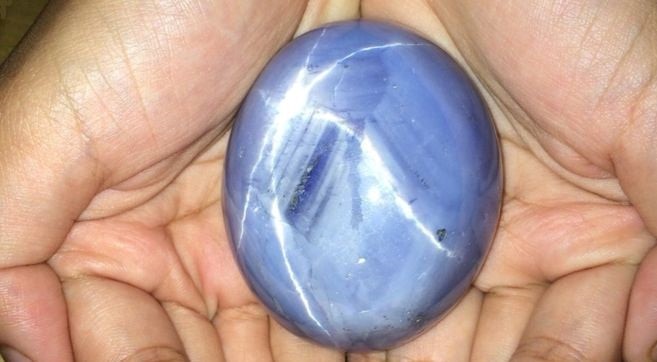
The star of Adam was discovered as of the year 2016, is a giant blue star sapphire. This sapphire has been certified by Srilankan gemologist that this stone weighs 1404.49 carats stone and is valued up to 300 million dollars.
The black star of Queensland

This famous sapphire has been discovered in queens land in Australia in the late 1930s. Harry Kazanjian has cut and polished the masterpiece, bringing the black star of Queensland in the weight of 733 carats.
This black star has been prized at high range oscillating between 4.1 million and 50 million dollars. Doug Kazanjian grandson of Harry has done the lapidary and continues the legacy of cutting other sapphires.
It has an appearance of galaxy or universe in your finger.
The star of Bombay
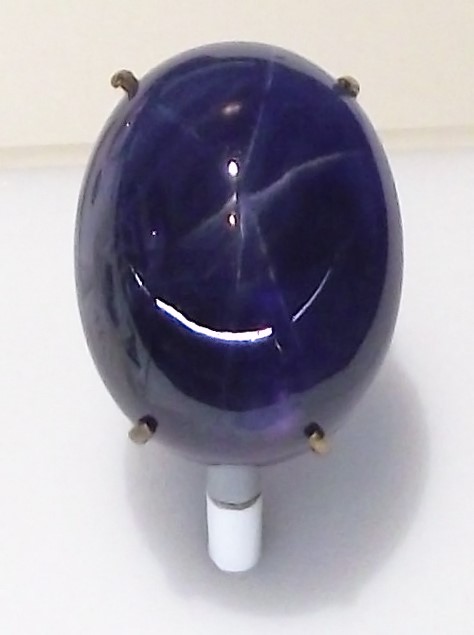
This stone was also discovered in the early 1930s and is star of Bombay having beautifully carved violet – blue star sapphire with wide asterism weighing in at around 182 carats. This stone was selected by actor Douglas Fairbanks as a gift for his wife Mary Pickford.
The Bismarck Sapphire Necklace
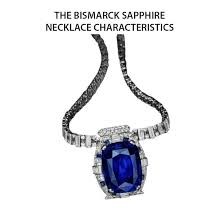
This is a 98.56 carat cornflower blue sapphire was mined in Burma and purchased in the year 1926 by American tycoon Harrison Williams for Countess Mona won Bismarck. This particular sapphire gemstone is being re cut by Cartier upon request.
The Bismarck necklace has been most influential ART DECO jewelry.
Many more famous sapphires continue to woo the collectors and the institutes worldwide keeping the joy of jewelry worldwide.







By Shivaram A
The Core Issue
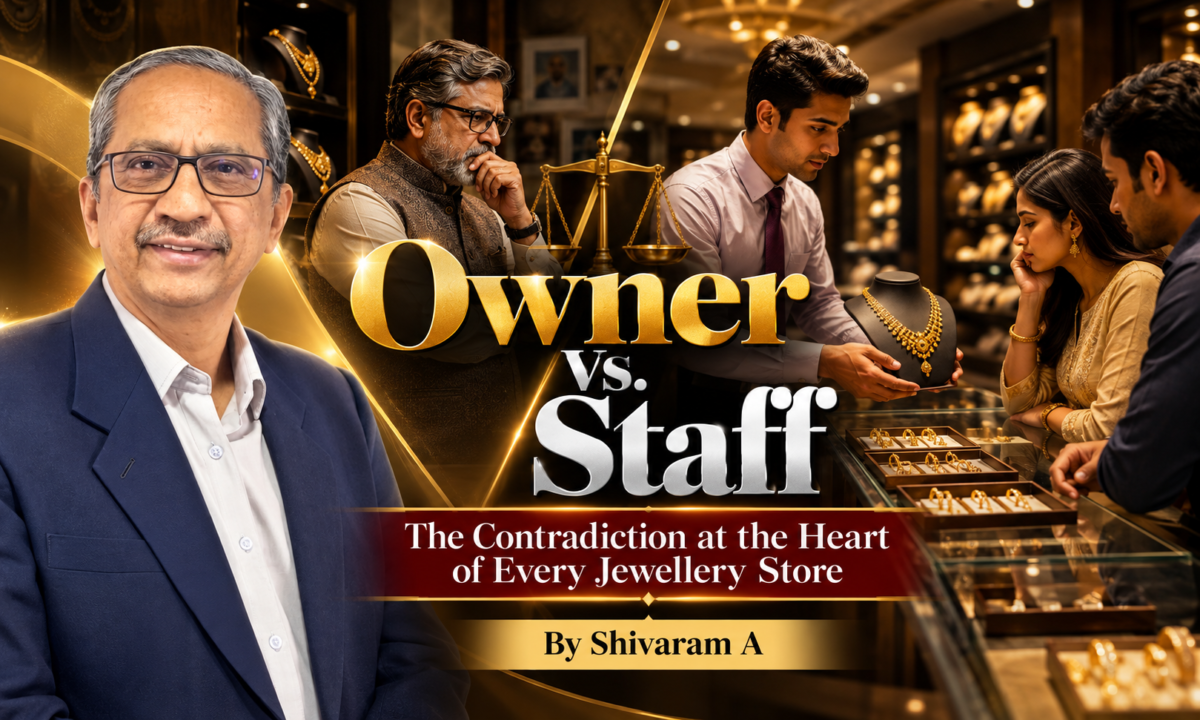
The owner carries the entire risk of the business — investment, gold stock, working capital, loans, everything is in their name. The long-term asset also belongs to the owner — reputation, brand, the customer base built over years, often meant to pass to the next generation. But the moment that matters most — when the customer is standing at the counter, when trust is being built or broken — that moment is entirely controlled by the staff.
The person with the most risk is not present at the decisive moment. And the person with the least to lose holds the most power in that moment. This structural mismatch creates frustration on both sides — and it’s rarely discussed openly.
Making the Conflict Explicit
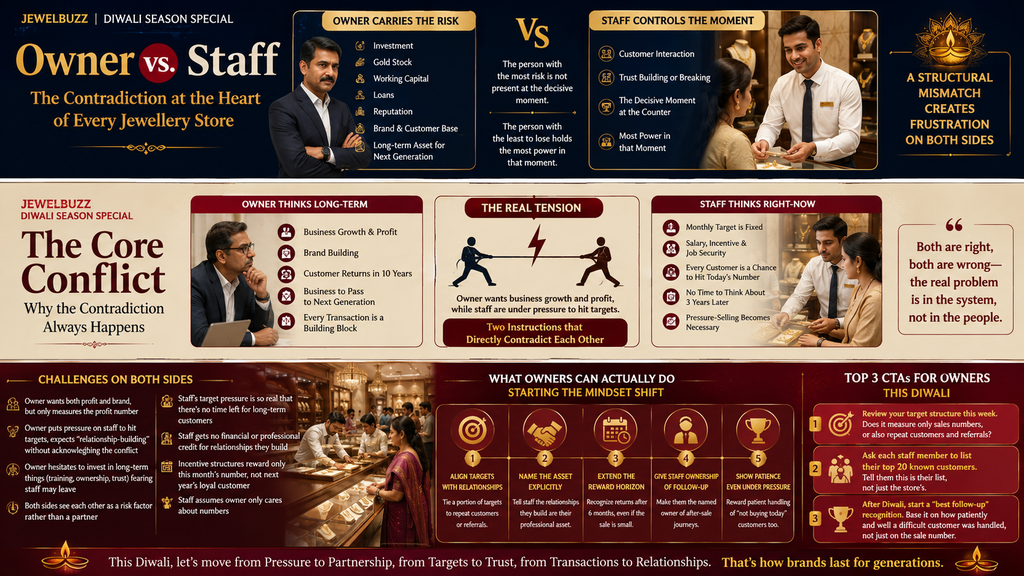
The real tension is this: the owner wants business growth and profit, while staff are under pressure to hit targets.
The owner thinks long-term — how does the brand grow, how does a customer come back after ten years, how does the business pass to the next generation. For the owner, every transaction is a building block toward something bigger.
The staff’s reality is completely different. Their monthly target is fixed. Their salary, incentive, and sometimes even job security depend on how much they sold this month, this Diwali. For staff, every customer is a chance to hit today’s number — right now, this moment. They cannot afford to think about whether this customer comes back in three years, because their performance is reviewed at month-end, not three years later.
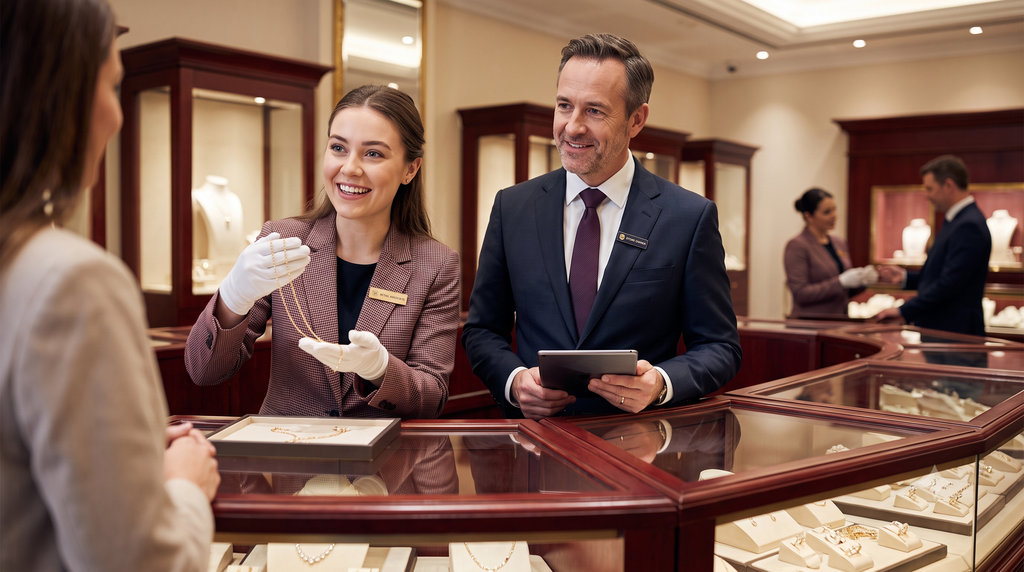
So when the owner says “build the relationship, be patient,” and in the same breath increases the target by 20%, these two instructions directly contradict each other. Staff are not confused about what they should ideally do — they understand it perfectly. But they don’t have the choice. The target has to be met, so pressure-selling becomes necessary — even if it means pushing a customer slightly, or using lines like “buy today, rate will go up tomorrow” that create small cracks in trust.
These cracks don’t show up immediately. But after Diwali, when that customer doesn’t return a second time, the owner assumes it’s the staff’s fault. The staff believes the owner set an unrealistic target. Both are right, and both are wrong — because the real problem is in the system, not in the people.
The Challenges on Both Sides
- Owner wants both profit and brand, but only measures the profit number
- Owner puts pressure on staff to hit targets, then also expects “relationship-building” — without acknowledging the two often can’t coexist
- Owner hesitates to invest in long-term things (training, ownership, trust) due to fear that staff will leave anyway
- Staff’s target pressure is so real that there’s no time left to think about the long-term customer
- Staff gets no financial or professional credit for the relationships they build
- Incentive structures reward only this month’s number, not next year’s loyal customer
- Both sides see each other as a risk factor rather than a partner — the owner assumes staff will eventually leave, staff assumes the owner only cares about numbers
What Owners Can Actually Do — Starting the Mindset Shift
- Stop treating targets and relationships as separate — align them. Don’t set targets purely on sales numbers. Tie a small portion of the target to repeat customers or referrals, so staff know that long-term customers count too.
- Name the asset explicitly. Tell staff directly: the relationship you’re building with a customer is your professional asset, not just the store’s. This has to be shown in practice, not just said out loud.
- Extend the reward horizon. Don’t reward only Diwali-week sales — when a customer returns six months later and asks for that staff member by name, recognize that, even if the sale itself is small.
- Give staff ownership of the follow-up. Make each staff member the named owner of their customers’ after-sale journey — repairs, exchanges, the next occasion. This helps them feel the relationship is theirs, not just a transaction.
- Show patience even under pressure. If Diwali week only rewards closed sales, staff will only chase closing. If a staff member who handles a “not buying today” customer well is also appreciated, that’s when the mindset actually starts to shift — because staff notices what the owner actually rewards, not just what they say.
Top 3 CTAs for owners this Diwali
- Review your target structure this week. Does it only measure sales numbers, or does it also give weight to repeat customers and referrals? If not, try a small adjustment starting this Diwali.
- Ask each staff member to list their top 20 known customers. Tell them this is their list, not just the store’s. This builds a sense of ownership.
- After Diwali, start a “best follow-up” recognition. Base it not on the sale number, but on how patiently and well a difficult customer was handled. Staff need to see that patience is rewarded too, not just closing.
Shivaram A
Retail Gurukul
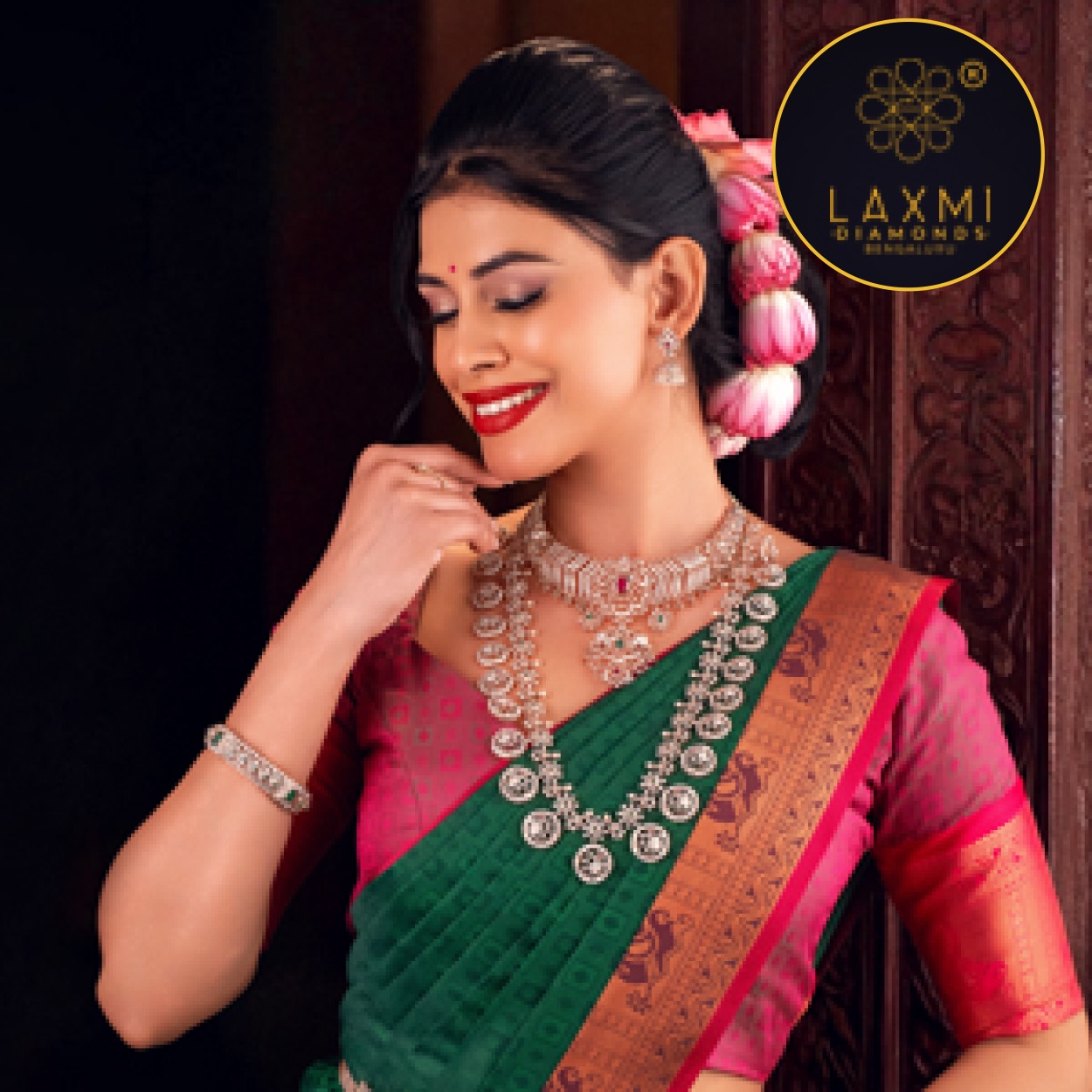


India’s Festive Jewellery Market Eyes Growth As Consumers Shift Towards Lightweight Designs and Value-Led Purchases

Kicky & Perky Opens Its First Official Store At DLF Midtown Plaza, Marking A New Chapter In Its Retail Journey

Senco Gold & Diamonds Brings Festive Cheer With “Dhanteras Shagun”, Offering Exclusive Savings and Rewards

Dhanteras Shopping Guide 2026:Gold, Silver, Diamonds & Festive Jewellery Trends To Watch

Indriya, Aditya Birla Jewellery Unveiled India’s Largest Sustainable Jewellery Rangavalli

From Diya Puja To Diwali Soirées: Jewellery Designed To Go Beyond The Festive Season
-
 JB Insights3 days ago
Dhanteras Shopping Guide 2026:Gold, Silver, Diamonds & Festive Jewellery Trends To Watch
-
 National News3 days ago
Indriya, Aditya Birla Jewellery Unveiled India’s Largest Sustainable Jewellery Rangavalli
-
 BrandBuzz3 days ago
From Diya Puja To Diwali Soirées: Jewellery Designed To Go Beyond The Festive Season
-

 BrandBuzz3 days ago
The Solenne Collection: A Celebration Of Diwali By Bharti Bangur Fine Jewels