
International News
Precious Metals Caught Between Hawks and Hormuz – AUGMONT BULLION REPORT
Warsh’s Hawkish Debut and Renewed Geopolitical Uncertainty Drive Gold’s Next Move

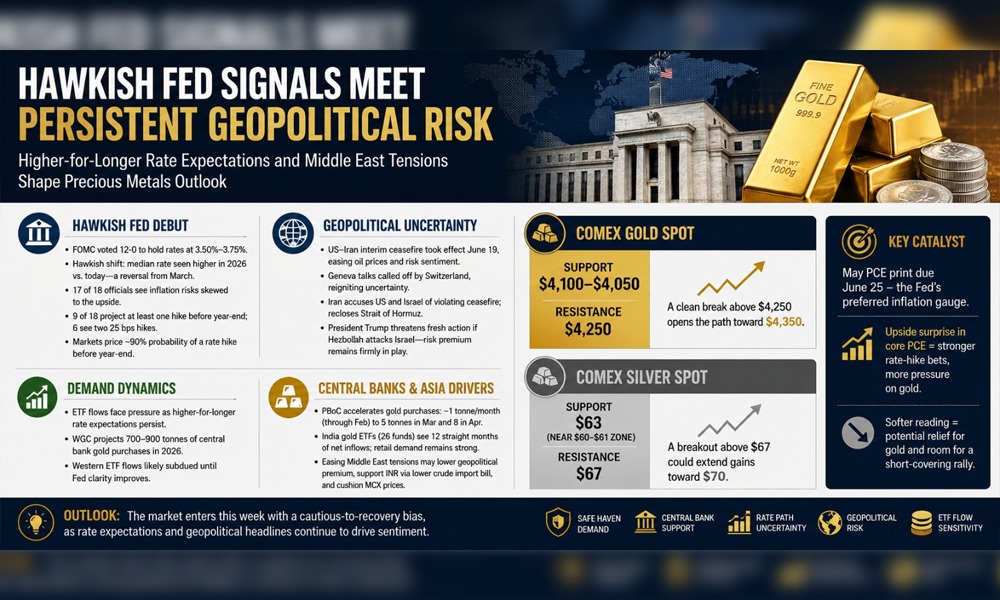
Last week was defined by two main events: Kevin Warsh’s first FOMC meeting as Fed Chair. What markets had widely anticipated as a routine, status quo hold turned into one of the most consequential policy communications in recent months—not because of what the Fed did, but because of what it signalled it might do next. The FOMC voted 12-0 to hold the federal funds rate at 3.50%–3.75%, but simultaneously stripped out prior language hinting at future rate cuts and delivered a strikingly compressed 130-word statement, down sharply from 341 words in the April release.
The updated dot plot told a decisively hawkish story. The median policymaker now expects rates to end 2026 higher than they are today—a direct reversal from March, when the median still implied a cut. Seventeen of the 18 officials assessed inflation risks as skewed to the upside. Nine of the 18 voting participants projected at least one rate hike before year-end, with six projecting two 25-basis-point increases. Officials simultaneously raised their 2026 PCE inflation forecast to 3.6%, well above the 2.7% projected in March, citing energy price pressures stemming from the ongoing Middle East conflict. Chair Warsh declined to offer personal forward guidance—consistent with his longstanding scepticism of the practice—but the committee’s collective message was unambiguous: cuts are off the table for now, and a hike is a live possibility. Traders have taken note, with markets now pricing in nearly a 90% probability of a rate increase before year-end.
The second event was the geopolitical backdrop, which added further complexity. A US–Iran interim ceasefire took effect on Thursday, June 19, following weeks of diplomatic uncertainty since US military operations commenced under Operation Epic Fury in late February 2026. The initial ceasefire eased crude oil prices and briefly lifted risk sentiment, prompting a partial unwinding of gold’s safe-haven war premium. However, sentiment reversed sharply over the weekend when Switzerland announced that the planned Geneva talks—intended to formalise a broader peace arrangement—would not go ahead. That late-week development reintroduced uncertainty, provided residual support for gold, and limited Friday’s downside, with markets already thinned by the US June 10 holiday. Since then, Iran has accused the US and Israel of violating the ceasefire terms and announced the reclosure of the Strait of Hormuz, citing continued Israeli strikes in Lebanon. President Trump simultaneously threatened fresh military action if Hezbollah continued attacks on Israel, reinforcing the fragility of the diplomatic process and keeping the geopolitical risk premium firmly in play.
On the demand side, ETF flows—which had broadly recovered through April—came under renewed pressure as higher-for-longer rate expectations reasserted themselves. The WGC’s structural case for gold remains intact: geopolitical risk continues to anchor demand in 2026, and central bank purchases are projected at 700–900 tonnes for the full year. Near-term Western ETF flows, however, are likely to stay subdued until there is greater clarity on the Fed’s next move.
The People’s Bank of China has meaningfully accelerated its reported gold purchases—from roughly one tonne per month through February to five tonnes in March and eight tonnes in April—providing a consistent price floor on sharp dips. India’s gold ETF ecosystem, now comprising 26 funds, has registered 12 consecutive months of net inflows, and domestic retail demand remains a structural pillar despite price sensitivity at elevated MCX levels. Separately, the ceasefire and potential Strait of Hormuz normalisation, while a net negative for gold’s geopolitical premium, are easing India’s crude import bill—a development that supports the rupee and partially cushions MCX prices from dollar-denominated weakness over time.
COMEX Gold Spot
Near-term COMEX support sits at $4,100–$4,050, with resistance at $4,250; a clean break above that level opens the path toward $4,350. In silver, prices found support at $63 last week, near the $60–$61 support zone, with resistance at $67 and a potential extension toward $70 on a breakout.
COMEX Silver Spot
The market enters this week with a cautious-to-recovery bias. The key catalyst is the May PCE print due on June 25—the Fed’s preferred inflation gauge. An upside surprise in core PCE would reinforce rate-hike bets and add further pressure on gold. A softer reading, conversely, could give bulls the opening they need for a short-covering rally.




International News
Gold Prices On Track To Reach $4,900/oz By End 2026 :Goldman Sachs
Goldman’s $4,900/oz Forecast Assumes Central Bank Demand Averages 50 Tonnes Per Month In 2026 and 40 Tonnes Per Month In 2027
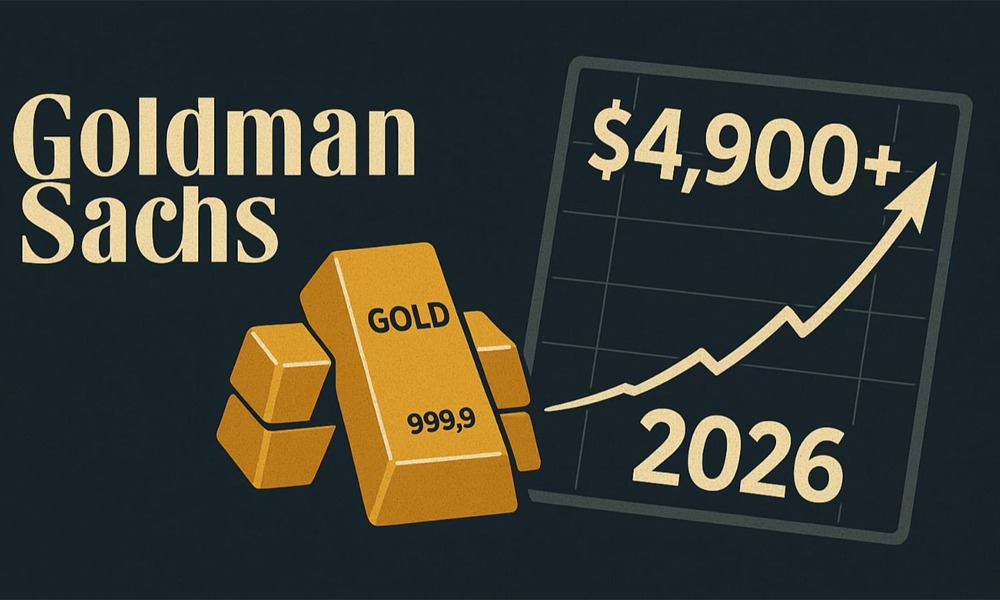
Gold prices are on track to reach $4,900 per ounce by the end of 2026, driven by aggressive central bank purchases—led by undisclosed buying from China—and recovering exchange-traded fund (ETF) demand, Goldman Sachs said in a research note.
The bank maintained its bullish base-case target for bullion while warning that positioning in options markets could amplify price volatility in both directions. Central banks accumulated an estimated 44 tonnes of gold in July, well above the pre-2022 monthly average of 17 tonnes, according to Goldman Sachs’ nowcast model. On a three-month seasonally adjusted basis, central bank buying stood at 91 tonnes per month.
China was the primary driver, with Goldman estimating the People’s Bank of China bought 35 tonnes in July—roughly 75% more than official public disclosures indicated.
To account for unreported sovereign purchases, Goldman’s model tracks physical bullion flows through London’s over-the-counter (OTC) market into custodian vaults. The Bank of England’s central bank holdings alone rose by 63 tonnes in July, exceeding outflows from the Federal Reserve Bank of New York.
Price Risks and Volatility
Goldman’s $4,900/oz forecast assumes central bank demand averages 50 tonnes per month in 2026 and 40 tonnes per month in 2027, alongside steady Federal Reserve policy and a rebound in private ETF inflows.
However, analysts noted that elevated demand for gold call options—used by investors to hedge against macroeconomic and geopolitical risks—creates mechanical upside and downside risks:
Bullish Case: Continued strong ETF inflows combined with existing call option positioning could force options dealers to buy underlying metal to hedge short exposure, pushing prices “well above” $4,900.
Bearish Case: If the Federal Reserve resumes interest rate hikes, unwinding hedge positions and triggering ETF outflows, gold could drop to $4,440/oz by end-2026. Goldman noted that ongoing central bank buying would limit further downside.
Goldman expects the Federal Reserve to remain on hold through 2026 as inflation cools, removing a key interest rate headwind for the non-yielding asset.


-

 Special Reports1 day ago
Growth of the 925 Sterling Silver Gifting Segment
-

 ShowBuzz1 day ago
TRENDS @ SSI DELHI 3RD EDITION
-

 JB Insights2 days ago
Devotion, Heritage & Diversification: The defining trends of SSI Delhi’s 3rd Edition
-

 JB Insights2 days ago
Gold-plated silver jewellery is seeing explosive growth
