JB Insights
Jewellery Stocks Surge Following Gold ETF FoF Restrictions
Fresh Curbs On Paper-Gold Products Have Pushed Investor Attention Toward Physical Gold and Organised Jewellers Just As Dussehra, Diwali and The Wedding Season Arrive. The Rally Was Real, But It Was Narrower, and IYU78ts Cause Less Certain,Than The Headline Suggests.


Key Takeaways
- Around 17 fund houses temporarily halted fresh subscriptions to gold ETF funds of funds (FoFs) on 15 and 16 October 2026, reportedly on SEBI instructions relayed through AMFI.
- On 16 October, jewellery stocks rose by as much as 9% in early trade. The sharpest moves came in smaller names: PC Jeweller, Shanti Gold, Sky Gold and Diamonds, and TBZ. Titan and Kalyan Jewellers moved far less.
- No verified evidence shows that money blocked from gold FoFs flowed into jewellery shares. Market commentary treats the curbs as a catalyst for attention, not a proven cause.
- Gold prices have since eased, and the sector now trades on festive demand, margins and earnings quality rather than on the curbs alone.
What Happened
Seventeen mutual fund houses temporarily restricted fresh investments in their gold ETF FoFs, with the curbs taking effect on 15 and 16 October. The restrictions cover fresh lump sums, switch-ins, top-ups, and new SIP and STP registrations. ICICI Prudential, HDFC, Tata, Kotak, DSP, Mirae Asset, UTI, HSBC, LIC, Quantum, Zerodha and Groww are among the AMCs that issued notices. Several also curbed bulk subscriptions to gold ETFs themselves, and HDFC and Mirae extended the curbs to their gold-silver passive FoFs.
Three features matter for readers:
- The curbs are temporary. Notices say they stay in place until further notice.
- Existing holders are untouched. Redemptions continue, and SIP and STP instalments registered before the cut-off dates run as usual.
- No reasons were given. The notices did not state a rationale. The context is pressure on India’s external balances and the rupee, a heavy import bill and a festive season in which gold and silver ETF subscriptions surged last year.
Gold ETF net inflows had already jumped to Rs 4,450.61 crore in September, up 71.4% from Rs 2,596.70 crore in August, according to AMFI data. Globally, gold ETFs drew about 67 tonnes (nearly $10 billion) in September, according to the World Gold Council.
The Investment Thesis
The logic circulating in the market runs as follows:
- Substitution. With new money barred from FoFs, some investors may turn to coins, bars and jewellery, or to listed jewellers as a proxy for gold demand.
- Festive timing. Dussehra, Dhanteras, Diwali and the wedding season are the strongest demand window of the year, and the shifted festive calendar could lift the October–December quarter’s share of annual sales.
- Organised-sector share gains. Analysts expect Titan, Kalyan and Senco Gold to keep winning share from the unorganised segment.
- Consumer adaptation. Buyers are coping with high prices through lightweight jewellery, smaller tickets and old-gold exchange.
- Operating momentum. Recent reported jewellery growth has been strong: Titan’s jewellery business up 21%, Kalyan’s India revenue up 27%, Senco Gold up 31% and PC Jeweller up 28% in consolidated revenue.
What the Evidence Does Not Show
A careful reading of the available coverage suggests caution on the causal story:
- No proven money flow. Nothing verifies that capital denied access to gold FoFs went into jewellery shares.
- Different routes remain open. The curbs hit specific FoFs and some ETF bulk subscriptions, not every way of owning gold.
- Concentrated, not sector-wide. The sharpest moves were in smaller stocks, where low bases and momentum trading amplify headlines.
- Values are not volumes. Jewellery sales can rise in rupee terms while customers buy fewer grams of gold.
- Imports are not surging. Gold imports fell to $1.8 billion in September from $2.3 billion in August, so a festive import surge is a concern, not a confirmed outcome.
In short, the curbs lit the fuse, but festive demand and company fundamentals are the fuel.
Macro Backdrop
- Duty and appeals. Earlier this year the government raised effective gold and silver import duties to 15% from 6%. In May, the Prime Minister urged citizens to defer gold purchases for a year to conserve foreign exchange. Jewellery stocks fell 5.5% to 11% on that appeal, and they also fell on the duty hike while gold ETFs and gold-loan lenders rallied.
- Gold prices. 24-carat gold stood at Rs 1,50,980 per 10 grams on 12 October and Rs 1,47,440 on 16 October. By 21 October it had slipped to roughly Rs 1,46,080, about 3.25% below the 12 October level. Buyers are watching whether prices find a floor before Dhanteras.
- Six-month stock performance. To mid-October, Kalyan was up over 27%, Thangamayil about 13%, Sky Gold and Diamonds about 139%, Senco Gold flat and Titan down about 2%.
Implications for the Trade
- Retailers. Policy now cuts both ways: restrictions on paper gold support physical demand narratives, while duties, appeals and rupee-defence measures can dampen it. Lightweight designs, exchange schemes and gold-metal-loan and hedging discipline remain the practical levers.
- Manufacturers and wholesalers. Festive restocking, working-capital cost and hedge cover matter more than headline sentiment.
- Investors. Analysts caution against treating the curbs as a standalone reason to buy. Margins, same-store growth and sustainable earnings should drive the decision.
What to Watch
- Any relaxation or extension of the FoF subscription curbs, and whether other gold-linked products see similar action.
- Domestic gold price direction through Dhanteras and Diwali.
- Festive-quarter commentary and results from Titan, Kalyan, Senco and PC Jeweller.
- Gold import data for October and the state of the rupee.
- Further policy signals on duties or gold-buying appeals.
Bottom Line
The FoF curbs gave jewellery stocks a timely narrative, and small-cap names ran hardest on it. But the durable case for organised jewellers rests on festive and wedding demand, share gains from the unorganised sector and clean earnings. The curbs are a headline; the festive footfall is the test.


JB Insights
Jewellery Advertising and Promotion Hijacked By AI and Algorithms
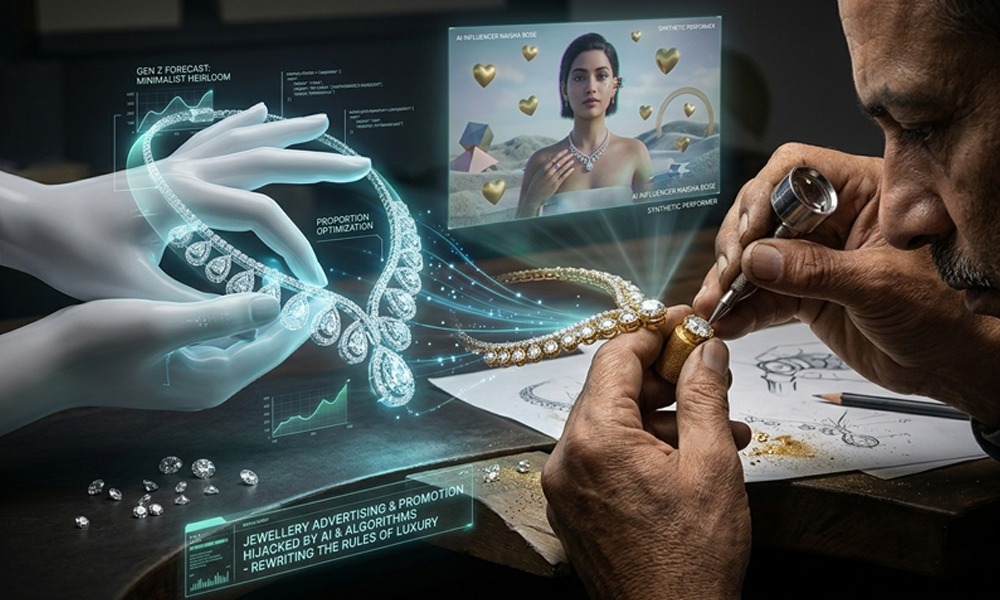
From decoding what Gen Z wants before they even know they want it, to conjuring surreal ad campaigns featuring models who don’t have a pulse, tech is rewriting the rules of luxury.
By Steve Fernandes
Forget dusty velvet trays and weeks of agonizing over sketches. The jewellery world—an industry notoriously obsessed with heritage, heavy gold, and “the way we’ve always done it”—just got a massive software update.Artificial Intelligence has officially crashed the atelier. From decoding what Gen Z wants before they even know they want it, to conjuring surreal ad campaigns featuring models who don’t have a pulse, tech is rewriting the rules of luxury.
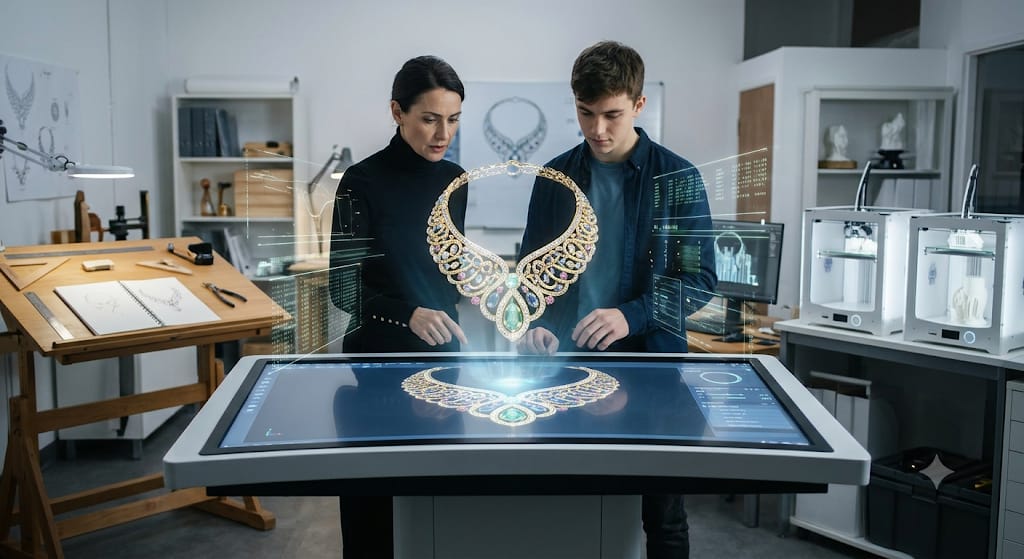
But while algorithms are churning out prototypes at warp speed, the industry’s heavy hitters are drawing a hard line in the gold dust: AI can crunch the numbers, sure, but only human hands can give a piece a heartbeat.
The Tireless Studio Assistant

Walk into a modern design studio today, and you’re just as likely to see prompt engineering as you are pencil shavings. With gold prices hovering in the stratosphere and lifestyles shifting toward lighter, everyday statement pieces, brands can no longer afford to guess what will sell.
The conversation around AI isn’t about replacing artisans—it’s about removing the guesswork. AI test-drives hundreds of variations in gemstones, proportions, and finishes before a single gram of gold hits the workbench. Instead of looking in the rearview mirror at last season’s sales, AI scours search trends and social chatter to predict the next big silhouette.
Pair AI-driven trend forecasting with next-gen hardware—think 3D printing, paper casting, and electroforming—and you get intricate, feather-light pieces hitting shelves at record speed. Throw in blockchain for airtight traceability, and suddenly, the ancient trade of goldsmithing looks straight out of Blade Runner.
Decoding the Modern Buyer
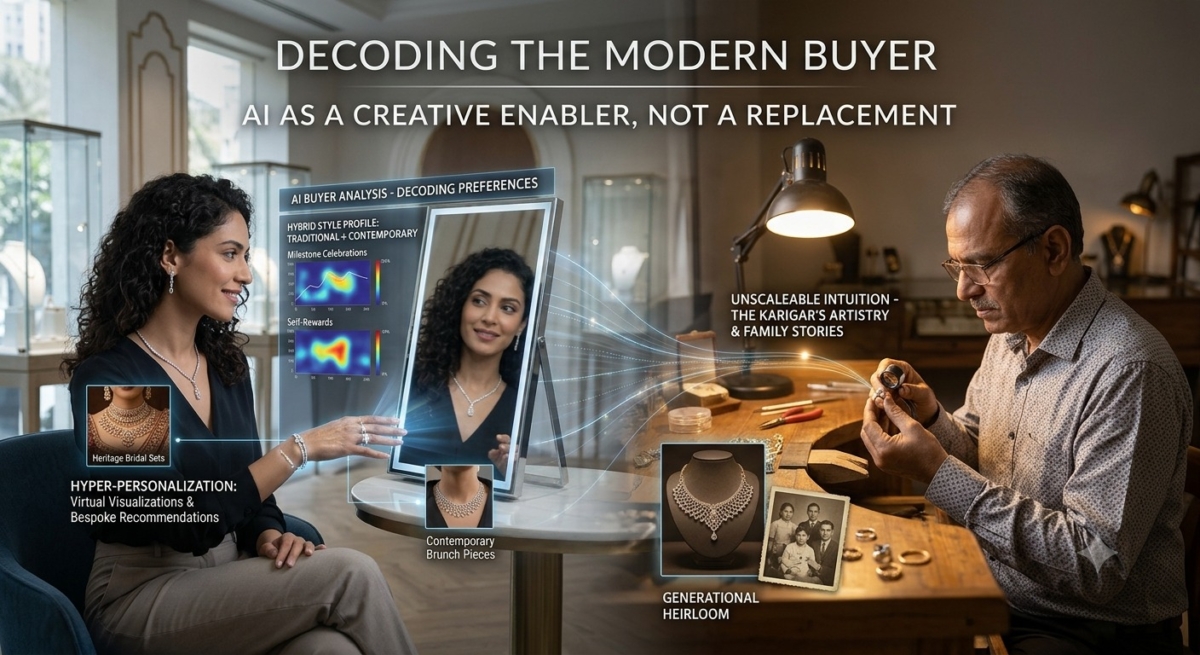
If you think AI is just a backend factory tool, think again. It’s also reading the room—and the customer.
In hyper-discerning markets shoppers want it all: a heritage bridal set steeped in tradition for the wedding, and sleek, contemporary pieces for Monday morning brunch.
By analyzing buyer behavior, AI helps jewellers nail hyper-personalization, offering virtual visualizations and bespoke directions tailored to specific milestones, self-rewards, or celebrations.
Remember: You can’t code the intuition of a seasoned karigar hand-setting a diamond, nor can an algorithm translate a family’s multi-generational story into an heirloom. AI is a creative enabler, not a replacement.
Pixels, Faux-Models,
Of course, the revolution isn’t just happening at the workbench—it’s taking over your feed. Traditional luxury shoots are notoriously brutal on budgets: massive crews, exotic locations, and logistical nightmares. Enter generative AI, slashing content production times by up to 65%.
Brands are ditching physical sets for surreal, dreamlike digital editorials—picture golden heart pendants floating in zero-gravity landscapes—and tapping virtual influencers to front major drops. Just look at Indian label KALON Art Jewellery, which rolled out its “Wildfire” collection starring AI influencer Naisha Bose.
The Glitch in the Glamour
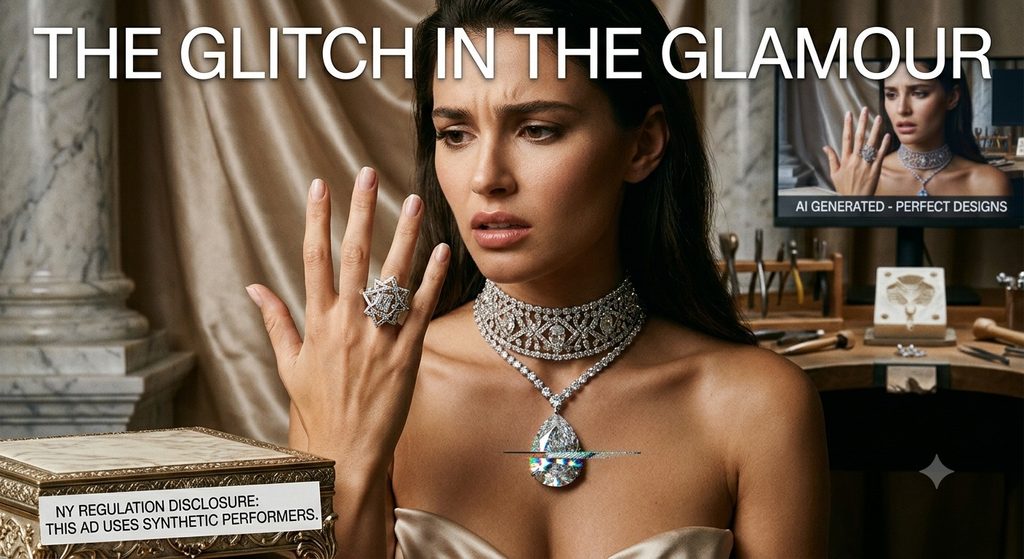
Before we hand the keys of the vault over to our silicon overlords, let’s talk about the catch. For all its swagger, AI still has a glaring blind spot: reality.
Generative algorithms don’t understand physics, metal thickness, or stone-setting mechanics. A ring that looks transcendent on a screen might be structurally impossible to forge in a real workshop without a complete CAD overhaul. Worse, AI still trips over basic human anatomy—nothing kills a luxury vibe faster than a viral campaign featuring a model with six fingers or a warped gemstone.
Then there’s the trust factor. Buying fine jewellery is an emotional, high-stakes flex, and consumers are starting to push back when they realize the radiant model wearing a diamond choker doesn’t actually exist.
The law is catching up, too—New York just passed a landmark regulation forcing brands to slap a disclosure label on ads using “synthetic performers.”
The Verdict
The future of fine jewellery isn’t a cage match between the algorithm and the artisan—it’s a collab. The brands poised to win the next decade are the ones bold enough to let AI handle the heavy lifting of data, speed, and hyper-personalization, while fiercely protecting the raw, messy, irreplaceable magic of human craftsmanship.

-
 National News1 day ago
This Men’s Day, say it with Candere: Jewellery Gifts he didn’t know he needed
-
 International News1 day ago
Cartier Romanov sapphire bracelet nets $4.9mn at Sotheby’s Geneva auction
-

 National News1 day ago
FGLOC to host inaugural Gold Summit in Kochi
-

 National News1 day ago
Domestic precious metal markets record steady retail pricing