JB Insights
Gold Loan Defaults Will Hurt Credit Scores
Repayment Behavior On These Secured Loans Significantly Impacts A Borrower’s Overall Credit Profile

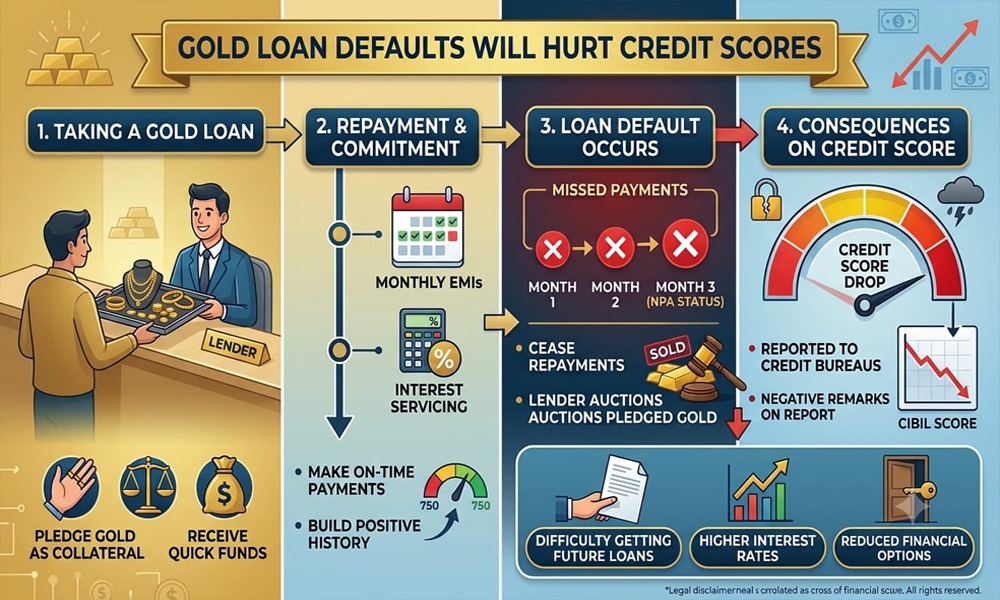
Gold loans continue to be a preferred financing route for short-term liquidity needs owing to low documentation and quick disbursal. However, while credit scores play a minimal role during the initial approval stage, repayment behavior on these secured loans significantly impacts a borrower’s overall credit profile, financial experts note.
Unlike unsecured personal loans, gold loans are backed by physical collateral—jewelry and ornaments—allowing public and private sector lenders to offer high-value credit, up to Rs 1 crore, without demanding income proof.
Approval relies primarily on the purity, weight, and prevailing market rate of the pledged gold rather than a borrower’s credit history. Despite lenient onboarding criteria, credit bureaus track gold loan accounts closely once disbursed.
Experts outline key ways gold loans interact with credit scores
Timely Repayments Boost Credit Profile
Paying dues punctually—whether via monthly EMIs or bullet payments at tenure completion—builds a positive repayment track record, enhancing the borrower’s credit score over time.
Delays and Defaults Cause Damage
Missing payment deadlines or defaulting leads lenders to report non-payment to credit reporting agencies, leading to a notable decline in the borrower’s credit score.
Risk of Collateral Liquidation
Extended defaults force lenders to auction off the pledged gold to recover outstanding dues, an action that severely harms a borrower’s long-term credit rating and future borrowing capacity.
Financial advisors recommend opting for a gold loan only when a clear repayment strategy is in place, ensuring timely servicing to protect both credit standing and pledged assets.





JB Insights
Why Israel’s Election Is Rippling Through Gold, Oil, and Capital Markets
The Immediate Channel Connecting Electoral Politics To Precious Metals Is The Market’s Assessment Of Regional Stability Across The Middle East.

When citizens cast their ballots in a tightly contested general election, the focus is naturally on parliamentary seats, coalition alignments, and domestic policy. But in today’s deeply interconnected global economy, the reverberations of a high-stakes national vote rarely stop at national borders.
Look no further than the commodities trading desks in London, New York, and Mumbai: as election results trickle in, spot gold continues to hold firm above the historic $4,000 per ounce milestone, keeping investors on high alert.
At first glance, linking a country’s legislative election directly to global bullion prices might seem like a stretch. Yet, for gold and silver, the election isn’t merely about who occupies the Prime Minister’s office—it is about the indirect geopolitical and macroeconomic waves that follow.
1. Geopolitical Risk Premiums: The Safe-Haven Calculus
The immediate channel connecting electoral politics to precious metals is the market’s assessment of regional stability across the Middle East.
- Prolonged Deadlock or a Netanyahu Victory: Markets tend to price in a continuation—or even an escalation—of a firm military stance regarding regional conflict points and tensions with Iran. For global traders, this lingering friction translates into sustained safe-haven demand, keeping a firm floor under gold prices.
- An Opposition Shift: Conversely, a victory by an opposition bloc (led by figures such as Gadi Eisenkot) is often interpreted by international markets as potentially easing immediate regional geopolitical friction. Should risk premiums recede, safe-haven assets could experience minor profit-taking or stabilizing pressure.
However, political headlines are only one piece of a much larger economic puzzle.
2. Energy, Inflation, and Shipping Corridors
Electoral outcomes carry subtle yet direct implications for global energy flows. When political shifts influence expectations surrounding crucial shipping routes—such as the Strait of Hormuz—crude oil markets react instantly.
Fluctuations in oil prices spill directly into global inflation expectations. Rising energy costs complicate central bank targets worldwide, reinforcing gold’s historic role as a premier hedge against persistent inflationary pressure.
3. The Real Drivers: The Fed, the Dollar, and Bond Yields
While political headlines grab attention, macro forces remain the ultimate drivers of gold’s long-term trajectory. Precious metals rarely move in a vacuum; they respond aggressively to monetary policy, U.S. Treasury yields, and currency swings.



Gold Loan Defaults Will Hurt Credit Scores

KISNA Takes Festive Gifting Nationwide With 300+ Billboards Featuring Shahid and Mira Kapoor

MCX Gold Futures Trade Near ₹1.42 Lakh Amid Dollar Strength and Fed Rate Cues

Dhanteras Shopping Guide 2026:Gold, Silver, Diamonds & Festive Jewellery Trends To Watch

The Solenne Collection: A Celebration Of Diwali By Bharti Bangur Fine Jewels

From Diya Puja To Diwali Soirées: Jewellery Designed To Go Beyond The Festive Season
-
 JB Insights5 days ago
Dhanteras Shopping Guide 2026:Gold, Silver, Diamonds & Festive Jewellery Trends To Watch
-
 BrandBuzz5 days ago
The Solenne Collection: A Celebration Of Diwali By Bharti Bangur Fine Jewels
-
 BrandBuzz5 days ago
From Diya Puja To Diwali Soirées: Jewellery Designed To Go Beyond The Festive Season
-

 National News5 days ago
Indriya, Aditya Birla Jewellery Unveiled India’s Largest Sustainable Jewellery Rangavalli