JB Insights
JewelBuzz Festive & Wedding Season Report
#UTSAVkiUMEED

Introduction
JewelBuzz spoke to jewellery manufacturers, wholesalers and retailers across the country to check out the consumer mindset. Indian jewellery buyers this Diwali are not abandoning gold; they are shopping it differently. Reading industry voices through the buyer’s eyes, one picture emerges: shoppers watch the gold rate like a stock ticker, shrink the piece rather than skip the purchase, hunt for proof of fairness, and plan their buying around weddings and festivals, with Dhanteras on 6 November the next big test.
Overall Outlook
- Industry sentiment is cautiously optimistic: most jewellers expect healthy value growth during Dhanteras, Diwali and the wedding season, even though physical gold volumes may remain subdued due to elevated prices.
- Recent corrections in gold and silver prices have improved affordability, revived footfalls and encouraged advance bookings ahead of Dhanteras on 6 November.
- Retailers broadly expect value growth to outpace volume growth, as consumers continue buying but choose lighter, lower-carat and more versatile pieces.
- Sales expectations vary widely: some retailers project 15–25% year-on-year value growth, while more cautious players say matching last year’s volumes with modest growth would be a good outcome.
Demand Drivers
- Festive and wedding demand remains the strongest support: Dhanteras, Diwali, Bhai Dooj and the November-onwards wedding calendar are expected to sustain purchases.
- Gold’s cultural, emotional and investment appeal continues to drive buying, particularly for bridal jewellery, gifting and auspicious occasions.
- Lower gold prices, rate-booking schemes, old-gold exchange programmes and promotional offers are helping convert deferred demand into actual sales.
- Retailers report improving footfalls, early bridal orders and healthy inventory replenishment by manufacturers ahead of the peak season.
Key Consumer Trends
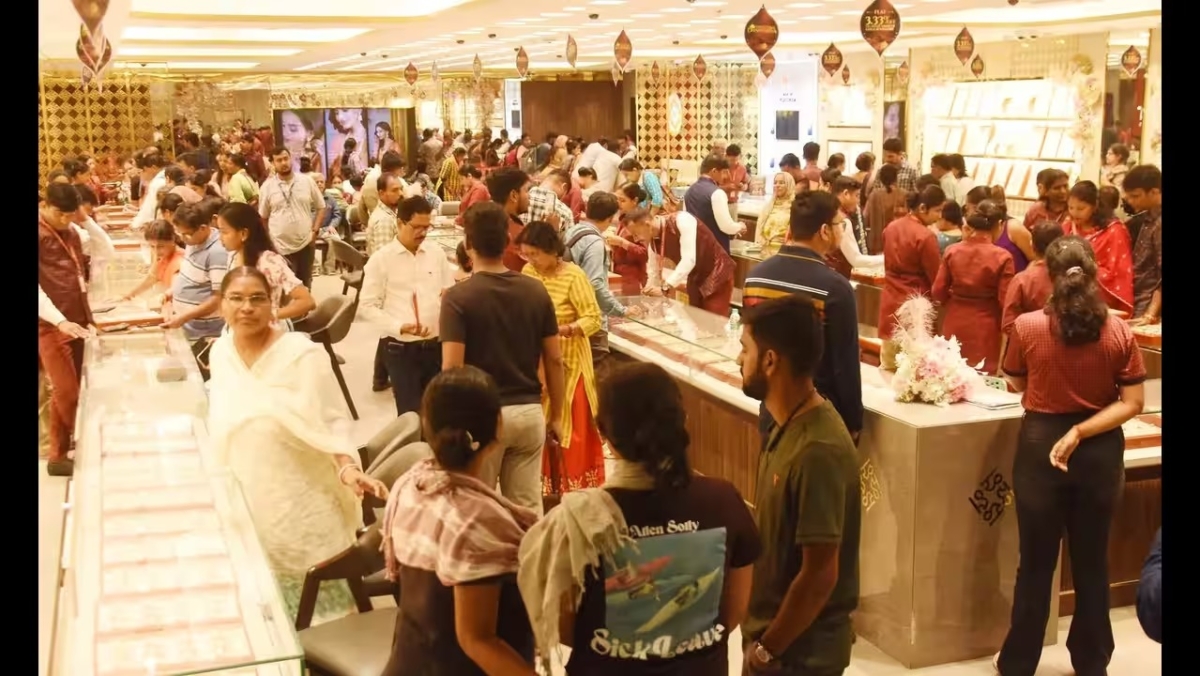
- Consumers are becoming more value-conscious and discerning, comparing design, purity, craftsmanship, price and wearability before purchase.
- Lightweight jewellery is the dominant trend, especially among younger buyers and first-time purchasers.
- Demand is rising for 9KT, 14KT and 18KT gold, allowing customers to access traditional designs at more affordable price points.
- Buyers prefer versatile, multi-use pieces that work for daily wear, festive occasions and weddings, rather than heavy occasion-only sets.
- Old-gold exchange is playing a major role, with exchange volumes rising and accounting for a significant share of sales at several retailers.
Category-wise Outlook
- Gold jewellery:
Volume growth is likely to remain limited, but value sales should stay strong due to higher prices; bridal sets, rani haars and traditional pieces continue to attract wedding buyers.
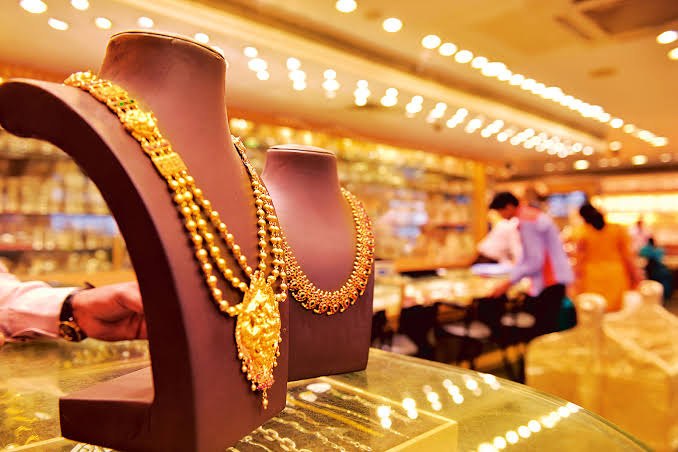
- Diamonds: Natural diamond jewellery is seeing positive momentum, particularly lightweight studs, pendants, rings, bangles and versatile festive designs; Senco reports 25–30% diamond growth and Zen Diamond reported 30% Dussehra sales growth.
- Lab-grown diamonds: Expected to outperform the wider category, driven by larger stones at accessible prices, certification-led trust, transparent pricing and rising acceptance among younger and Tier 2/3 consumers.
- Platinum:
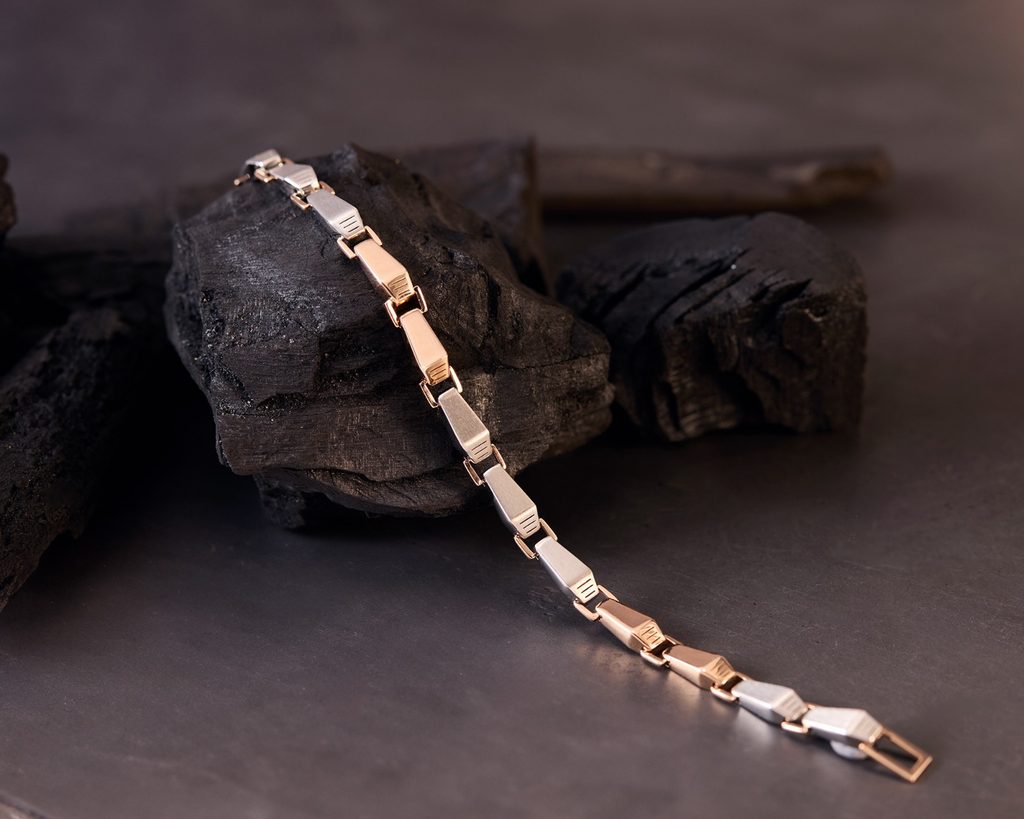
Seen as a premium, contemporary growth category, with potential beyond weddings into self-purchase, everyday luxury and younger consumers.
- Silver:
Silver lamps, coins and articles are gaining festive traction, although some silver jewellers note temporary sales slowdown due to falling prices; lower price points could support stronger consumer purchases during Diwali
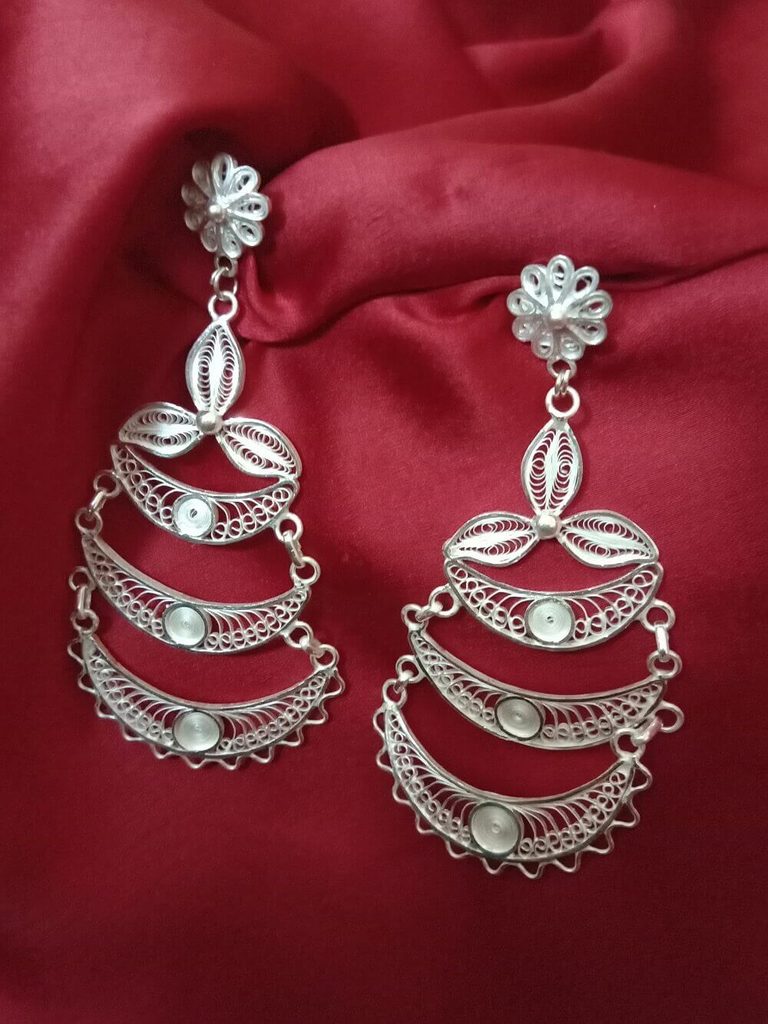
- Fashion jewellery: Strong demand is reported during Navratri, Dussehra and Karwa Chauth, with Kundan, antique, temple, Polki-look, jadau-inspired and CZ designs expected to lead Diwali and wedding-season sales.
New Collections & Product Innovation
- Jewellers are launching festive, bridal and everyday collections focused on lightweight gold, diamonds, platinum, silver and versatile designs.
- Notable launches include NAC’s Surabhi traditional cow collection, ABARAN’s festive and bridal lines, Nemichand Bamalwa’s Eden Collection, Aisshpra’s Navni 9-in-1 diamond bridal collection, Bharti Bangur’s Elumé collection and Avama’s wedding-festive edit.
- Manufacturers are focusing on design innovation, faster inventory rotation, consistent availability, competitive pricing and market-relevant collections to support retail partners.
- Modular, convertible and multi-styling jewellery is gaining importance, particularly for modern brides seeking statement pieces with multiple wear options.
Challenges & Risks
- High and volatile gold prices remain the biggest constraint, reducing the quantity consumers can afford and encouraging smaller-ticket purchases.
- Some industry voices describe sentiment as muted, warning that inflated pricing or artificial discounts could damage consumer confidence.
- The key uncertainty is whether advance bookings and rate-lock schemes convert into final Dhanteras and Diwali purchases.
- A shift from jewellery towards investment gold is visible in some segments, with bars and coins gaining share as consumers prioritize value preservation.
Market Data & Expectations
- India’s gold jewellery consumption fell 20% year-on-year to 100 tonnes in Q3 2026, the weakest third quarter since 2020, though spending value rose 19% to US$38 billion in the first nine months.
- Between April and June 2026, jewellery demand fell 15% by volume, while total gold spending reached a record Rs 1.98 lakh crore, reflecting the shift from quantity to value.
- Listed jewellers reported 20–30% year-on-year revenue growth in July–September, supported by weddings, festive buying, lightweight designs and e-commerce.
- The World Gold Council expects full-year India gold demand of 625–675 tonnes, with the festive and wedding season providing a favourable near-term backdrop despite price-related volume pressure.
Strategic Priorities for Retailers
- Focus on lightweight, lower-carat and studded collections to align with affordability-led demand.
- Strengthen exchange offers, rate-booking schemes, financing options and genuine promotions to build trust and improve conversion.
- Curate a balanced range across budgets, from everyday and gifting pieces to premium bridal jewellery.
- Invest in design innovation, quality assurance, faster stock rotation and digital engagement to meet evolving consumer expectations.
- Target younger consumers, self-purchasers and Tier 2/3 markets with contemporary, wearable and certified jewellery options


JB Insights
Jewellery Advertising and Promotion Hijacked By AI and Algorithms
From decoding what Gen Z wants before they even know they want it, to conjuring surreal ad campaigns featuring models who don’t have a pulse, tech is rewriting the rules of luxury.
By Steve Fernandes
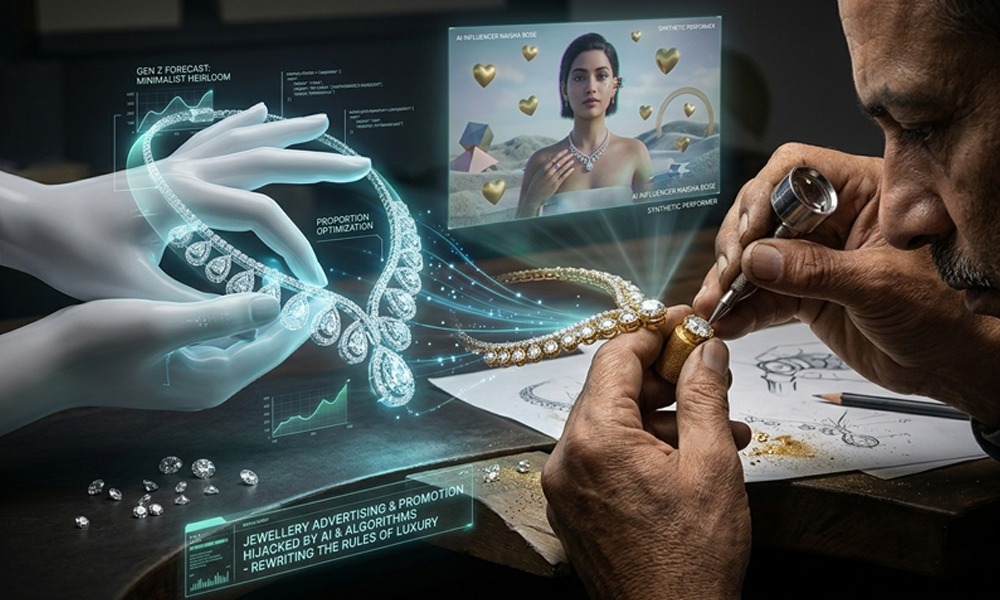
Forget dusty velvet trays and weeks of agonizing over sketches. The jewellery world—an industry notoriously obsessed with heritage, heavy gold, and “the way we’ve always done it”—just got a massive software update.Artificial Intelligence has officially crashed the atelier. From decoding what Gen Z wants before they even know they want it, to conjuring surreal ad campaigns featuring models who don’t have a pulse, tech is rewriting the rules of luxury.
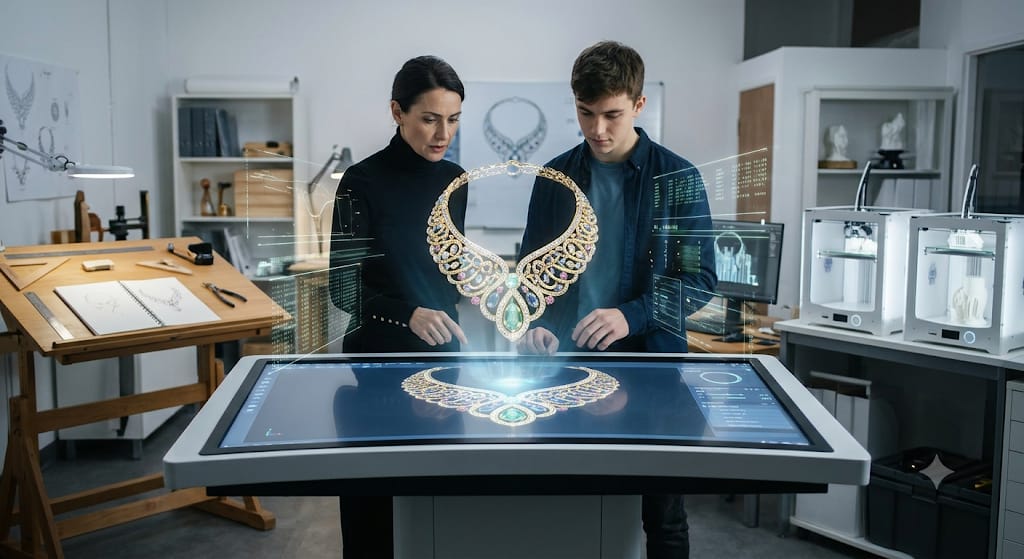
But while algorithms are churning out prototypes at warp speed, the industry’s heavy hitters are drawing a hard line in the gold dust: AI can crunch the numbers, sure, but only human hands can give a piece a heartbeat.
The Tireless Studio Assistant
Walk into a modern design studio today, and you’re just as likely to see prompt engineering as you are pencil shavings. With gold prices hovering in the stratosphere and lifestyles shifting toward lighter, everyday statement pieces, brands can no longer afford to guess what will sell.
The conversation around AI isn’t about replacing artisans—it’s about removing the guesswork. AI test-drives hundreds of variations in gemstones, proportions, and finishes before a single gram of gold hits the workbench. Instead of looking in the rearview mirror at last season’s sales, AI scours search trends and social chatter to predict the next big silhouette.
Pair AI-driven trend forecasting with next-gen hardware—think 3D printing, paper casting, and electroforming—and you get intricate, feather-light pieces hitting shelves at record speed. Throw in blockchain for airtight traceability, and suddenly, the ancient trade of goldsmithing looks straight out of Blade Runner.
Decoding the Modern Buyer
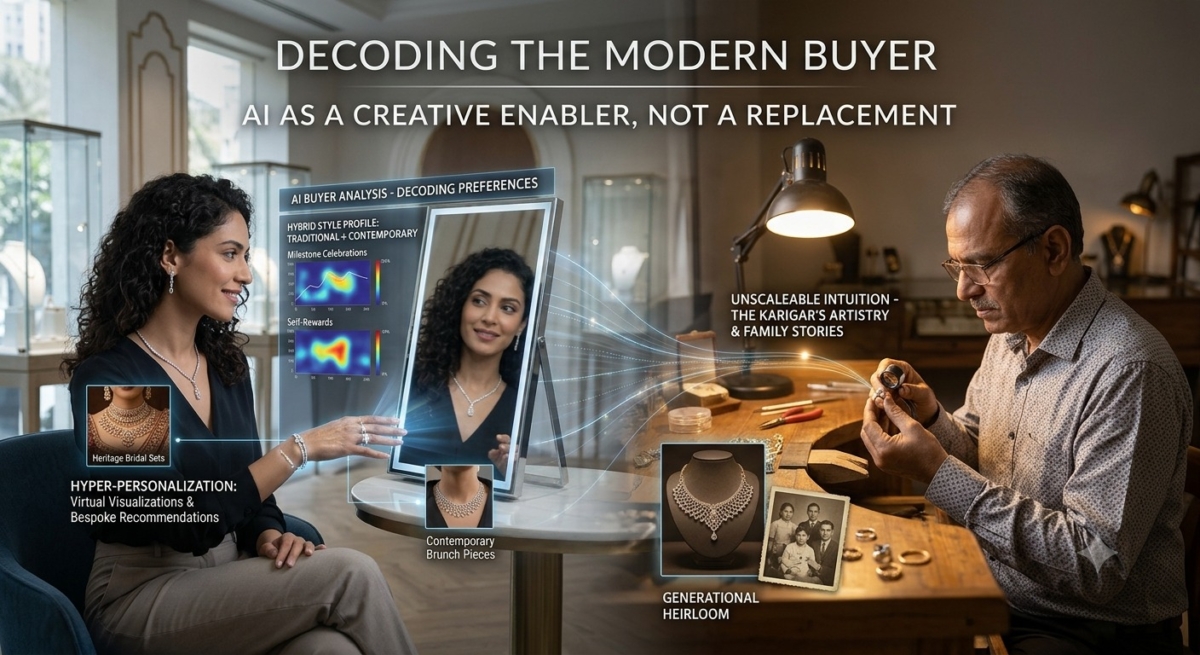
If you think AI is just a backend factory tool, think again. It’s also reading the room—and the customer.
In hyper-discerning markets shoppers want it all: a heritage bridal set steeped in tradition for the wedding, and sleek, contemporary pieces for Monday morning brunch.
By analyzing buyer behavior, AI helps jewellers nail hyper-personalization, offering virtual visualizations and bespoke directions tailored to specific milestones, self-rewards, or celebrations.
Remember: You can’t code the intuition of a seasoned karigar hand-setting a diamond, nor can an algorithm translate a family’s multi-generational story into an heirloom. AI is a creative enabler, not a replacement.
Pixels, Faux-Models,
Of course, the revolution isn’t just happening at the workbench—it’s taking over your feed. Traditional luxury shoots are notoriously brutal on budgets: massive crews, exotic locations, and logistical nightmares. Enter generative AI, slashing content production times by up to 65%.
Brands are ditching physical sets for surreal, dreamlike digital editorials—picture golden heart pendants floating in zero-gravity landscapes—and tapping virtual influencers to front major drops. Just look at Indian label KALON Art Jewellery, which rolled out its “Wildfire” collection starring AI influencer Naisha Bose.
The Glitch in the Glamour
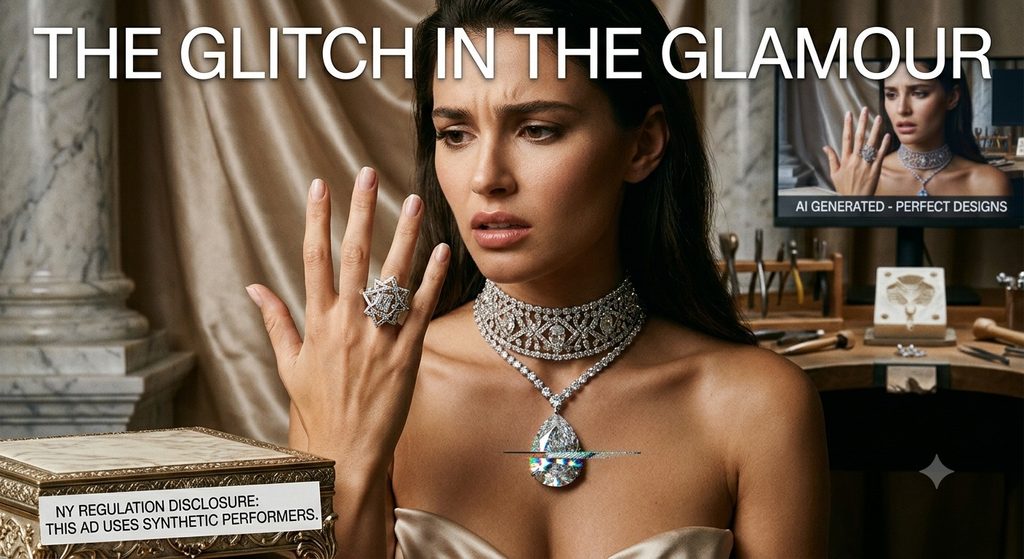
Before we hand the keys of the vault over to our silicon overlords, let’s talk about the catch. For all its swagger, AI still has a glaring blind spot: reality.
Generative algorithms don’t understand physics, metal thickness, or stone-setting mechanics. A ring that looks transcendent on a screen might be structurally impossible to forge in a real workshop without a complete CAD overhaul. Worse, AI still trips over basic human anatomy—nothing kills a luxury vibe faster than a viral campaign featuring a model with six fingers or a warped gemstone.
Then there’s the trust factor. Buying fine jewellery is an emotional, high-stakes flex, and consumers are starting to push back when they realize the radiant model wearing a diamond choker doesn’t actually exist.
The law is catching up, too—New York just passed a landmark regulation forcing brands to slap a disclosure label on ads using “synthetic performers.”
The Verdict
The future of fine jewellery isn’t a cage match between the algorithm and the artisan—it’s a collab. The brands poised to win the next decade are the ones bold enough to let AI handle the heavy lifting of data, speed, and hyper-personalization, while fiercely protecting the raw, messy, irreplaceable magic of human craftsmanship.

-

 National News35 minutes ago
5 Ways To Elevate Your Diwali Style With Diamond Stacking
-

 National News3 hours ago
P N Gadgil Jewellers Limited – Diwali Sales Update
-
 JB Insights3 hours ago
Jewellery Advertising and Promotion Hijacked By AI and Algorithms
-
 BrandBuzz7 hours ago
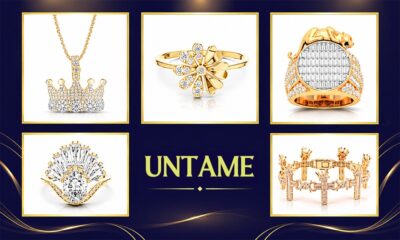
UNTAME Launches In India With Versatile Everyday Fine Jewellery