JB Insights
Jaipur Jewellery Show 2023


JJS 2023 HIGHLIGHTS
- Over 50,000 visitors
- Around 1000 premium retailers
- 1100 exhibition booths
- 67% Designer Booths
- Exclusive B2B Traders Pavilion ‘Pink Club’
The 21st edition of the Jaipur Jewellery Show (JJS) was held from 22nd to 25th December, 2023 at the Novotel Jaipur Convention Centre, Jaipur. JJS 2023 was inaugurated by Deputy Chief Minister of Rajasthan, Diya Kumari. In her address she said jewellery industry is employment giver; providing a direct employment for 2 lakh persons. JJS concluded on 25 December 2023 with a Valedictory Ceremony; the Chief Guest on the occasion was Deputy Chief Minister of Rajasthan, Dr Prem Chand Bairwa.

Guest of Honour Vipul Shah, Chairman GJEPC said “2023 has been a challenging year for the gems and jewellery industry owing to the geopolitical concerns and economic downturn. However, the industry has bounced back and is experiencing a gradual but significant rise. The GJEPC and jewellers are jointly taking various initiatives such as the diamond bourse in Surat and the upcoming one in Jaipur to make India a key global hub in this sector.”
Pramod Derewala, Chairman of NGJCI said that the Gem & Jewellery industry of Jaipur is contributing towards the economy of the state as well as the country by way of foreign exchange earnings, tax revenue and employment generation.

In his welcome address, Chairman JJS, Vimal Chand Surana said that the Jaipur Royal family has been a huge supporter of the gems and jewellery industry in the city. The Jaipur Jewellery Show is an important and progressive show and it has grown from strength to strength over the years.
Saiyam Mehra, Chairman, GJC “There is an exceptional display of jewellery here and JJS is giving a tough fight to all international shows.”
Putting special focus on the gemstone ‘Emerald’, the theme for this year’s JJS was ‘Emerald… Your Stone Your Story’. To promote Emerald, a group of 15 members was formed as the Emerald Promotion Group with GEMFIELDS as the prime emerald promotion partner.
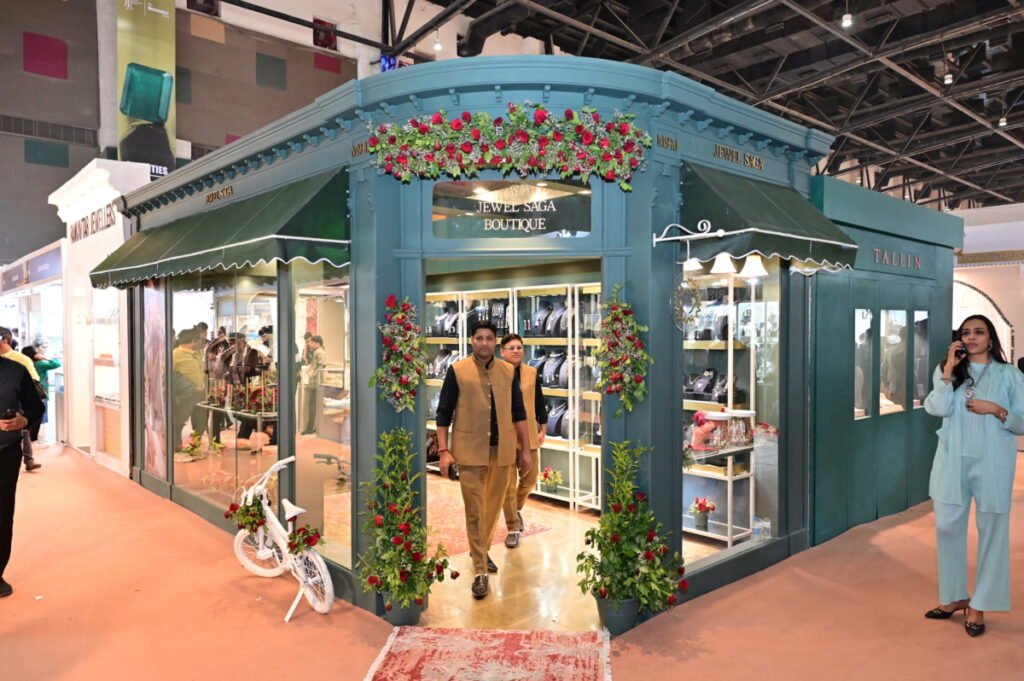
Visitors came source exquisite ornaments of emerald, gold, diamond, silver, coloured gemstones, kundan meena, polki, jadau, among others. While buyers come across the usual display of a wide variety of goods both in colour gemstones and diamonds – the metals, beads and carving were equally popular. At the same time, B2C – Consumers got an opportunity to see nearly 1000 plus booths displaying goods- they could simply pick and buy from a number of sellers.
Nearly 1000 top retailers of India participated in the show. These retailers visit the show every year on the invitation of JJS. Over 50 specially invited GJC members attended JJS.
A grand networking dinner was organised on the evening of the second day of JJS. This year’s brand ambassador of JJS and actress, Pooja Batra and Gemfields India Head, Gopal Kumar were also present at the event. Like its previous editions, JJS 2023 also witnessed encouraging business in terms of trade networking, exhibitors and participating members.
An exclusive B2B Traders Pavilion ‘Pink Club’, which was introduced at JJS 2022, was the main attraction at JJS. Only B2B customers were able to visit this pavilion for B2B interaction.
To celebrate and promote designers, JJS hosted Jaipur Jewellery Design Festival (JJDF) for the sixth time, this year with the theme ‘Go Tech & its effect on the Jewellery Industry’.

‘Taraash’ is a new and one-of-its-kind initiative that was kick started at JJS 2023. The objective is to contribute to the development of the start-up ecosystem, specifically for GJ industry. This is a joint initiative of JJS and TiE Rajasthan.
Indian Jewellery Design Awards-2023 took place on the first day of JJS. Film actor, Malaika Arora’s presence graced the evening at the awards.
Navrattan Kothari, Chairman, KGK Group, received the Lifetime Achievement Award for Outstanding contribution to gems and jewellery trade, particularly for his long innings in the diamond sector.
JJS 2024 will be held from 20th to 23rd December












JB Insights
CIBIL Score Plays A Key Role In Festive Financing
A Consumer’s CIBIL Score and Report Play A Decisive Role In Determining Loan Eligibility, Interest Rates, and Overall Borrowing Terms During High-Spending Seasons.


Gold in India is more than just a precious metal; it represents tradition, emotion, and long-term financial security. As major celebrations such as Dhanteras, Diwali, and the upcoming wedding season approach, consumer demand for gold reaches its annual peak.
However, with gold prices rising due to both global macroeconomic pressures and heightened domestic demand, an increasing number of buyers are turning to credit options—specifically gold loans and personal loans—to finance their festive purchases.
In light of these market dynamics, maintaining awareness of one’s financial profile is critical.
A consumer’s CIBIL Score and Report play a decisive role in determining loan eligibility, interest rates, and overall borrowing terms during high-spending seasons.
The Mechanics Behind Festive Gold Price Surges
Gold prices do not move in isolation. The seasonal increase in retail price is driven by a combination of key domestic and international factors:
Global Economic Uncertainty: International market volatility frequently drives capital into gold as a traditional safe-haven asset.
Macroeconomic Indicators: Currency fluctuations and persistent inflation impact local procurement costs.
Domestic Seasonal Demand: Concentrated buying during auspicious cultural dates creates short-term supply-demand imbalances, further driving up retail costs.
The Strategic Role of Your CIBIL Score in Festive Financing
When household budgets face pressure during peak shopping periods, credit-based financing offers immediate liquidity. Whether securing an uncollateralized personal loan or a loan against existing gold holdings, financial institutions rely heavily on credit risk assessments.
The CIBIL Score—a 3-digit numerical summary ranging from 300 to 900—serves as the primary benchmark for creditworthiness:
Approval Probability: A high CIBIL Score significantly increases the likelihood of quick loan sanctioning.
Cost of Capital: Lenders offer competitive, lower interest rates to high-scoring applicants, reducing total borrowing costs.
Flexible Repayment Structure: Favorable credit profiles grant borrowers stronger leverage to negotiate manageable tenure options.
Best Practices for Smart Festive Borrowing
To enjoy festive celebrations without compromising long-term financial stability, consumers are advised to adopt responsible borrowing strategies:
Check Credit Reports Early: Review your CIBIL Report prior to applying for financing to resolve any discrepancies or evaluate your standing.
Borrow Within Limits: Limit loan amounts strictly to what can be comfortably serviced within monthly household budgets.
Maintain Timely Repayments: Ensure all equated monthly installments (EMIs) are paid on time to avoid negative marks on your credit profile.
By pairing festive financial planning with active credit monitoring, consumers can meet their cultural commitments while preserving robust financial health for the future.


-

 International News12 hours ago
US Holiday Shopping Expected To Top $1 Trillion For The First Time: NRF
-

 National News6 hours ago
Belgian Consul General H. E. Mr. Pierre Stverlynck Graces BDB Annual Day
-

 National News7 hours ago
Limelight Lab Grown Diamonds Crosses 100 Stores Milestone This Dussehra: Targets 200 In 2027
-

 New Premises7 hours ago
Joyalukkas Opens Its 2nd Bengaluru Showroom in Jayanagar