
DiamondBuzz
JA, key industry persons met Washington officials on concerns about Russian sanctions
Jewelers of America (JA) and key industry figures met with lawmakers in Washington, DC, last week to express their concerns about plans for sanctions on Russian diamonds.


Jewelers of America (JA) and key industry figures met with lawmakers in Washington, DC, last week to express their concerns about plans for sanctions on Russian diamonds.
“JA has been working tirelessly behind the scenes, and this visit to Washington, DC, was a critical step to ensure we minimize unnecessary disruptions to the US diamond industry,” JA president and CEO David Bonaparte said in a statement Tuesday. “We are very concerned about the additional requirements that could take effect on September 1.”
These would include adopting a European Union proposal forcing all 0.50-carat and larger diamonds destined for Group of Seven (G7) markets to pass through a single import channel in Belgium, Bonaparte noted.
JA supports efforts to keep diamonds of Russian origin out of the supply chain, including the more stringent rules that went into effect on March 1, it said. These require importers to self-certify that diamonds of 1 carat or larger are not Russian, notwithstanding their having been manufactured in a third country.
However, mandating physical verification and certification in Belgium for all rough diamonds “would cause maximum damage to the global diamond and jewelry supply chain, while having minimal effect on Russia’s diamond revenues,” JA argued in the statement.
Joining Bonaparte on the visit were Jon Bridge, chairman and counsel emeritus at Ben Bridge Jeweler; Dave Meleski, president and CEO of Richline Group; Matthew Swibel, vice president for sustainability and social impact at Signet Jewelers; and Ronnie VanderLinden, immediate past president of the Diamond Manufacturers Importers Association of America (DMIA) and president of the International Diamond





DiamondBuzz
888.88-Carat Infinity Diamond Unveiled At Dubai Diamond Conference 2026
An Extraordinary Fancy Black Natural Diamond, Fashioned From A 1,138-Carat Rough Stone Discovered In The Democratic Republic Of The Congo, Highlights The Enduring Importance Of Rarity, Provenance and Craftsmanship In The Natural Diamond Industry.

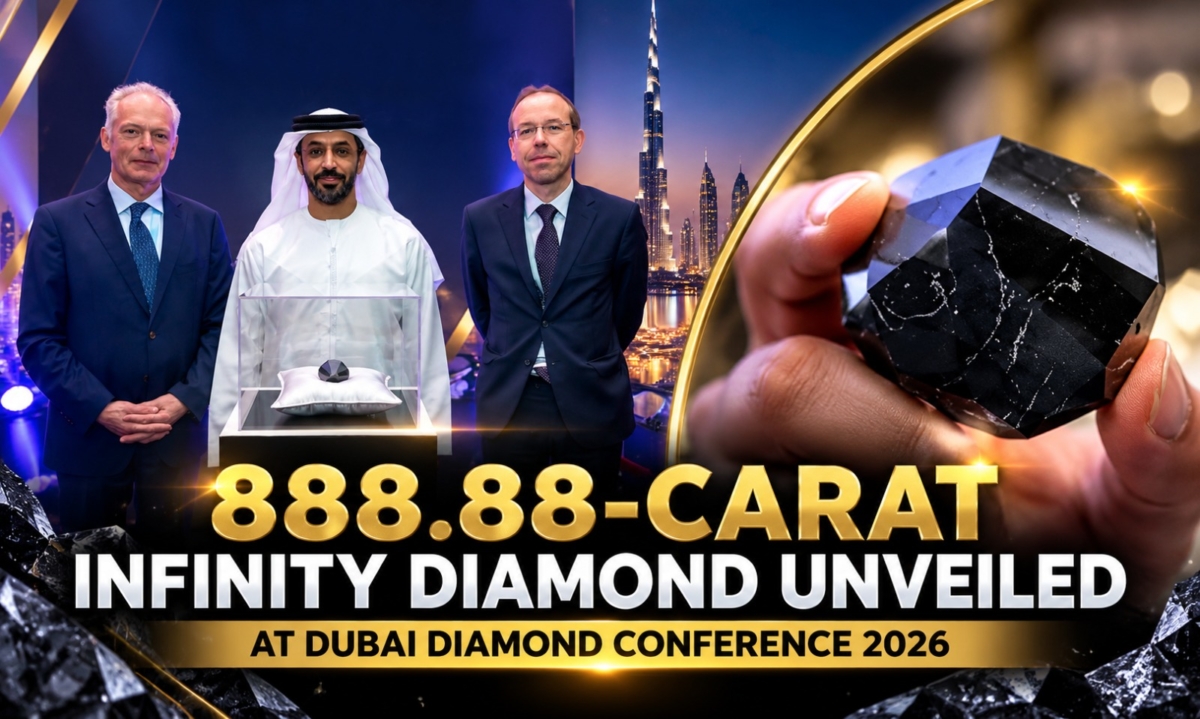
The Dubai Diamond Conference 2026 featured the unveiling of the Infinity diamond, an exceptional 888.88-carat fancy black natural diamond presented by Diamond Trading NV. The remarkable stone brought together a compelling history spanning five decades, exceptional natural characteristics and an intricate transformation from a 1,138-carat rough diamond into a finished gemstone of extraordinary scale.
Originating from the Democratic Republic of the Congo (DRC), the diamond’s story dates back to 1975, when Andrew Coxon acquired the rough stone on behalf of De Beers. Its journey from acquisition to finished diamond reflects the combination of geological rarity, specialist assessment and the technical expertise required to work with an exceptional natural stone.
From a 1,138-Carat Rough to an Extraordinary Finished Diamond
The Infinity diamond’s origins distinguish it from conventional diamond discoveries and commercial cutting projects. Weighing 1,138 carats in its rough form, the stone represented a significant natural specimen even before the transformation that would ultimately give it its present identity.
In 2013, the rough diamond was examined by the Gemological Institute of America (GIA). At that time, the institute documented it as the largest single-crystal natural diamond it had examined and reported on. The assessment added an important gemological dimension to the stone’s history, establishing a documented reference point for its exceptional size and natural origin.
The diamond subsequently underwent an extensive transformation between 2022 and 2024, culminating in the finished 888.88-carat Infinity diamond. Converting a rough diamond of this magnitude into a finished gemstone requires careful evaluation of its natural structure, the distribution of material within the stone and the desired final form. Every decision must balance the preservation of the diamond’s distinctive characteristics with the technical requirements of shaping and finishing it.
The difference between its original weight of 1,138 carats and its finished weight of 888.88 carats reflects the material removed during the transformation process. However, the significance of such a project extends beyond weight retention: the objective is to reveal and preserve the qualities that make an exceptional natural diamond distinctive.
The Significance of Its Fancy Black Colour
The Infinity diamond’s designation as a fancy black natural diamond adds another dimension to its appeal. Unlike the colourless diamonds that traditionally dominate discussions of high-value diamond grading, fancy black diamonds occupy a distinctive position within the broader natural diamond market.
Their appearance, visual character and rarity offer a different aesthetic from the brilliance and transparency commonly associated with colourless diamonds. Black diamonds can appeal to collectors, designers and luxury consumers seeking stones that make a strong visual statement while offering an alternative to conventional diamond jewellery.
For an exceptionally large natural diamond, colour and character become integral to its identity. The Infinity diamond’s scale, black appearance and documented history combine to distinguish it from more familiar categories of high-value diamonds.
Its presentation also illustrates the breadth of the natural diamond category, which encompasses stones with widely differing colours, structures, sizes and visual properties. Such diversity can create opportunities for specialist collectors and luxury brands to explore new interpretations of exclusivity and design.
Provenance: A Defining Element of Natural Diamond Value
The Infinity diamond’s history demonstrates why provenance has become an important consideration in the natural diamond business. Its documented journey—from the Democratic Republic of the Congo and its acquisition in 1975 to its examination by GIA in 2013 and transformation between 2022 and 2024—provides a historical narrative that extends well beyond the finished gemstone.
In the premium diamond market, provenance can contribute to a stone’s identity by connecting its geological origin with its ownership, assessment and subsequent development. For exceptional stones, this historical record can distinguish an individual diamond from others with similar physical characteristics.
Craftsmanship Behind the Transformation
Transforming a rough diamond weighing more than 1,100 carats into a finished stone weighing 888.88 carats is an undertaking that calls for specialised technical knowledge and careful planning.
Large natural diamonds present challenges that differ considerably from those encountered in the cutting of more conventional stones. Their internal structure, natural features and overall form influence the decisions involved in processing them. The scale of the material increases the importance of understanding how each stage of the transformation may affect the finished diamond.
The Infinity diamond’s development over the 2022–2024 period highlights the time and expertise that can be involved in bringing an exceptional rough stone to its finished form. Its presentation at the Dubai Diamond Conference offered an opportunity to appreciate the result of that process and the relationship between a diamond’s natural formation and the human skill involved in shaping it.
For the wider diamond industry, such projects also reinforce the importance of specialist expertise in handling rare stones. While technology continues to influence diamond evaluation, planning and manufacturing, the transformation of exceptional natural diamonds remains a highly specialised discipline.
Dubai’s Role in the Global Diamond Industry
The unveiling at the Dubai Diamond Conference 2026 placed the Infinity diamond before an international audience in one of the world’s important diamond trading centres.
Dubai has developed a prominent role in the global diamond trade, connecting producers, manufacturers, dealers, retailers and other market participants across established and emerging trading corridors. Its position as an international commercial hub provides a setting in which exceptional stones can be presented to industry stakeholders and discussed in the context of wider market developments.
The display of a diamond of this scale also offers an opportunity to highlight the diversity of the natural diamond business. Alongside the large volumes of rough and polished diamonds that move through global trading centres, exceptional individual stones attract attention because of their rarity, distinctive characteristics and historical significance.
For Dubai, presentations of this nature contribute to the city’s profile as a venue for industry engagement, commercial networking and the showcasing of significant diamonds. They also provide a platform for conversations about the role of natural diamonds in the luxury economy and the factors that shape their long-term appeal.
Reinforcing the Appeal of Natural Diamonds
The Infinity diamond’s unveiling comes against a backdrop in which the diamond industry continues to address changing consumer preferences, evolving product categories and the need to communicate the distinctive attributes of natural diamonds.
Its story offers a different perspective on the value proposition of natural stones. Rather than focusing exclusively on size, price or conventional grading characteristics, the diamond brings together several elements: an exceptional rough weight, a documented historical record, a distinctive fancy black appearance and a transformation extending across several years.
These attributes underline how individual natural diamonds can develop identities of their own. For collectors and luxury consumers, the appeal of a rare stone may lie not only in its physical properties but also in its geological origins, documented history and the craftsmanship involved in its transformation.
At the same time, an individual unveiling should not be interpreted as evidence of broader market-price movements or changing consumer demand. The Infinity diamond is a singular example of an exceptional natural stone, and its significance is best understood through its specific characteristics and history.



Gargi By P N Gadgil & Sons Invites Women To #GETNOTICED This Diwali In New Campaign With Mithila Palkar

IBJA, SAARTHI 360 Sign MoU To Launch ‘NextGen CEO: Leadership for the Future’

Jos Alukkas Unveils New Website For A Seamless Online Jewellery Shopping Experience

Dhanteras Shopping Guide 2026:Gold, Silver, Diamonds & Festive Jewellery Trends To Watch

The Solenne Collection: A Celebration Of Diwali By Bharti Bangur Fine Jewels

From Diya Puja To Diwali Soirées: Jewellery Designed To Go Beyond The Festive Season
-
 JB Insights4 days ago
Dhanteras Shopping Guide 2026:Gold, Silver, Diamonds & Festive Jewellery Trends To Watch
-
 BrandBuzz4 days ago
The Solenne Collection: A Celebration Of Diwali By Bharti Bangur Fine Jewels
-
 BrandBuzz4 days ago
From Diya Puja To Diwali Soirées: Jewellery Designed To Go Beyond The Festive Season
-

 National News4 days ago
Indriya, Aditya Birla Jewellery Unveiled India’s Largest Sustainable Jewellery Rangavalli
