Connect with us

International News

India, UK sign historic free trade agreement FTA; gems and jewellery, leather, textiles sectors stand to gain

Published

on

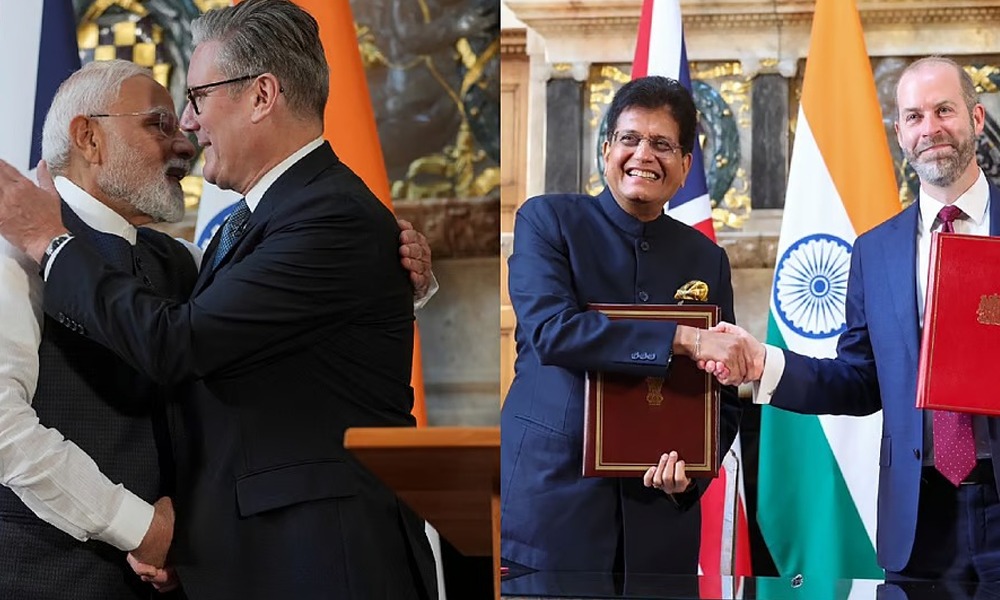
The United Kingdom and India signed a historic free trade agreement (FTA), boosting bilateral trade by around $34 billion annually. The FTA, signed during Prime Minister Narendra Modi’s visit to the UK, includes tariff cuts, improved mobility for professionals, and market access guarantees that together mark one of India’s most comprehensive trade pacts.

The FTA offers duty-free access to the UK’s $23 billion market, giving Indian MSMEs a strong advantage over other countries in labour-intensive sectors such as gems and jewellery, leather and footwear, textiles. India’s gems and jewellery exports to the UK are currently valued at $941 million, with jewellery alone accounting for $400 million. With the UK importing $3 billion worth of jewellery annually, India’s exports are expected to double in 2–3 years.

The deal took three years to reach and also commits to a new India-UK plan to tackle illegal migration.Opponents had warned the deal could undercut British workers due to extended social security terms, but UK Business Secretary Jonathan Reynolds said this was “completely wrong” and Indian workers on temporary secondment to the UK would get the same deal already offered to many other countries.

The trade deal is expected to ensure comprehensive market access for Indian goods across all sectors and India will gain from tariff elimination on about 99 per cent of tariff lines (product categories) covering almost 100 per cent of the trade values, the officials said.

After signing the landmark deal, the two prime ministers are also expected to unveil an “UK-India Vision 2035” to take their partnership to new heights in a time of rapid global change.

The UK said Indian consumers will benefit from improved access to the best British products — from soft drinks and cosmetics to cars and medical devices — as average tariffs will drop from 15 per cent to 3 per cent after the FTA kicks in.


Continue Reading
Advertisement JewelBuzz Banner
Click to comment
Subscribe
Notify of
guest
0 Comments
Oldest
Newest Most Voted
Inline Feedbacks
View all comments

International News

WGC Gold Market Commentary: Hiking Up A Volcano

Gold Is Also Facing Near-Term Headwinds and Significant Oil Shock Could Prolong The Malaise.

Published

on

Gold fell 1% in May, on continued positive risk sentiment and modest global gold ETF outflows.

The Fed may need to hike rates as inflation pressures mount. We make the case for why it could – surprisingly – benefit gold. But gold also faces headwinds, which could be prolonged if the Hormuz standoff drags on.

Nothing to see here

Gold fell 1% in May, finishing the month at US$4,546/oz, and marginally lower in most major currencies. India and Turkey saw monthly gains

According to our Gold Return Attribution Model (GRAM), there were no stand out drivers for gold’s performance in May from the explicit variables in the model. Positive risk sentiment via equity inflows, less bond inflows, and a fall in implied volatility proved a minor drag, alongside gold ETF outflows from Asia and the US (US$2.3bn, 17.3t). US dollar weakness helped gold at the margin, as did momentum factors including European gold ETF inflows (US$0.3bn, 1.2t). Other opaque flows – possibly in the over-the-counter (OTC) market, not captured explicitly in our model – may have been a contributor to the negative residual.

COMEX managed money futures positioning continued to linger in neutral territory with a very modest gain of US$1.4bn (8t) in May.

Hiking up a volcano

The Fed may have to hike later this year and that could spell trouble for risk assets and the economy. History is mixed when it comes to hikes and gold’s response

Notable precedents show similarities to today and on those occasions gold responded positively to a hike

But gold is also facing near-term headwinds and significant oil shock could prolong the malaise.

Following a somewhat contentious US rate-cutting cycle that began in 2024, the market has pivoted to the strong possibility of rate hikes into year-end and beyond, with a firm economy facing pass-through inflation pressures. This could weigh on risk assets through discount rates, as well as increase borrowing costs for households and businesses.

Convention has it that higher policy rates pressure gold through higher real yields and a stronger US dollar. The evidence is mixed. Historically, rate hikes have not seen a uniform response from yields, the dollar or gold.

The data: Gold has positively surprised on hikes more than 50% of the time. It’s median one-month (21-day) return following hikes – adjusted for the long-run average 21-day return of 0.84% – has been positive.1

Context: What matters more than the policy rate itself is how markets interpret the implications of tightening for growth, inflation credibility, financial stability and the US dollar

This time may be different: In prior cycles, hikes often signalled policy credibility and economic normalisation. Today, however, hikes may increasingly signal:

Persistent inflation pressure as resource nationalism ramps up

Fiscal stress both in the US and abroad

Policy error risk on more divergent FOMC views, political pressure and the fear of getting it wrong (again).

Cue the US dollar: Historically the US dollar appeared more important to gold’s fortunes than to rates. Medium term growth and yield convergence, and a diversification push away from US assets, has set quite a clear path for a weaker dollar ahead, upon which consensus is agreed.

Other things matter: Demand from China, India and central banks is structurally less sensitive to US rates and could provide support beyond the current lull

Risk asset fragility: Higher rates may prove to be the last straw for equity markets. Aside from the mechanical repricing of discount rates, Vanda Research notes that even relatively modest rises in long-end Treasury yields have repeatedly destabilised short-term equity rallies over the past couple of years.2

When and why hikes benefited gold

There are notable historical precedents during which gold bucked expectations with a positive hike

29 June 2006: This was the final hike in a cycle; housing was slowing and growth concerns were mounting. Gold was also in an early innings of rate-insensitive buying from a recently liberated Chinese investment market, the advent of gold ETFs, and a commodity boom. In other words, the Fed was hiking into fragility and ‘other’ things mattered – as they do today

15 March 2017: The post-election reflation trade and long-dollar positioning had become crowded. The hike was interpreted as dovish relative to expectations and long-end yields declined.3 The case for a resumption of dollar weakness today is strong and widely held even as positioning is neutral

19 December 2018: Markets interpreted the hike as a policy error, resulting in a sharp equity sell off4 and long-end yields collapsed. The possibility today of a policy error with a more divided and potentially politicised Fed is non-zero

2 November 2022: An aggressive hiking cycle collided with growing market fragility. The UK LDI crisis had already destabilised bond markets and the US dollar subsequently peaked.5 Today long bond yields are rising across the G10 on fiscal fears and long-term inflation concerns. And gold has a decent track record of responding to geopolitical spikes

22 March 2023: The Fed tightened into acute banking stress. Long-end yields fell sharply as markets accelerated expectations of a pause and eventual easing.6 There are no clear signs of banking stress today, but concerns have grown over private credit.

What could go wrong?

Our argument is not that a hike is inherently bullish for gold.

Historically, hikes have tended to be negative for gold if they strengthen the US dollar, lift real yields and boost sentiment If a hiking cycle materially improves the market’s assessment of Fed credibility, gold could face additional pressure.

Some physical markets appear to have softened, with discounts in India, South Korea and anecdotal evidence of some selling in Japan. Global gold ETF flows have been lacklustre in May. The possibility of sporadic official-sector swaps or sales remains as the Hormuz Strait standoff continues. Technically, gold remains vulnerable – perched on its 200-day moving average, in what looks like a declining channel.

The largest near-term risk may come from energy markets. Oil is dominating headlines and inflation expectations, as well as driving bond yields. A sharp rise in energy prices driven by inventory depletion could initially push yields higher, strengthen the dollar and extend gold’s current malaise before the longer-term implications become apparent.7

Our main models generally associate rate rises with gold price falls, with price rises the exception rather than the rule. The argument here is simply that if hikes ultimately arrive, there is a reasonable case for the exception to occur. Rather than reinforcing confidence, markets may interpret them as evidence of underlying fragility.

Continue Reading

Trending

JewelBuzz is Asia’s First Digital Jewellery Media & India’s No.1 B2B Jewellery Magazine, published by AM Media House. Since 2016, we’ve been the trusted source for jewellery news, market trends, trade insights, exhibitions, podcasts, and brand stories, connecting jewellers, retailers, and industry professionals worldwide.

We would like to hear from you...

GET WHATSAPP NEWS ALERTS

0
Would love your thoughts, please comment.x
()
x