
International News
Guyana’s Small Diamond Miners Chase Gold As Rough Supply Collapses
With Gold Appreciating and Small Rough Diamonds Losing More Than Half Their Value Over The Same Stretch, The Economic Logic For Alluvial Operators Points Firmly Away From Diamonds

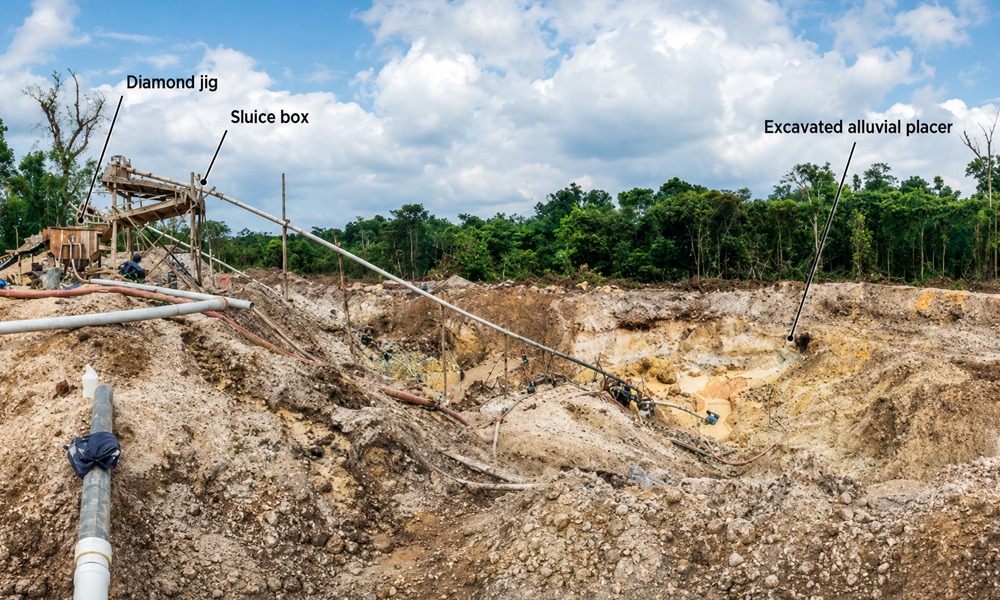
Small-scale diamond miners across several producing countries are abandoning diamond pits for gold pans, and nowhere is the shift more visible than in Guyana, where alluvial operators are converting equipment once used to dig for rough stones into gold-recovery rigs.
The move is a practical one. Alluvial mining setups — sluices, dredges, and washing plants — require little modification to switch from separating diamonds to separating gold, and in Guyana the geography makes the transition even easier: diamond mines sit directly alongside gold concessions, so miners can relocate their operations without leaving the district.
A 70–80% Drop in Six Months
Guyana has never experienced such a decrease in diamond exports. Year-on-year, in the first six months of 2026, the drop in available rough diamonds is 70% to 80%. That is not a gradual softening of supply — it is a near-collapse in the volume of rough reaching the market, driven by miners simply choosing to dig for a different commodity next door.
What Guyanese Rough Looks Like
Guyana’s run-of-mine production is typically sorted through -6 and -11 sieves, split between makeables and sawables. The profile skews small: most goods are 1 carat and under, and roughly 85% of the parcel value sits in half-carat-and-smaller sizes. Large stones are genuinely rare — in a 1,000-carat parcel, no more than six to ten stones will weigh over 2 carats each.
Color is a signature feature of the origin. Guyanese rough often carries a greenish surface tone caused by external spotting, but once cut and polished, most of it comes out H color or whiter. Some material stays light brown, though the parcel mix is offset by the occasional fancy green — among the most sought-after and hardest-to-find colors in the trade.
The Economics Behind the Exodus
For miners weighing which commodity to chase, Grouper reduces the decision to a single comparison.
With gold appreciating and small rough diamonds losing more than half their value over the same stretch, and with the equipment and concessions already in place to make the switch, the economic logic for alluvial operators points firmly away from diamonds. The result is a supply squeeze that is now showing up directly in Guyana’s export figures — and, if the pattern holds across other small-producer nations, one that could tighten availability of small, fine-color rough well beyond Guyana’s borders.




International News
U.S. specialty jewellery retailers recorded a 5.7% y-o-y revenue increase in Sept 2026:Tenoris
The growth continues to be driven primarily by high-end purchases rather than sales volume. Average consumer spend per item jumped 11% in September, offsetting an 11% drop in sales volume for lower-priced merchandise.

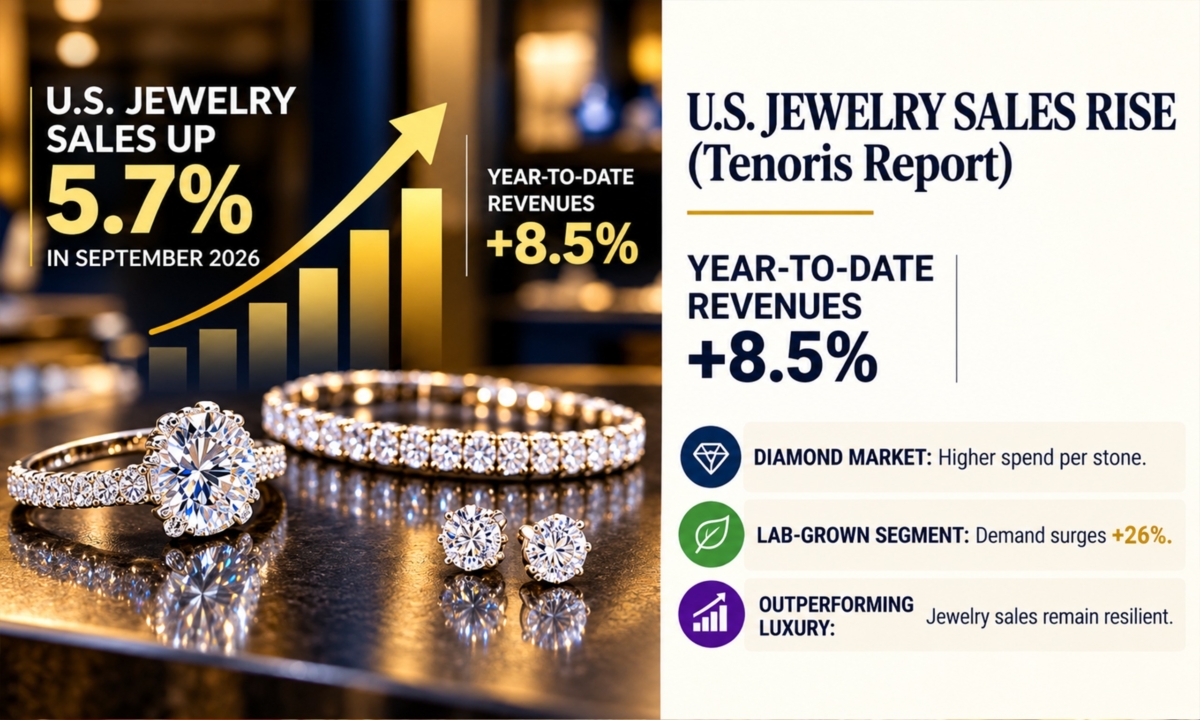
U.S. specialty jewelry retailers recorded a 5.7% year-over-year revenue increase in September 2026, extending nearly two years of continuous monthly growth despite broader economic headwinds, according to new data from industry analytics firm Tenoris. Year-to-date jewelry revenues are now up 8.5%.
The growth continues to be driven primarily by high-end purchases rather than sales volume. Average consumer spend per item jumped 11% in September, offsetting an 11% drop in sales volume for lower-priced merchandise.
Key insights from the September report include:
- Diamond Market Dynamics: Sales of finished diamond jewelry dipped slightly by 0.6%, though average spending per stone rose 11%.
- Lab-Grown Segment: Demand for lab-grown diamond jewelry surged nearly 26% year-over-year. However, revenue for loose lab-grown diamonds fell for a fifth straight month due to declining prices.
- Outperforming Broader Luxury: While overall U.S. luxury spending fell 6% in September—according to recent Citi credit card data—jewelry sales remained comparatively resilient, driven by affluent buyers.
When overall revenue increases even as the number of individual items sold drops, it creates a optical illusion of growth. On paper, top-line financial performance looks strong, but underneath, the business is relying on fewer transactions at much higher prices.Heading into the high-volume fourth quarter—driven by holiday shopping—this dynamic presents specific operational challenges and strategic risks for jewelry retailers.



U.S. specialty jewellery retailers recorded a 5.7% y-o-y revenue increase in Sept 2026:Tenoris

GJC lauds GST 2.0, says it is landmark reform that ushers in a new era of trust, transparency, for GJ sector

Titan Jewellery portfolio posts 21% yoy growth in Q2 FY27
-

 National News3 days ago
P N Gadgil Jewellers Limited – Quarterly Update Q2FY27
-

 National News3 days ago
57th GST Council Recommends Faster Refunds, Lower Penalties and Simpler Compliance
-

 BrandBuzz2 days ago
9 Special Gemstones for this Navratri By Irasva Fine Jewellery
-
 International News2 days ago
U.S. specialty jewellery retailers recorded a 5.7% y-o-y revenue increase in Sept 2026:Tenoris
