

National News
GSI’s Colored Stone Professional (CSP) Programme Explores New Mine in Sri Lanka
Students visited the Rakwana Gem Deposit, observing mechanised mining, gravel sorting, and recovery of sapphires, chrysoberyl, spinel, and tourmaline

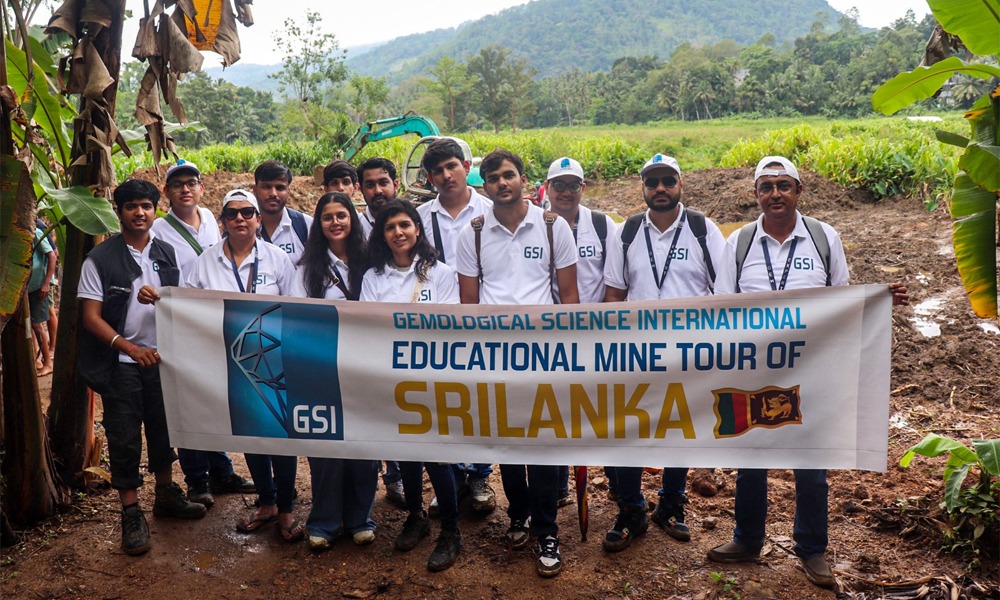
GSI’s Colored Stone Professional (CSP) Diploma programme, recognised for its innovative combination of theoretical knowledge and practical, real-world experiences, recently embarked on an educational mine visit to Sri Lanka’s renowned Rakwana Gem Deposit. As part of the recent CSP student cohort, the visit was organised to provide comprehensive and immersive exposure to the gemstone pipeline, encompassing mining, processing, and trading.
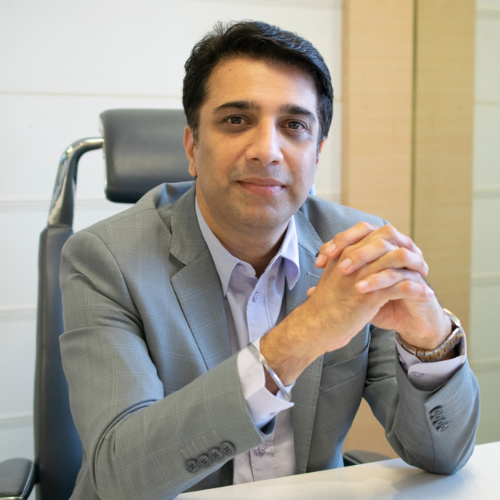
“Experiences such as these are essential for developing a well-rounded understanding of the gemstone industry,” says Ramit Kapur, MD, GSI India. Sri Lanka, with its rich heritage and world-renowned gemstones, provides the perfect backdrop for such learning. By engaging directly with the mining process and following the journey through cutting, processing, and trade, students not only bridge the gap between geological science and commerce but also gain a true appreciation of the value each gemstone carries through its transformation.
As part of the field visit, students explored the Rakwana Gem Deposit in Sri Lanka’s Ratnapura District, a globally recognised source of fine sapphires since 2017. They observed small-scale mechanised mining carried out on agricultural lands, yielding sapphires alongside chrysoberyl, spinel, and tourmaline. The visit also included demonstrations of manual gravel sorting, where skilled miners separate gem-bearing pebbles.
“Classroom learning provides the foundation, but witnessing the journey of gemstones at their source offers an unparalleled perspective,” says Meenu Vyas, Chief Global Gemologist & GSI Education Centre. “Through this visit, students gained first-hand insights into Sri Lanka’s pivotal role in the global gemstone economy and developed a stronger appreciation of the processes that shape a gemstone’s value—from extraction to trade.”

The visit extended to the Karawita Mining Area, where students observed both artisanal and mechanised mining, followed by demonstrations of traditional Geuda sapphire heat treatment in Ratnapura. They also explored the gem markets of Ratnapura and Beruwala, engaging with traders to understand market dynamics, negotiation practices, and global trade systems.
At the Beruwala Gem Cutting Workshop, students witnessed the precision of cutting and polishing sapphires, gaining insight into how cut, clarity, and colour determine value.
GSI’s CSP diploma programme in Jaipur, continues to emphasise the importance of combining theory with intensive practical sessions. Whether students are learning to identify over 1,000 varieties of gemstones, visiting gemstone cutting factories, or learning from industry leaders through guest lectures, the programme provides them with the kind of experience that cannot be learned from textbooks alone.
Through the CSP programme’s experiential approach, students gain a nuanced understanding of the entire gemological process, from mining and cutting to trading. This holistic education not only prepares students to become experts in the field but also shapes them into well-rounded professionals who can drive innovation and ethical practices in the gemstone industry.









India’s appetite for borrowing against gold is reshaping the country’s credit landscape. Outstanding gold-backed loans have surged 128% from a year earlier, crossing Rs.4 lakh crore ($48 billion) for the first time, according to data from the Reserve Bank of India. As of Jan. 31, loans secured by gold jewellery stood at Rs.4,00,517 crore, marking one of the fastest expansions in retail credit in recent years.
The boom in gold loans has helped propel overall non-food bank credit growth to 14.4% year-on-year. Personal loans now account for 34.5% of total bank lending, outpacing other segments and underscoring a broader shift toward consumer-driven credit expansion
Gold loans alone contributed roughly 9% of incremental bank credit during the period. Between January 2024 and January 2026, outstanding gold-backed credit rose by nearly Rs.3.1 lakh crore—an increase of about 338% over two years—more than quadrupling the size of the portfolio.
Two factors are driving the surge. First, gold prices have climbed roughly 152% over the past two years, increasing the collateral value of household holdings. Second, regulatory guidance requiring banks to classify loans secured by gold explicitly as gold loans has sharpened reporting and accelerated balance-sheet growth in the segment.
The trend highlights a distinctive feature of India’s financial system: households’ vast stock of physical gold, long viewed primarily as a store of wealth, is increasingly being mobilized as collateral for formal credit.
While personal lending and credit to nonbank financial companies within the services sector continue to expand rapidly, industrial credit remains uneven. Loans to micro, small and medium enterprises are growing steadily, but borrowing by large corporations has stayed relatively muted.
Since March 21, 2025, banks have added Rs.21.8 lakh crore to their non-food loan books, translating into 12% growth for the financial year to date. Yet it is gold—rather than factories or infrastructure—that is emerging as one of the most dynamic engines of India’s current credit cycle.


-

 National News4 days ago
IIBS-11: Navigating the ‘New Gold Rush’ in a fragmenting global economy
-

 International News4 days ago
Oroarezzo 2026, with Italian Exhibition Group, Manufacturing Explores New Markets
-

 International News4 days ago
Gemfields nets $53m in Bangkok ruby auction
-

 New Premises4 days ago
Limelight Diamonds Unveils Exclusive Visakhapatnam Store in the Presence of Union Minister of Civil Aviation Shri Kinjarapu Ram Mohan Naidu
