
International News
Gold prices in India continued to decline, modest recovery in global prices
geopolitical risks,rising energy prices continue to underpin gold demand globally.


Gold prices in India continued to decline on Thursday, marking the third straight session of losses even as global bullion prices attempted a modest recovery amid rising geopolitical tensions.
In the domestic market, 24-karat gold has fallen sharply over the past three days, with prices dropping by about ₹85,800 per 100 grams. The correction reflects a mix of global market volatility, profit-taking after recent highs, and currency movements affecting local bullion pricing.
As of Thursday morning, 24-karat gold was quoted at ₹16,451 per gram, down ₹311 from the previous session. The price of 22-karat gold slipped to ₹15,080 per gram, a decline of ₹285.
The drop in domestic prices comes even as international gold markets showed signs of stabilizing. Global bullion prices climbed back above $5,160 an ounce on Wednesday after recovering part of their earlier losses.
The rebound followed escalating tensions in the Middle East as the conflict involving the U.S., Israel and Iran entered its fifth day. Reports that Israel targeted a building where clerics were meeting to discuss the selection of a new Supreme Leader heightened geopolitical uncertainty, prompting renewed safe-haven flows into gold.
In India, however, retail bullion prices continued to reflect the recent correction.
On the derivatives side, gold futures on the Multi Commodity Exchange (MCX) were largely flat. The April 2026 contract opened at ₹1,63,265 per 10 grams, traded between ₹1,61,241 and ₹1,64,047 during the session, and was last quoted around ₹1,61,550—up marginally by ₹25, or 0.02%.
Market participants say geopolitical risks and rising energy prices could continue to underpin gold demand globally. Analysts note that if international prices hold above the $5,200 level, bullion could move toward the $5,450–$5,600 range in the near term, with price dips likely to attract strategic buying.


International News
US Holiday Shopping Expected To Top $1 Trillion For The First Time: NRF
While Overall Buying Power Remains High, Ongoing Inflation and Rising Household Costs Mean Some Families Will Have To Watch Their Spending More Carefully Than Others

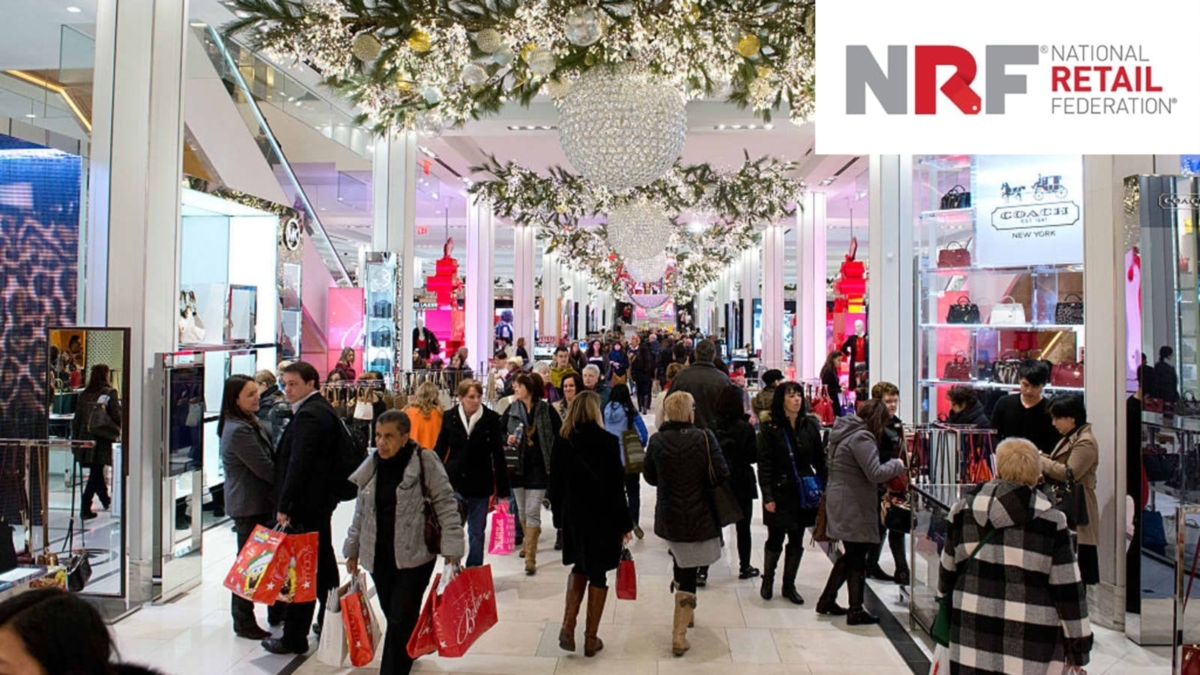
The National Retail Federation (NRF) predicts Americans will spend $1.01 trillion on holiday shopping in November and December. That is a 4.2% jump from $972 billion last year.
NRF said its forecast was based on economic modeling that incorporates consumer spending, employment, wages and historical retail sales data. It excludes automobile, gasoline and restaurant sales
Extra Hiring: To handle the surge in shoppers, stores plan to hire 325,000 to 375,000 temporary holiday workers.
Mixed Budget Impact: Higher gas prices and inflation could still strain some family budgets, affecting low- and high-income shoppers differently.
Retailers expect a strong shopping season because people continue to make holiday spending a priority.
Store owners are ready to attract shoppers by offering competitive prices, deals, and choices for every budget.
While overall buying power remains high, ongoing inflation and rising household costs mean some families will have to watch their spending more carefully than others.



Belgian Consul General H. E. Mr. Pierre Stverlynck Graces BDB Annual Day

Limelight Lab Grown Diamonds Crosses 100 Stores Milestone This Dussehra: Targets 200 In 2027

Joyalukkas Opens Its 2nd Bengaluru Showroom in Jayanagar

US Holiday Shopping Expected To Top $1 Trillion For The First Time: NRF
Belgian Consul General H. E. Mr. Pierre Stverlynck Graces BDB Annual Day
Limelight Lab Grown Diamonds Crosses 100 Stores Milestone This Dussehra: Targets 200 In 2027
-
 International News18 hours ago
US Holiday Shopping Expected To Top $1 Trillion For The First Time: NRF
-
 National News12 hours ago
Belgian Consul General H. E. Mr. Pierre Stverlynck Graces BDB Annual Day
-
 National News13 hours ago
Limelight Lab Grown Diamonds Crosses 100 Stores Milestone This Dussehra: Targets 200 In 2027
-
 New Premises13 hours ago
Joyalukkas Opens Its 2nd Bengaluru Showroom in Jayanagar
