
JB Insights
GEMS & JEWELLERY BANKING SUMMIT
The GEMS & JEWELLERY BANKING SUMMIT held in Mumbai addressed the critical issue of perceived lack of transparency in the GJ industry, due to which bankers are reluctant to finance GJ businesses to a large extent. The industry is facing challenges such as higher interest rates on business loans, lack of transparency on the banking policy, and limited access to bank loans.

Avenues explored for enhancing access to finance, fostering entrepreneurship and catalysing digital transformation
The GEMS & JEWELLERY BANKING SUMMIT held in Mumbai addressed the critical issue of perceived lack of transparency in the GJ industry, due to which bankers are reluctant to finance GJ businesses to a large extent. The industry is facing challenges such as higher interest rates on business loans, lack of transparency on the banking policy, and limited access to bank loans.

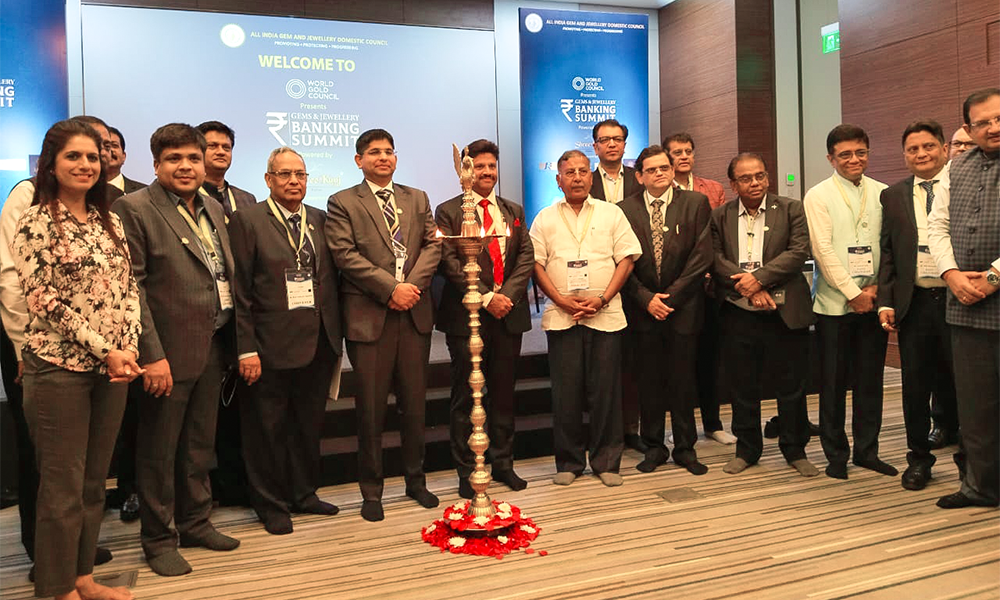
The Gems & Jewellery Banking Summit was inaugurated at the Jio World Convention Centre, Mumbai .Present at the inauguration were Sachin Jain, CEO -WGC, Saiyam Mehra, Chairman -GJC, Rajesh Rokde, Vice Chairman-GJC ,Ravi Prakash Agarwal, Director-GJC and Convenor – Gems & Jewellery Banking Summit, Sunny Dholakia, Co Convenor -Gems & Jewellery Banking Summit, committee members of GJC and dignitaries of the GJ industry and banking & finance sector.
Gems & Jewellery Banking Summit, an initiative of GJC, is presented by WGC. The Summit is powered by ShreeKunj- Kolkata and supported by Banglore Refinery, Mukti Gold , Yes Bank and Laxmi Diamonds, Bengaluru.
The GJ sector communicated to the banks and financial institutions that they want to be treated like any other mature sector. Saiyam Mehra,Chairman- GJC in his inaugural welcome address said “Like other industries, GJ sector is also transforming. The GJ sector is requesting all bankers to treat GJ industry on par with other industries; keep interest rates at 8-9 % with a spread of 0-1%. Additionally the industry is seeking easier policies and facilitation for EMI based buying facilities for end-consumers, credit card swiping interest rates and EDC/POS machine implementation in every retail showroom.”


An advantage of dealing with GJ SECTOR was underscored at the summit::This industry not only provides sales profit but also benefits from price increases. Gold prices rarely decrease, so the increased price profit is also shared with the bankers. Furthermore, the domestic G&J sector has a unique modus operandi, requiring proper KYC of the end consumer, creating a database for more transparency in the sector.
Leading players from the GJ and banking sectors held intensive panel discussions. The session on Strength of the GJ industry: Financing opportunities for Bankers & Building resilience in the GJ industry pointed out that for a long time banks viewed the GJ sector with scepticism. But, there has been a change in the relationship with industry getting organized, especially post the Gold Control Act. There was a unanimous opinion that compliance, governance, ethical and efficient accounting were key to building a reputation as an ethical player. It was essential to share data with banks, maintain accounts and meticulous documentation.
In Understanding of Financial Tools for Jewellery Industry the panelists underscored the importance of taking advantage of facilities offered by banks if one wishes to grow. It is imperative to get a credit rating for one’s business. Finance is based on data, not just on collaterals. There was an intense discussion on the features and modalities of gold metal loan including the fact it is an affordable way of funding and that it is a pure hedge. There were various suggestions from the panel and the audience on how the GML could be streamlined and contributed to ease of doing business.
In the Banking strategy to revitalize and empower session panellists concurred that jewellery industry must take cognizance of the fact that to grow and expand one cannot rely on internal accruals; one has to avail of the funds and products available from banks. The panel concurred that there was lack of awareness on why one should avail of credit – especially against a rising asset like gold.A large percentage of jewellers don’t want to take a loan or don’t get loans because of improper financial statements and documentation.
The panellists in the session Risk Management Mechanism stressed on understanding and respecting regulations and laws of the land .Ratings and credit scores that demonstrate creditworthiness are crucial. It is important to understand that banks don’t wish to place any hindrances, they just work within regulatory and risk management guidelines. Compliance and transparency will be crucial in upliftment of the GJ industry.
The summit concluded on a positive note with both parties keen on continuing the conversation. As Sachin Jain stated that we may not have all the answers and solutions at the end of the summit, but it is encouraging that we have commenced a dialogue.
The next edition of the GEMS & JEWELLERY BANKING SUMMIT is scheduled for 17 May 2025.


JB Insights
CIBIL Score Plays A Key Role In Festive Financing
A Consumer’s CIBIL Score and Report Play A Decisive Role In Determining Loan Eligibility, Interest Rates, and Overall Borrowing Terms During High-Spending Seasons.


Gold in India is more than just a precious metal; it represents tradition, emotion, and long-term financial security. As major celebrations such as Dhanteras, Diwali, and the upcoming wedding season approach, consumer demand for gold reaches its annual peak.
However, with gold prices rising due to both global macroeconomic pressures and heightened domestic demand, an increasing number of buyers are turning to credit options—specifically gold loans and personal loans—to finance their festive purchases.
In light of these market dynamics, maintaining awareness of one’s financial profile is critical.
A consumer’s CIBIL Score and Report play a decisive role in determining loan eligibility, interest rates, and overall borrowing terms during high-spending seasons.
The Mechanics Behind Festive Gold Price Surges
Gold prices do not move in isolation. The seasonal increase in retail price is driven by a combination of key domestic and international factors:
Global Economic Uncertainty: International market volatility frequently drives capital into gold as a traditional safe-haven asset.
Macroeconomic Indicators: Currency fluctuations and persistent inflation impact local procurement costs.
Domestic Seasonal Demand: Concentrated buying during auspicious cultural dates creates short-term supply-demand imbalances, further driving up retail costs.
The Strategic Role of Your CIBIL Score in Festive Financing
When household budgets face pressure during peak shopping periods, credit-based financing offers immediate liquidity. Whether securing an uncollateralized personal loan or a loan against existing gold holdings, financial institutions rely heavily on credit risk assessments.
The CIBIL Score—a 3-digit numerical summary ranging from 300 to 900—serves as the primary benchmark for creditworthiness:
Approval Probability: A high CIBIL Score significantly increases the likelihood of quick loan sanctioning.
Cost of Capital: Lenders offer competitive, lower interest rates to high-scoring applicants, reducing total borrowing costs.
Flexible Repayment Structure: Favorable credit profiles grant borrowers stronger leverage to negotiate manageable tenure options.
Best Practices for Smart Festive Borrowing
To enjoy festive celebrations without compromising long-term financial stability, consumers are advised to adopt responsible borrowing strategies:
Check Credit Reports Early: Review your CIBIL Report prior to applying for financing to resolve any discrepancies or evaluate your standing.
Borrow Within Limits: Limit loan amounts strictly to what can be comfortably serviced within monthly household budgets.
Maintain Timely Repayments: Ensure all equated monthly installments (EMIs) are paid on time to avoid negative marks on your credit profile.
By pairing festive financial planning with active credit monitoring, consumers can meet their cultural commitments while preserving robust financial health for the future.



Joyalukkas Opens ‘Jewel Of Joy,’ The Biggest jewellery Destination In The Middle East’s At Dubai Gold District.

PNG Jewellers Brings Madhuri Dixit and Ranbir Kapoor Together In Its New Brand Campaign, Unstoppable Legacy

GJEPC, IndusInd Bank Host Webinar On FEMA Guidelines For GJ Exporters

US Holiday Shopping Expected To Top $1 Trillion For The First Time: NRF
Joyalukkas Opens ‘Jewel Of Joy,’ The Biggest jewellery Destination In The Middle East’s At Dubai Gold District.
GJEPC, IndusInd Bank Host Webinar On FEMA Guidelines For GJ Exporters
-
 International News5 hours ago
US Holiday Shopping Expected To Top $1 Trillion For The First Time: NRF
-
 New Premises1 hour ago
Joyalukkas Opens ‘Jewel Of Joy,’ The Biggest jewellery Destination In The Middle East’s At Dubai Gold District.
-
 National News4 hours ago
GJEPC, IndusInd Bank Host Webinar On FEMA Guidelines For GJ Exporters
-
 BrandBuzz2 hours ago
PNG Jewellers Brings Madhuri Dixit and Ranbir Kapoor Together In Its New Brand Campaign, Unstoppable Legacy
