
DiamondBuzz
Despite revenue growth in jewellery sector, natural diamond upstream sees stagnation
Lab-grown disruption, soaring gold prices and leaner retail inventories decouple jewellery revenue growth from natural diamond mining and manufacturing demand

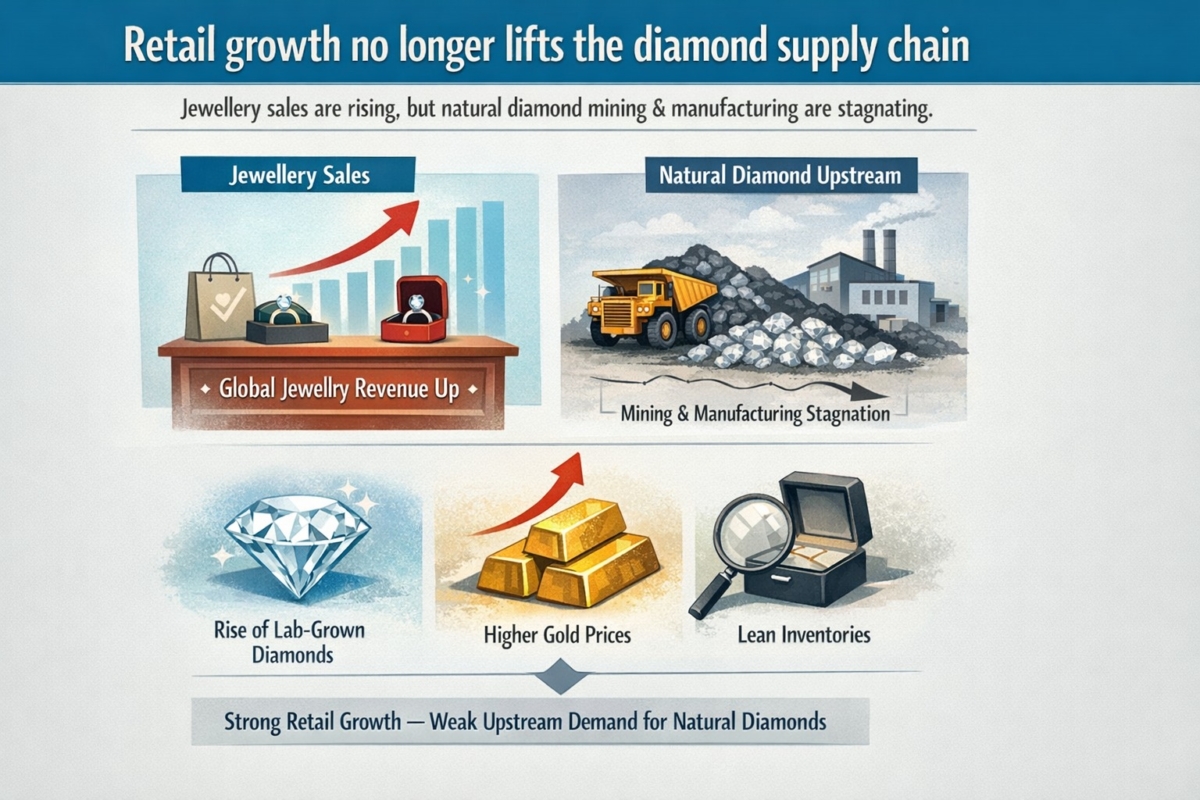
Despite robust revenue growth in the global jewellery sector, the natural diamond upstream (mining and manufacturing) is facing stagnation due to a fundamental shift in product mix and inventory strategy. Jewellery sales are rising across key markets, but a shift toward lab-grown stones, higher gold prices and leaner inventories means that growth at the counter is no longer translating into stronger demand for natural diamonds upstream.
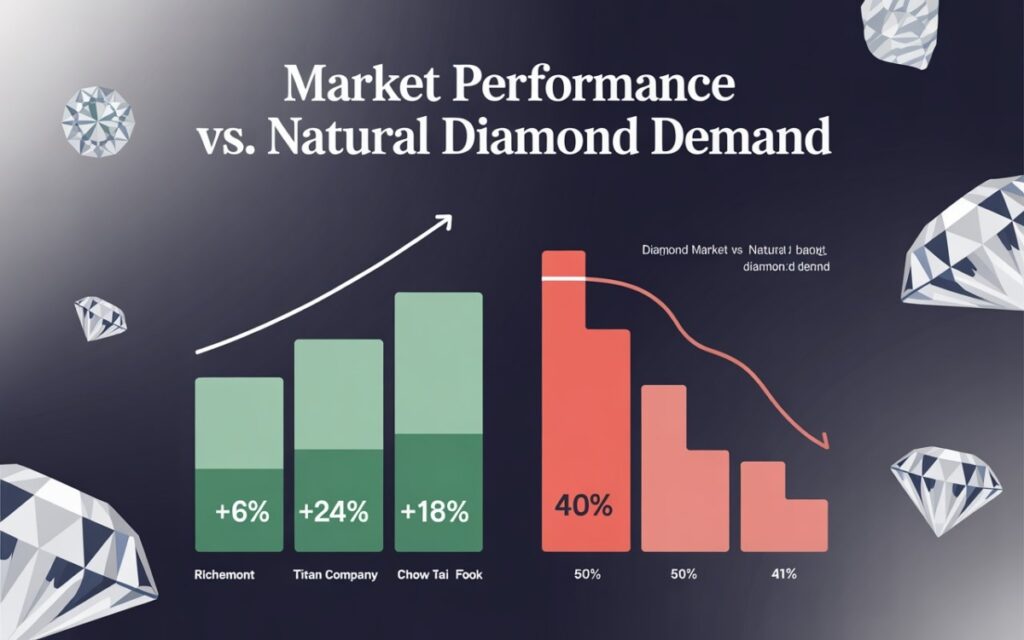
Market Performance vs. Natural Diamond Demand
- Strong Retail Indicators: Major luxury conglomerates and commercial retailers reported significant YOY revenue growth (e.g., Richemont +6%, Titan Company +24%, Chow Tai Fook +18%).
- The Disconnect: While total jewellery revenue is rising, the natural diamond component of that revenue is shrinking. Diamonds now represent ~41% of total jewellery sales, down from 50% a decade ago.
Primary Drivers of Structural Disruption
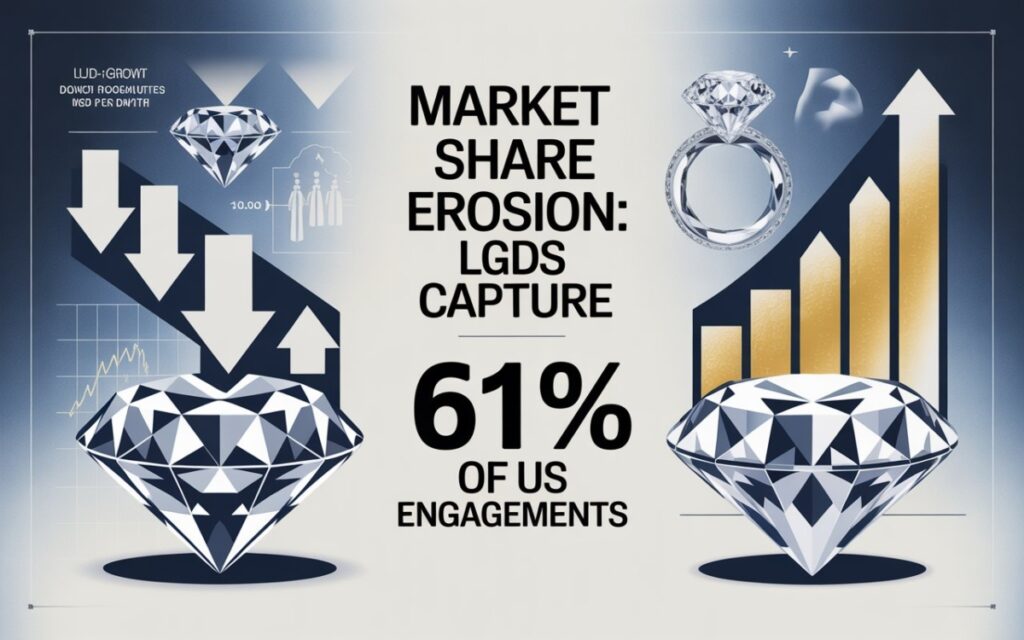
- Market Share Erosion by Lab-Grown Diamonds (LGDs):
-
- LGDs have achieved dominant penetration in the bridal segment (61% of US engagements in 2025).
- Retailers are actively “leading” with LGDs, diverting unit volume away from natural stones.
- Segment Squeezing & Substitution:
- Consumers are opting for larger LGDs at price points previously reserved for 0.50–1.50 carat natural stones.
- This has hollowed out the “mid-market” natural diamond category, forcing upstream demand toward only the highest-value, large stones.
- Commodity Price Pressure (The Gold Factor):
-
- Surging gold prices have absorbed a larger share of the consumer’s total “per-piece” budget.
- Design Engineering: Manufacturers are reducing diamond counts or using smaller accent stones to maintain price points, leading to lower natural diamond volume per SKU.
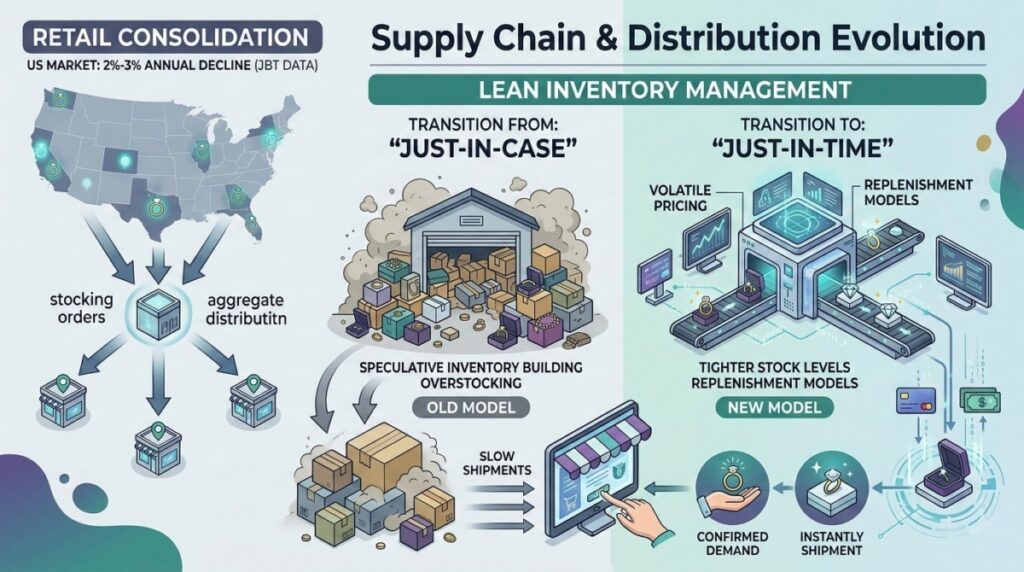
Supply Chain & Distribution Evolution
- Retail Consolidation: The US market is seeing a 2%–3% annual decline in the number of jewellery businesses (JBT data). A smaller retail footprint naturally results in fewer aggregate “stocking orders.”
- Lean Inventory Management: * Transition from “Just-in-Case” to “Just-in-Time” replenishment models.
Retailers are maintaining tighter stock levels due to volatile pricing and high credit costs, buying only against confirmed consumer demand rather than speculative inventory building.
The New Normal for Upstream Stakeholders
The traditional “bullwhip effect” that previously benefited miners and manufacturers has been dampened. Growth at the retail counter no longer guarantees a surge in the midstream. The natural diamond supply chain must now realign for a lower-volume, higher-value environment until natural stones can reclaim a distinct value proposition relative to LGDs and gold-heavy designs.



DiamondBuzz
De Beers Group Sets Out Portfolio and Organisational Actions to Support Long-Term Value Creation
Company outlines strategic cost optimisation, portfolio streamlining and operational changes to strengthen resilience while positioning for long-term growth in the natural diamond industry.

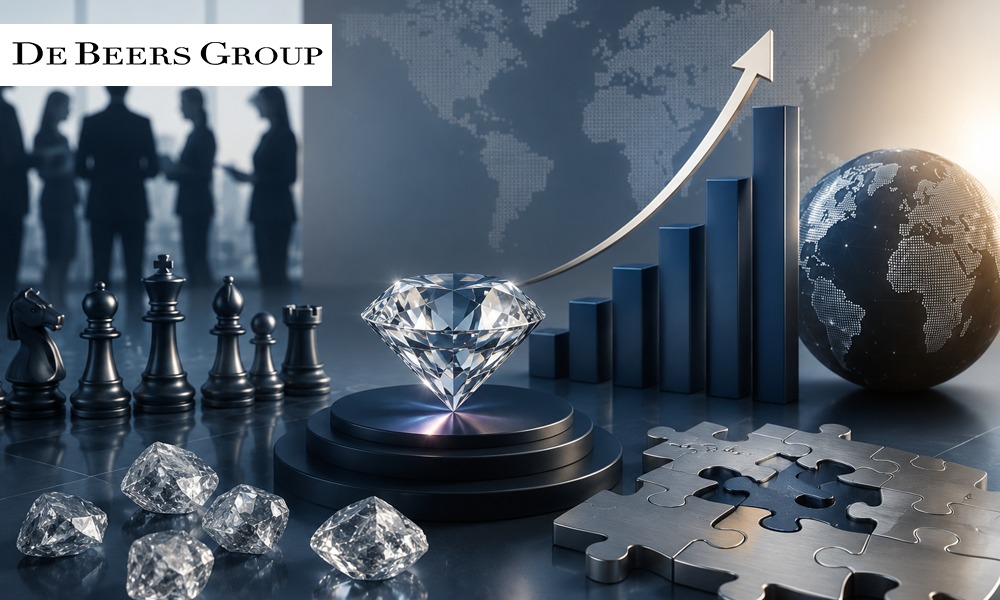
De Beers Group is advancing delivery of its business streamlining by setting out a number of planned portfolio and organisational changes to ensure an efficient cost base that strengthens resilience in the near-term while enhancing future competitiveness and retaining optionality as industry conditions improve.
Since 2024, De Beers has been streamlining its business in line with its Origins strategy to reduce costs, divest non-core assets and prioritise investment in activities that create the most value. Significant progress has been made, with more than $100 million of annual overhead costs removed from the business, the sale or closure of a number of non-core assets and significant capital and cost reconfigurations to asset expansion projects.
Simultaneously, De Beers has reinvested in natural diamond category marketing to support the industry’s efforts to grow natural diamond demand, launching new large-scale campaigns and collaborating with key stakeholders across the value chain to foster industry-wide investment. Global consumer demand for natural diamond jewellery returned to growth in 2025, while natural diamond sales increased across US independent jewellers in 2025 and into Q1 2026, led by higher value diamonds and those promoted by De Beers’ Desert Diamonds marketing campaign.
On the supply side, global rough diamond production is now decreasing, with several producers closing mines during 2026. Whilst the increasing rarity of diamonds and the emerging signs of improvement in consumer demand are likely to support longer-term value creation, rough diamond trading conditions are expected to remain challenging in the near-term due to cyclical and industry-specific factors.
Consistent with recent actions to improve business resilience, De Beers intends to pause production at the Venetia mine in South Africa for two years to reduce costs while also rephasing capital expenditure on its underground project. This will involve critical infrastructure investment to enhance the capacity and efficiency of the mine, with the intention to support future production growth as business and industry conditions improve.
De Beers is engaging with stakeholders in accordance with relevant requirements and the company’s values as it moves through this process, and will both support impacted employees and continue to invest in its community and Social and Labour Plan commitments.
This proposed action at Venetia Mine follows the decision earlier this year to pause the Tuzo Phase 3 expansion project at the Gahcho Kué Mine in Canada.
In parallel, De Beers plans to reconfigure its global operating model to refocus and prioritise resources on the core operational businesses and reduce its central corporate cost base.
Al Cook, CEO of De Beers Group, said:

“In line with our commitment to focus and streamline our business, we are making a number of changes to De Beers to ensure greater business resilience in the near-term, while supporting long-term value creation. We recognise the protracted challenging conditions as the diamond industry evolves, though we are encouraged by signs of consumer demand growth in the US and beyond, particularly in higher quality diamonds.
Global rough diamond supply is falling, bringing more support to the market. The changes we are making to our business are focused on underpinning our efficiency now and into the future, favourably positioning De Beers in its leadership role.”
De Beers Group will maintain current production levels through its other operations, and previous production guidance remains unchanged.



Van Cleef & Arpels Unveils ‘Fascinating Egypt’ High Jewellery Collection Inspired By Ancient Civilisation

Bollywood Star Rakul Preet Singh Unveils Senco Gold & Diamonds’ Flagship Store in Bhubaneswar

Rajiv Jain Elected Chairman Of Jaipur Jewellery Show
Van Cleef & Arpels Unveils ‘Fascinating Egypt’ High Jewellery Collection Inspired By Ancient Civilisation
Bollywood Star Rakul Preet Singh Unveils Senco Gold & Diamonds’ Flagship Store in Bhubaneswar

Vinsmera Jewels Expands UAE Presence With Soft Opening Of New Al Barsha Showroom In Dubai
-
 BrandBuzz5 minutes ago
Van Cleef & Arpels Unveils ‘Fascinating Egypt’ High Jewellery Collection Inspired By Ancient Civilisation
-
 New Premises2 hours ago
Bollywood Star Rakul Preet Singh Unveils Senco Gold & Diamonds’ Flagship Store in Bhubaneswar
-

 BrandBuzz23 hours ago
FIFA Unveils First-Ever 18K Gold Diamond Championship Rings to celebrate Spain’s World Cup Victory
-

 National News22 hours ago
Nature’s Elegance, Reimagined: Lotus Arts De Vivre’s Cape Gooseberry Earrings Continue To Captivate
