National News
Titan Shares Gain as Q2 Profit Soars 59% YoY to ₹1,120 Crore; Jewellery Sales Shine, Morgan Stanley Sets ₹3,953 Target Price
Early festive demand and robust performance across Tanishq, CaratLane, and Zoya fuel Titan’s record quarterly results; analysts remain bullish on sustained growth momentum.

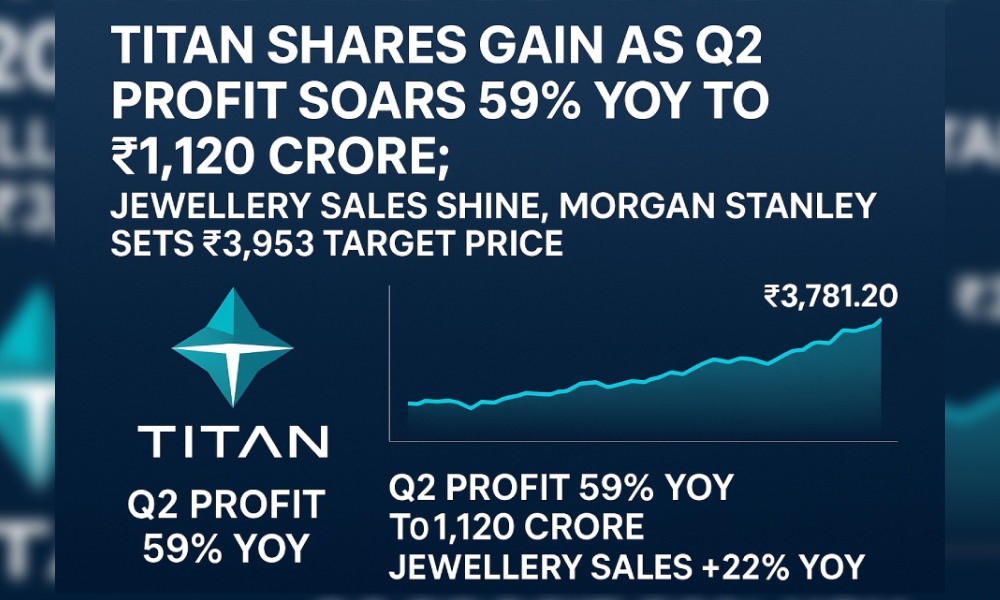
Titan Company shares climbed 1.4% to hit an intraday high of Rs.3,781.20 on the BSE on Tuesday, November 4, after the Tata Group lifestyle major reported a stellar 59% year-on-year (YoY) rise in consolidated net profit to Rs.1,120 crore for Q2 FY26. The surge was powered by a strong festive season boost and stellar performance from its jewellery division, which remained the company’s key growth driver.
Total sales rose 22% YoY to Rs..16,461 crore, reflecting broad-based momentum across business segments. EBITDA jumped 51% to Rs.1,799 crore, aided by improved margins and double-digit growth in most categories.
Titan’s jewellery division—comprising Tanishq, Mia, Zoya, and CaratLane—continued to anchor performance, with total income (excluding bullion and Digi-Gold) rising 21% YoY to Rs.14,092 crore. The domestic jewellery segment, including Tanishq, Mia, and Zoya, grew 18% to Rs.12,460 crore, while CaratLane, Titan’s online-first jewellery brand, registered an impressive 32% YoY growth to Rs.1,072 crore. International operations across the UAE and North America nearly doubled revenue to ₹561 crore, underscoring Titan’s expanding global footprint.
The watches and wearables segment also reported solid growth, with total income up 13% YoY to Rs.1,477 crore, driven by robust demand for Titan, Fastrack, and Sonata. EBIT stood at Rs.238 crore, yielding a margin of 16.1%. The analog watches category recorded 17% growth, fueled by higher volumes and average selling prices.
Titan’s eyewear business, operating under the Titan Eye+ brand, saw income rise 9% YoY to ₹220 crore, with EBIT of ₹12 crore and a 5.3% margin. The company expanded its premium eyewear presence by adding five new ‘Runway’ stores during the quarter.
Following the results, global brokerage firm Morgan Stanley reaffirmed its Overweight rating on Titan and set a target price of Rs.3,953. The brokerage said Titan outperformed expectations across revenue, EBITDA, and profit after tax (PAT) metrics, citing continued margin expansion and festive-driven sales strength.
Titan’s consolidated EBITDA margin (excluding bullion) stood at 11.5%, 64 basis points above consensus estimates. The jewellery business posted a robust 19% YoY growth, supported by higher ticket sizes and sustained festive demand, with the company’s gold exchange programme further boosting volumes despite elevated gold prices. CaratLane’s revenue growth of 32% came with a healthy margin of 10.1%.
Among other segments, watches grew 13% YoY with a 16.2% EBIT margin, while eyewear posted 8% growth with a relatively softer 5.5% margin. Morgan Stanley emphasised that festive demand trends and strong consumer sentiment are likely to sustain Titan’s growth momentum in the coming quarters, reinforcing its leadership in India’s lifestyle and jewellery market.




National News
NPCI Defers Rollout Of UPI Merchant Discount Rate Until After Diwali
Given Typical Retail Margins Of 2%–6% On Bullion and Plain Gold Jewellery, Absorbing A 0.4% Fee—Or Up To ₹300 Per Large Transaction—Would Have Directly Eaten Into Festive Profitability. The Deferral Keeps Bottom Lines Protected Through Dhanteras and Diwali.


The National Payments Corporation of India’s (NPCI) UPI and Services Steering Committee has deferred the implementation of Merchant Discount Rates (MDR) on select person-to-merchant (P2M) UPI transactions until immediately after Diwali.
The move aims to protect consumer sentiment and keep operational costs steady for businesses during the peak festive shopping season. A specific implementation date will be announced separately.
Key Highlights
- Festive Relief for Retail: The deferment ensures merchants face no additional payment processing costs during peak festive demand, helping avoid disruptions to consumer spending.
- The Approved MDR Structure:
- Applies only to eligible P2M transactions above Rs 2,000 at a rate of 0.4%.
- Capped at Rs 300 for high-value transactions of Rs 75,000 and above.
- Everyday low-value payments and small merchants remain fully exempt, preserving zero-cost digital transactions for general consumers.
- Timeline Adjustment: Originally notified on September 15 for an October 15 rollout, the framework will now take effect post-Diwali, giving banks, payment aggregators, and merchants additional runway to align their systems and communicate terms clearly.
Jewellery purchase values routinely exceed the Rs 2,000 threshold and frequently touch or surpass the Rs 75,000 cap. Given typical retail margins of 2%–6% on bullion and plain gold jewellery, absorbing a 0.4% fee—or up to Rs 300 per large transaction—would have directly eaten into festive profitability. The deferral keeps bottom lines protected through Dhanteras and Diwali.
Introducing transaction fees just as footfall surges would have forced retailers to decide whether to absorb the cost or pass it on to buyers (via checkout surcharges or selective discounts). Avoiding this choice prevents awkward billing counter negotiations and cart abandonment during rush hours.



NPCI Defers Rollout Of UPI Merchant Discount Rate Until After Diwali

Mutual Engagement Ring-Wearing On The Rise, Insurance Lagging: Jewelers Mutual Group 2026 Engagement Ring Study

GJEPC Partners With The Leela To Offer Exclusive Hospitality Benefits To Members
-
 National News17 hours ago
GJEPC Partners With The Leela To Offer Exclusive Hospitality Benefits To Members
-

 JB Insights18 hours ago
CIBIL Score Plays A Key Role In Festive Financing
-

 DiamondBuzz18 hours ago
Richemont and Signet Jewelers Could Join Global Diamond Consortium In Bid For De Beers
-

 National News18 hours ago
MCX Gold, Silver Surge Ahead On US Inflation Data, Crude Price Dip