JB Insights
Sovereign Bond Yields and The Strategic Pivot To Gold
When Government Bond Yields Rise Alongside A High Debt-To-GDP Ratio, Debt Servicing Costs Consume A Larger Share Of The Country’s Revenue. This Forces Central Banks To Adjust Their Reserve Assets Toward Zero-Risk Alternatives Like Gold.


Global finance is currently facing a big problem: government borrowing costs are rising sharply around the world, making it much harder for countries to manage their debt.
Here is what is happening and why it matters:
1. Rising Borrowing Costs: G7 vs. India
Between February and September 2026, government bond yields (the interest rate governments pay to borrow money) rose across major economies. However, some countries handled it better than others:
- G7 Nations (Rich Economies): The average 10-year yield surged by over 1.1 percentage points as investors demanded higher interest to hold government debt.
- India: India’s 10-year government bond yield rose by only 0.4 percentage points over the same period, showing much better stability due to strong domestic demand and steady central bank policy.
2. Historic Debt Levels
Global public debt is projected to pass 100% of global GDP by 2030. The world has not seen public debt this high since the end of World War II in 1945.
- Higher Interest Expenses: Countries must now spend a larger portion of their tax revenue just to pay interest on past loans, leaving less money for public services, infrastructure, and business investments.
- Refinancing Risk: Millions of dollars in old, low-interest bonds are maturing. Governments are forced to replace them with new bonds at much higher interest rates.
3. Why Central Banks Are Buying Gold
Because of these debt risks, foreign central banks are changing how they hold their emergency reserve funds:
- US Treasuries Are Losing Appeal: Big government deficits mean the US is issuing massive amounts of new bonds. This oversupply, combined with high inflation and market swings, makes US debt feel less safe to foreign investors.
- The Pivot to Gold: Central banks are diversifying away from US dollars and buying record amounts of physical gold (over 1,000 metric tons per year). Gold carries zero default risk, cannot be frozen by foreign governments, and holds its value during fiscal crises.


JB Insights
Jewellery Advertising and Promotion Hijacked By AI and Algorithms
From decoding what Gen Z wants before they even know they want it, to conjuring surreal ad campaigns featuring models who don’t have a pulse, tech is rewriting the rules of luxury.

By Steve Fernandes
Forget dusty velvet trays and weeks of agonizing over sketches. The jewellery world—an industry notoriously obsessed with heritage, heavy gold, and “the way we’ve always done it”—just got a massive software update.Artificial Intelligence has officially crashed the atelier. From decoding what Gen Z wants before they even know they want it, to conjuring surreal ad campaigns featuring models who don’t have a pulse, tech is rewriting the rules of luxury.
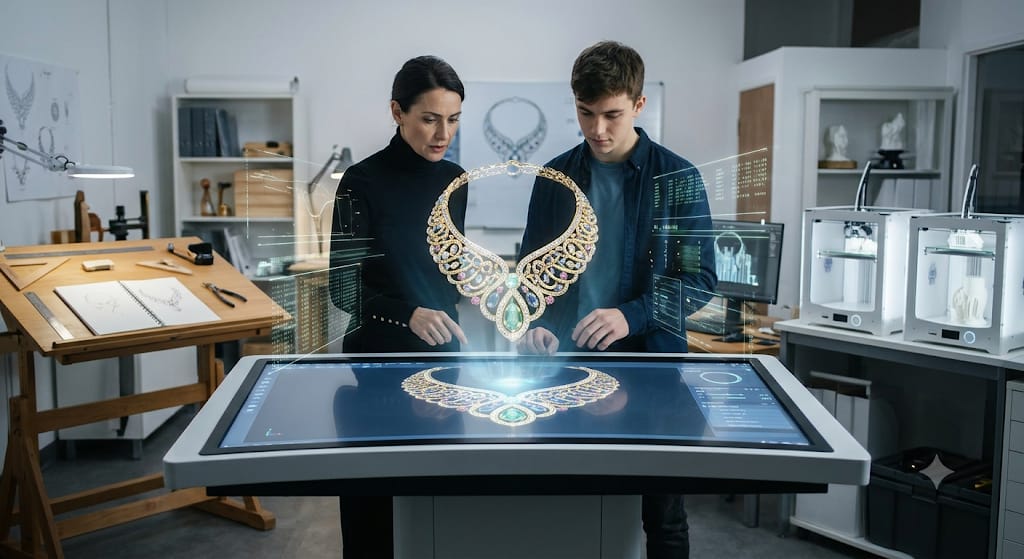
But while algorithms are churning out prototypes at warp speed, the industry’s heavy hitters are drawing a hard line in the gold dust: AI can crunch the numbers, sure, but only human hands can give a piece a heartbeat.
The Tireless Studio Assistant

Walk into a modern design studio today, and you’re just as likely to see prompt engineering as you are pencil shavings. With gold prices hovering in the stratosphere and lifestyles shifting toward lighter, everyday statement pieces, brands can no longer afford to guess what will sell.
The conversation around AI isn’t about replacing artisans—it’s about removing the guesswork. AI test-drives hundreds of variations in gemstones, proportions, and finishes before a single gram of gold hits the workbench. Instead of looking in the rearview mirror at last season’s sales, AI scours search trends and social chatter to predict the next big silhouette.
Pair AI-driven trend forecasting with next-gen hardware—think 3D printing, paper casting, and electroforming—and you get intricate, feather-light pieces hitting shelves at record speed. Throw in blockchain for airtight traceability, and suddenly, the ancient trade of goldsmithing looks straight out of Blade Runner.
Decoding the Modern Buyer
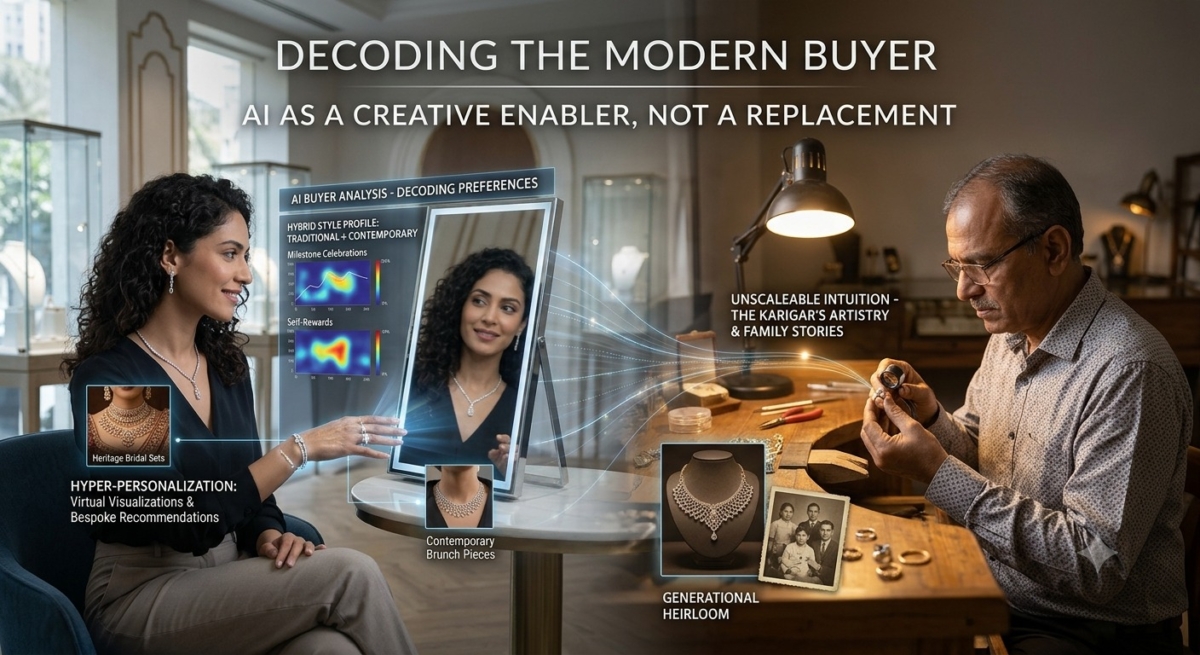
If you think AI is just a backend factory tool, think again. It’s also reading the room—and the customer.
In hyper-discerning markets shoppers want it all: a heritage bridal set steeped in tradition for the wedding, and sleek, contemporary pieces for Monday morning brunch.
By analyzing buyer behavior, AI helps jewellers nail hyper-personalization, offering virtual visualizations and bespoke directions tailored to specific milestones, self-rewards, or celebrations.
Remember: You can’t code the intuition of a seasoned karigar hand-setting a diamond, nor can an algorithm translate a family’s multi-generational story into an heirloom. AI is a creative enabler, not a replacement.
Pixels, Faux-Models,
Of course, the revolution isn’t just happening at the workbench—it’s taking over your feed. Traditional luxury shoots are notoriously brutal on budgets: massive crews, exotic locations, and logistical nightmares. Enter generative AI, slashing content production times by up to 65%.
Brands are ditching physical sets for surreal, dreamlike digital editorials—picture golden heart pendants floating in zero-gravity landscapes—and tapping virtual influencers to front major drops. Just look at Indian label KALON Art Jewellery, which rolled out its “Wildfire” collection starring AI influencer Naisha Bose.
The Glitch in the Glamour
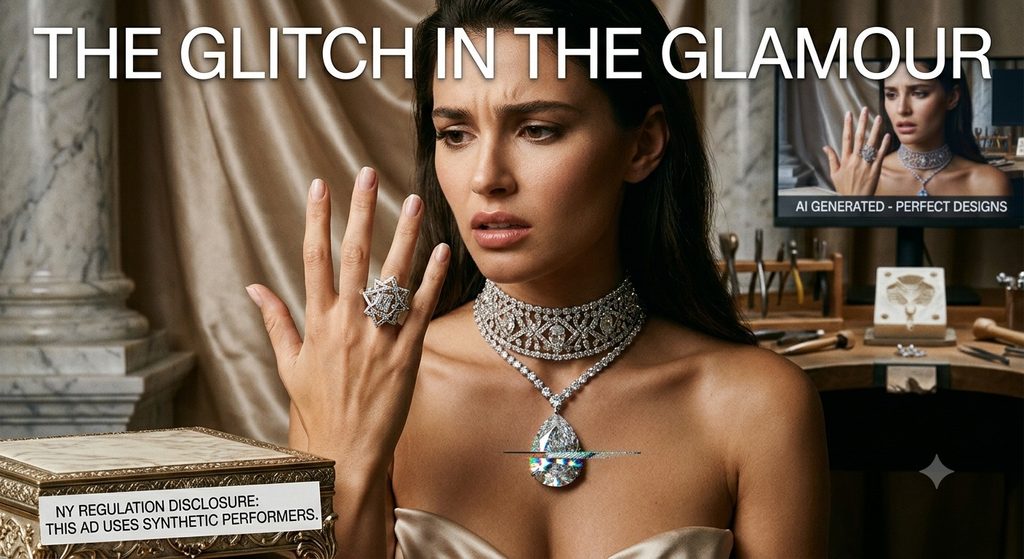
Before we hand the keys of the vault over to our silicon overlords, let’s talk about the catch. For all its swagger, AI still has a glaring blind spot: reality.
Generative algorithms don’t understand physics, metal thickness, or stone-setting mechanics. A ring that looks transcendent on a screen might be structurally impossible to forge in a real workshop without a complete CAD overhaul. Worse, AI still trips over basic human anatomy—nothing kills a luxury vibe faster than a viral campaign featuring a model with six fingers or a warped gemstone.
Then there’s the trust factor. Buying fine jewellery is an emotional, high-stakes flex, and consumers are starting to push back when they realize the radiant model wearing a diamond choker doesn’t actually exist.
The law is catching up, too—New York just passed a landmark regulation forcing brands to slap a disclosure label on ads using “synthetic performers.”
The Verdict
The future of fine jewellery isn’t a cage match between the algorithm and the artisan—it’s a collab. The brands poised to win the next decade are the ones bold enough to let AI handle the heavy lifting of data, speed, and hyper-personalization, while fiercely protecting the raw, messy, irreplaceable magic of human craftsmanship.


-

 JB Insights7 hours ago
Jewellery Advertising and Promotion Hijacked By AI and Algorithms
-

 National News8 hours ago
P N Gadgil Jewellers Limited – Diwali Sales Update
-

 National News5 hours ago
5 Ways To Elevate Your Diwali Style With Diamond Stacking
-

 BrandBuzz11 hours ago
UNTAME Launches In India With Versatile Everyday Fine Jewellery