JB Insights
SILVER SHOW OF INDIA – Delhi 1st Edition Silver dazzles in Delhi


The national capital shimmered in silver! We are talking of SILVER SHOW OF INDIA – Delhi 1st Edition, held at the magnificent Yashobhoomi IICC. Once again SSI proved to be an agent of transformation for the silver industry. The show featured 139 exhibitors spread across 380 booths. SSI saw a footfall of 8700 trade visitors and business of around 300 tonnes of silver being transacted.


Kangana Ranaut, Member of Parliament- Mandi, Himachal Pradesh and a powerhouse of Indian cinema inaugurated the Silver Show of India, Delhi 1st Edition. Present at the inauguration were Guests of Honour Shri T A Sharavana, MLC-Govt of Karnataka, Kirit Bhansali, Vice Chairman, GJEPC and Rajiv Jain, Hon Secretary, JJS, Former Chairman -GJEPC together with Prithviraj Kothari, National President -IBJA, Dr Chetan Kumar Mehta, President, Jewellery Division India- IBJA and Chairman, SSI Organizing Committee, Anurag Rastogi, Head-North India, IBJA Surendra Mehta, National Secretary, IBJA, Sreekanth Urs, MD-GES India Inc and other dignitaries from the GJ industry.
A radiant Kangana Ranaut beamed as she spoke of what she saw at SSI; “I am dazzled at jewellery on at SSI- the elegance, the designs, the variety. I could spend the whole day at SSI.”Speaking of Indian jewellery she said, “Across the ages India has informed and taught the world about precious metals and stones, craftsmanship in jewellery design and adornment. I appeal to all members of the GJ trade and industry to take Indian jewellery to all corners of the globe and showcase its exquisite elegance.”


The scale and importance of SSI was put in perspective by Dr Chetan Kumar Mehta, Chairman SSI, President- Jewellery Division India- IBJA, President –JAB, when he said “A new beginning has started well”.
Sreekanth Urs, MD-GES India Inc, said, “SSI is going to be an annual future in Delhi for all the coming years”.
SSI showcased over 3 lakh designs of silver jewellery designs by 139 exhibitors—across jewellery, artefacts, intricately designed home decor, finely crafted cutlery, and much more. Trade visitors from across India including attended SSI. The variety, innovation and the vast range of product segments and price points makes SSI a must-visit for the silver trade and industry.


SSI has been instrumental in providing respect and recognition to the silver and articles/artefacts segment. It provides a vision to the industry on the tremendous potential of silver. SSI showcases the strength of the industry by bringing such a large number of exhibitors together. As we have always maintained, SSI has truly put SILVER in the SPOTLIGHT!









JB Insights
Jewellery retailers’ Backward Integration Into Jewellery Manufacturing Strategy To Secure Design, Quality, Cost and Delivery Control.

By Steve Fernandes
Indian jewellery retailers are moving into manufacturing to secure design, quality, cost and delivery control. PNG Jewellers’ proposed diamond-and-gold manufacturing subsidiary is the latest example.
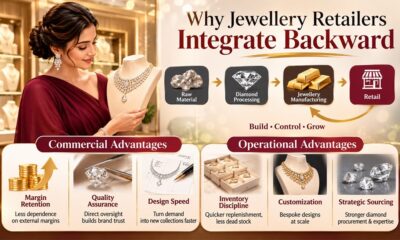
1. Why Retailers Integrate Backward
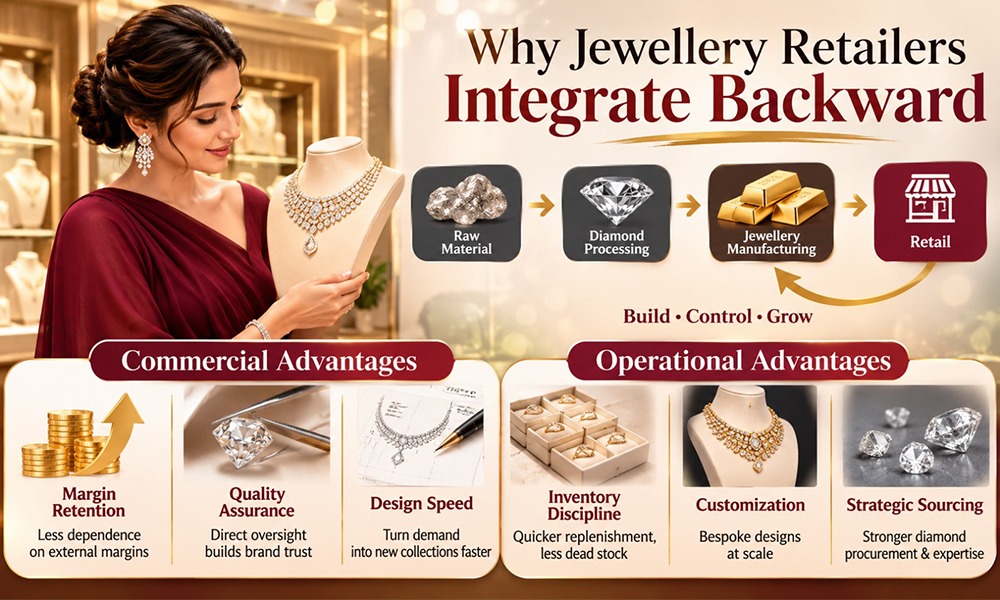
Backward integration means a retailer builds or acquires capability earlier in its value chain, here jewellery manufacturing, rather than relying solely on third-party suppliers. The commercial logic rests on margin capture, differentiation and supply-chain resilience.
1.1 Commercial Advantages
- Margin retention: Less dependence on external conversion margins; better control of product cost.
- Quality assurance: Direct oversight of diamond setting, gold purity, finishing and hallmarking protects brand trust.
- Design speed: Store-level demand signals convert into new collections faster than vendor production calendars allow.
1.2 Operational Advantages
- Inventory discipline: Quicker replenishment of fast sellers; less dead stock in slow-moving SKUs.
- Customization: A captive base supports bespoke, bridal, regional and occasion-led jewellery at scale.
- Strategic sourcing: Stronger diamond procurement, grading and polishing expertise, covering both natural and lab-grown stones.
2. PNG Jewellers: The Move
2.1 Deal Structure
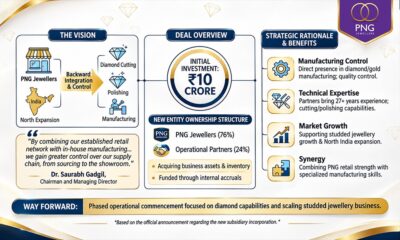
- Structure: Proposed 76%-owned subsidiary for diamond and gold jewellery manufacturing; initial investment of up to Rs 10 crore.
- Partners: Operational partners bring 27 years of technical experience, including cutting and polishing.
- Control with incentive: PNG keeps majority ownership and strategic direction, while the minority stake aligns partners with quality and execution.
2.2 Strategic Fit
- Not a standing start: PNG already has retail reach, a design portfolio and diamond-procurement capability.
- Northern push: Studded jewellery holds a higher market share in several northern states, so assured design range supports expansion there.
- Phased rollout: Validates asset acquisition, production quality, design acceptance and working capital before scaling.
3. How the Majors Compare
PNG’s announcement fits a broader pattern: vertically integrated players combine retail distribution with manufacturing, design and sourcing to create a more controllable value chain.
3.1 Integration Models at a Glance
| Retailer | Model | Highlights |
| Titan / Tanishq | Mature, integrated | Factories at Hosur and Pantnagar; stone-sourcing in Surat and Jaipur; product-development centre in Mumbai; mix of in-house plants, karigar centres and vendors. |
| Malabar Gold & Diamonds | Fully vertical | 15 manufacturing units across five countries and 14 wholesale units in eight. Hyderabad facility integrates design, refining, manufacturing, QA, hallmarking and warehousing; capacity above 4.7 tonnes of gold jewellery and 1.8 lakh carats of diamond jewellery. |
| Kalyan Jewellers | Hybrid | Consolidated manufacturing plus long-term contract manufacturers, supporting a franchise-led retail network. |
| Senco Gold | Regional | Senco Gold Artisanship Pvt. Ltd. preserves Eastern India design identity and supply reliability. |
| PNG Jewellers | Capital-light entry | Majority control with experienced partners; sits between Titan’s integration and Kalyan’s hybrid approach. |
3.2 Key Lesson
Integration need not mean owning everything. Retailers can balance control and flexibility:
- Captive capacity for high-value, design-sensitive, fast-turning products.
- Third-party vendors for overflow, seasonality and lower-complexity lines.
4. Success Factors for PNG
4.1 Execution Priorities
- Start with studded jewellery, where design and quality control matter most.
- Use capacity selectively, retaining external vendors for overflow and regional specialities.
- Build strong governance around diamond procurement, transfer pricing, capacity allocation and quality standards.
4.2 Scaling Discipline
- Prove unit economics before scaling: yield, rejection rates, labour productivity, inventory turns, delivery reliability.
- Link production to retail data, so store-level and regional demand drives designs, not factory capacity.
5. Bottom Line
KEY TAKEAWAY Controlling more of the value chain improves responsiveness and margin capture, but only when manufacturing is tightly tied to merchandising, quality systems and working-capital discipline.


Jewellery retailers’ Backward Integration Into Jewellery Manufacturing Strategy To Secure Design, Quality, Cost and Delivery Control.

IAGES, SPJIMR Commence Inaugural Cohort Of Advanced Leadership Programme In Gold Entrepreneurship In Mumbai

PNG Jewellers To Incorporate New Subsidiary, Strengthening Its Supply Chain and Entering Diamond Jewellery Manufacturing

Redefining Fine Jewellery: How Technological Innovation, Haute Couture Synergy, and Avant-Garde Palettes Are Shaping The Festive & Wedding Season
IAGES, SPJIMR Commence Inaugural Cohort Of Advanced Leadership Programme In Gold Entrepreneurship In Mumbai
Jewellery retailers’ Backward Integration Into Jewellery Manufacturing Strategy To Secure Design, Quality, Cost and Delivery Control.
-
 JB Insights10 hours ago
Redefining Fine Jewellery: How Technological Innovation, Haute Couture Synergy, and Avant-Garde Palettes Are Shaping The Festive & Wedding Season
-
 National News6 hours ago
IAGES, SPJIMR Commence Inaugural Cohort Of Advanced Leadership Programme In Gold Entrepreneurship In Mumbai
-
 JB Insights5 hours ago
Jewellery retailers’ Backward Integration Into Jewellery Manufacturing Strategy To Secure Design, Quality, Cost and Delivery Control.
-
 National News9 hours ago
PNG Jewellers To Incorporate New Subsidiary, Strengthening Its Supply Chain and Entering Diamond Jewellery Manufacturing