
By Invitation
Natural diamonds have to rediscover their relevance to a jaded consumer that wants to separate themselves from the past
By Edahn Golan


Martyn Charles Marriott, drawing on 45 years in the diamond industry, in a blog titled Co-Operation between African Diamond Producers on the IDMA website, advocates for a new era of co-operation among African diamond producers, seeing the current debate around De Beers’ future as an opportunity. He proposes forming a diamond “OPEC,” reminiscent of the stability once maintained by the Oppenheimers’ Central Selling Organization (CSO). The CSO, through a stockpile, quota system, and vast generic advertising historically benefited the entire industry. Marriott believes a collective entity involving nations like Botswana and Angola would be more stable and bankable than a single-country approach.

JewelBuzz spoke to noted diamond industry analyst Edahn Golanon his take on Marriott’s view and how practical and feasible this “ nostalgic yearning” was. This is what Edahn Golan has to say:
I don’t think that resurrecting a monopoly is possible, much less legal. I understand the nostalgic yearning for the ‘good old days,’ but that is not where the solution will be found. On the contrary, the industry at large – and De Beers in particular – needs to evolve and adapt. They both need to reinvent themselves.

Natural diamonds have to rediscover their relevance to a jaded consumer that wants to separate themselves from the past, a consumer market that wants luxury that doesn’t shout bling. Most importantly, diamonds should stand for values that are relevant to today’s cultural norms.
That is where diamonds will find their future, not by reimposing tight control on the pipeline.
I also read Chaim Even-Zohar’s column. I worked with him for many years and hold deep respect for both him and his approach to the industry.
That said, I believe Botswana does not need to go all in on owning De Beers.The country already receives more than 75% of the diamond revenue generated locally, along with a portion of the revenue De Beers earns from its operations in Namibia, Canada, and South Africa. Expanding that share or seeking a larger cut from other countries would only deepen Botswana’s dependency on diamonds.
Instead, Botswana should diversify its income sources and invest more internally, a process it should have initiated more than a decade ago.
For example, if it channels investment into its international airport and succeeds in expanding tourism, the country would generate greater income, reduce its reliance on luxury sales, improve foreign currency inflows, and, in the process, expose more of the world to its diamonds.




By Shivaram A
The Core Issue
The owner carries the entire risk of the business — investment, gold stock, working capital, loans, everything is in their name. The long-term asset also belongs to the owner — reputation, brand, the customer base built over years, often meant to pass to the next generation. But the moment that matters most — when the customer is standing at the counter, when trust is being built or broken — that moment is entirely controlled by the staff.
The person with the most risk is not present at the decisive moment. And the person with the least to lose holds the most power in that moment. This structural mismatch creates frustration on both sides — and it’s rarely discussed openly.
Making the Conflict Explicit
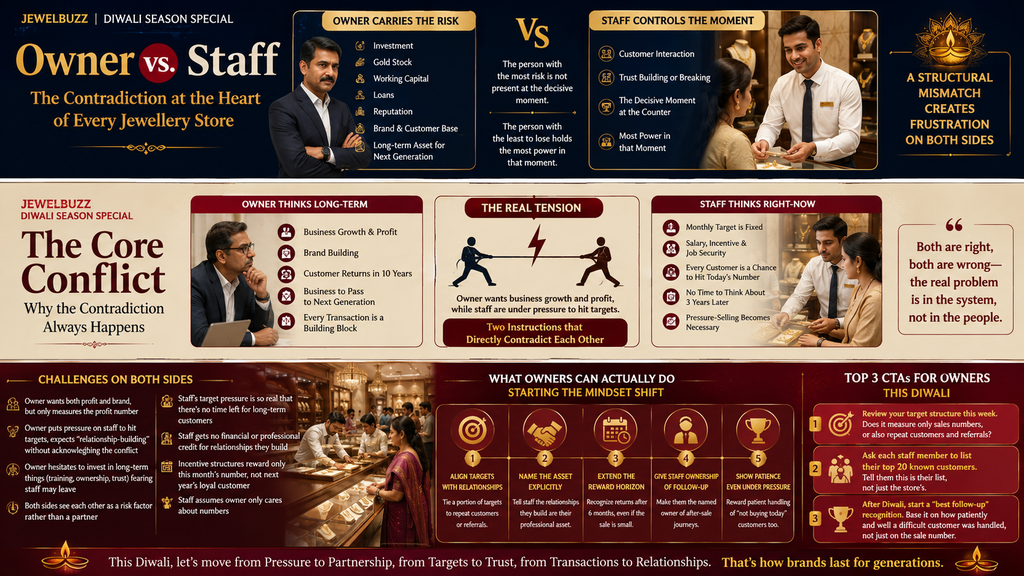
The real tension is this: the owner wants business growth and profit, while staff are under pressure to hit targets.
The owner thinks long-term — how does the brand grow, how does a customer come back after ten years, how does the business pass to the next generation. For the owner, every transaction is a building block toward something bigger.
The staff’s reality is completely different. Their monthly target is fixed. Their salary, incentive, and sometimes even job security depend on how much they sold this month, this Diwali. For staff, every customer is a chance to hit today’s number — right now, this moment. They cannot afford to think about whether this customer comes back in three years, because their performance is reviewed at month-end, not three years later.

So when the owner says “build the relationship, be patient,” and in the same breath increases the target by 20%, these two instructions directly contradict each other. Staff are not confused about what they should ideally do — they understand it perfectly. But they don’t have the choice. The target has to be met, so pressure-selling becomes necessary — even if it means pushing a customer slightly, or using lines like “buy today, rate will go up tomorrow” that create small cracks in trust.
These cracks don’t show up immediately. But after Diwali, when that customer doesn’t return a second time, the owner assumes it’s the staff’s fault. The staff believes the owner set an unrealistic target. Both are right, and both are wrong — because the real problem is in the system, not in the people.
The Challenges on Both Sides
- Owner wants both profit and brand, but only measures the profit number
- Owner puts pressure on staff to hit targets, then also expects “relationship-building” — without acknowledging the two often can’t coexist
- Owner hesitates to invest in long-term things (training, ownership, trust) due to fear that staff will leave anyway
- Staff’s target pressure is so real that there’s no time left to think about the long-term customer
- Staff gets no financial or professional credit for the relationships they build
- Incentive structures reward only this month’s number, not next year’s loyal customer
- Both sides see each other as a risk factor rather than a partner — the owner assumes staff will eventually leave, staff assumes the owner only cares about numbers
What Owners Can Actually Do — Starting the Mindset Shift
- Stop treating targets and relationships as separate — align them. Don’t set targets purely on sales numbers. Tie a small portion of the target to repeat customers or referrals, so staff know that long-term customers count too.
- Name the asset explicitly. Tell staff directly: the relationship you’re building with a customer is your professional asset, not just the store’s. This has to be shown in practice, not just said out loud.
- Extend the reward horizon. Don’t reward only Diwali-week sales — when a customer returns six months later and asks for that staff member by name, recognize that, even if the sale itself is small.
- Give staff ownership of the follow-up. Make each staff member the named owner of their customers’ after-sale journey — repairs, exchanges, the next occasion. This helps them feel the relationship is theirs, not just a transaction.
- Show patience even under pressure. If Diwali week only rewards closed sales, staff will only chase closing. If a staff member who handles a “not buying today” customer well is also appreciated, that’s when the mindset actually starts to shift — because staff notices what the owner actually rewards, not just what they say.
Top 3 CTAs for owners this Diwali
- Review your target structure this week. Does it only measure sales numbers, or does it also give weight to repeat customers and referrals? If not, try a small adjustment starting this Diwali.
- Ask each staff member to list their top 20 known customers. Tell them this is their list, not just the store’s. This builds a sense of ownership.
- After Diwali, start a “best follow-up” recognition. Base it not on the sale number, but on how patiently and well a difficult customer was handled. Staff need to see that patience is rewarded too, not just closing.
Shivaram A
Retail Gurukul



KISNA Diamond and Gold Jewellery Rolls Out Nationwide ‘Shop Sparkle Win’ Campaign Across 218 Cities, With 823 Vehicles Up For Grabs

Nemichand Bamalwa Creates Nav Avatar Necklace For Maa Durga At Indian Museum’s Durga Puja

Kangana Ranaut Unveils PNG Jewellers New Showroom In Ayodhya~

GGJS 2026 Concludes With High-Volume Trade and Strategic Focus On Next-Gen Leadership
Nemichand Bamalwa Creates Nav Avatar Necklace For Maa Durga At Indian Museum’s Durga Puja
KISNA Diamond and Gold Jewellery Rolls Out Nationwide ‘Shop Sparkle Win’ Campaign Across 218 Cities, With 823 Vehicles Up For Grabs
-
 National News7 hours ago
GGJS 2026 Concludes With High-Volume Trade and Strategic Focus On Next-Gen Leadership
-
 National News2 hours ago
Nemichand Bamalwa Creates Nav Avatar Necklace For Maa Durga At Indian Museum’s Durga Puja
-
 National News2 hours ago
KISNA Diamond and Gold Jewellery Rolls Out Nationwide ‘Shop Sparkle Win’ Campaign Across 218 Cities, With 823 Vehicles Up For Grabs
-
 New Premises6 hours ago
Kangana Ranaut Unveils PNG Jewellers New Showroom In Ayodhya~
