National News
MDR For UPI: Credit Card Bill Payments and Jewellery Purchases Remain Free For Consumers
Consumers Are Advised That Merchant-Imposed Surcharges On Card Or UPI Payments Violate Current Payment Guidelines

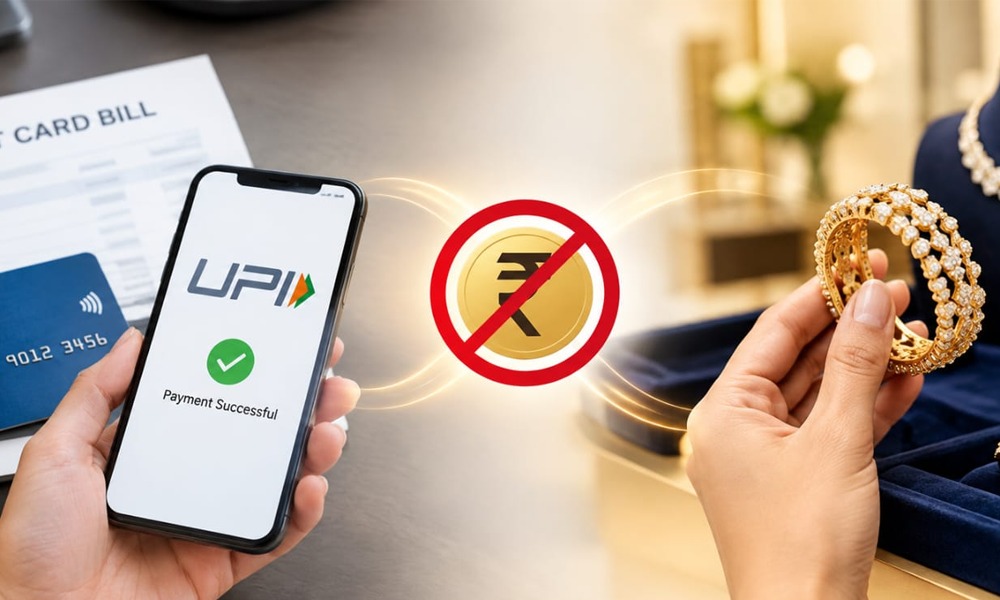
Following recent industry discussions regarding the updated Merchant Discount Rate (MDR) framework for Unified Payments Interface (UPI) transactions, financial experts and industry leaders have clarified that individual consumers will not incur any additional charges when paying credit card bills or purchasing high-value items like jewellery via UPI apps.
Zero Fees on Credit Card Bill Payments via UPI
Despite the implementation of the revised UPI MDR structure, consumers using UPI-enabled applications to pay their credit card bills remain entirely exempt from MDR fees.
No Cost Impact for Users: Cardholders can continue paying their bills through standard UPI QR codes or app-based transfers without losing reward points, credit float advantages, or incurring extra costs.
Understanding BBPS Fees: While standard bank-to-bank UPI transfers do not carry MDR, credit card bill payments processed through the Bharat Bill Payment System (BBPS) may incur small convenience or processing fees set directly by participating payment platforms under their own commercial terms—not as part of the UPI MDR framework.
Framework for Jewellery Purchases and High-Value Merchants
For high-value retail transactions, including jewellery purchases, regulatory guidelines mandate that the burden of MDR falls strictly on merchants, not customers:
Consumer Exemption: Merchants and payment platforms are prohibited from passing MDR charges or platform surcharges directly onto buyers.
Capped MDR for Jewellers: Under the revised Person-to-Merchant (P2M) framework for transactions exceeding Rs 2,000, jewellers and high-value merchants absorb a capped MDR of 0.4% (up to a maximum limit of Rs 300 per transaction for purchases of Rs 75,000 and above).
Payment Transparency: While jewellers absorb nominal fees for bank-linked UPI transactions, standard credit card fees continue to apply to credit card swipes and RuPay-credit card UPI transactions.
Consumers are advised that merchant-imposed surcharges on card or UPI payments violate current payment guidelines.








National News
WGC REPORT- India Gold Demand Trends, Q3 2026
Value Tells A Different Story: Demand Rose 3% Y/Y To INR2,419bn (US$25bn), and Is Up 38% Over Nine Months To INR6,688bn (US$71bn). Buyers Are Spending More To Acquire Less.
India’s gold market recovered sequentially in Q3 but remains well below last year in volume terms. Demand rose 24-25% q/q to 162t, yet stayed 29% lower y/y and 12% lower year-to-date (444t). Value tells a different story: demand rose 3% y/y to INR2,419bn (US$25bn), and is up 38% over nine months to INR6,688bn (US$71bn). Buyers are spending more to acquire less. On the supply side, official imports declined and recycling remained muted, while estimated unofficial inflows increased.
Prices: Domestic gold averaged INR148,891/10g, up 45% y/y on a weak rupee and the higher import duty, while the international price averaged US$4,262/oz (down 5% q/q, up 23% y/y). Domestic prices traded at a record US$43/oz discount to import parity, reflecting unofficial inflows and old-gold supply.
Jewellery: Demand climbed 33% q/q to 100t, helped by late-quarter price softening, weddings and South Indian festivals in August. It remained 20% lower y/y (18% lower year-to-date), partly because key festivals have shifted into Q4 this year.
Investment: Demand eased from last year’s exceptional levels but held up, rising 12% q/q to about 60t. Investment’s share of net demand fell to around 42% from 69% in Q1. Bars and coins rose 9% q/q to 55t but fell 40% y/y; India remains the world’s second-largest bar and coin market (about 21% of global demand). ETF demand improved to 5.3t from 3.6t. Digital gold is expanding (4.9t in Q3, up 76% year-to-date). Mutual funds’ temporary suspension of fresh gold FoF subscriptions in October bears watching, though the ETF impact is likely contained.
RBI: Reserves held steady at about 880.5t, with just 0.3t bought in nine months, signalling a shift from accumulation to maintenance.
Supply: Total supply fell 43% y/y to 136t. Official imports dropped 70% to 64t after May’s duty hike to 15%, while unofficial inflows jumped to about 50t from 3t a year ago. Recycling was muted at 19t (down 12% y/y), suggesting holders are reluctant to sell, possibly expecting higher prices.
Consumer sentiment (WGC-Kantar, Wave 2): Buying intentions strengthened. Those planning to buy more jewellery rose from 20% to 29%, and those planning to cut back fell from 51% to 40%. Purchases are concentrating around weddings and festivals, with more consumers trading down on purity (77%) and exchanging old jewellery (76%). Expectations of further price rises softened (69% to 61%).
Outlook: Seasonal buying should support Q4 demand, though jewellery volumes will likely stay constrained by high prices, and investment demand remains sensitive to price momentum.



-

 JB Insights2 weeks ago
Dhanteras Shopping Guide 2026:Gold, Silver, Diamonds & Festive Jewellery Trends To Watch
-

 BrandBuzz2 weeks ago
The Solenne Collection: A Celebration Of Diwali By Bharti Bangur Fine Jewels
-

 BrandBuzz2 weeks ago
From Diya Puja To Diwali Soirées: Jewellery Designed To Go Beyond The Festive Season
-

 National News2 weeks ago
Indriya, Aditya Birla Jewellery Unveiled India’s Largest Sustainable Jewellery Rangavalli