
International News
Massive 11,000-Carat Ruby Uncovered In Myanmar

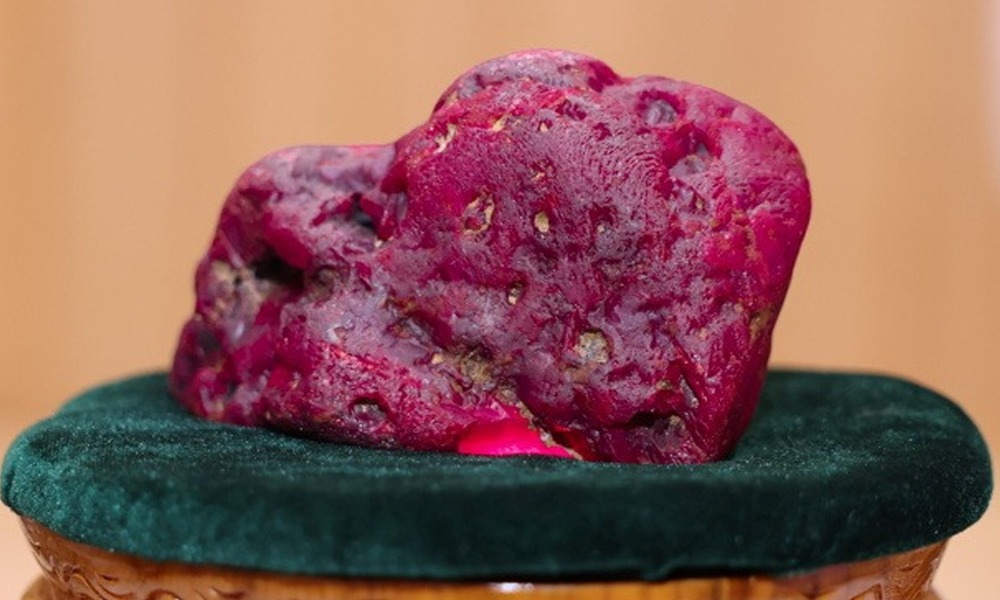
A massive 11,000-carat rough ruby has been recovered in the famed gem-rich region of Mogok, Myanmar, according to recent state media reports.
Weighing in at 2.2 kg (4 lbs 14 oz), the newly discovered stone is roughly half the size of the legendary 21,450-carat rough gem found in the same region back in 1996. However, experts and state officials report that this new find boasts vastly superior color, luster, and transparency.
Mogok rubies, sourced from the “Valley of Rubies” in Myanmar (Burma), are legendary for their unrivaled vivid color and supreme clarity. They are famous worldwide for their “pigeon blood” red hue, which is caused by trace elements and microscopic silk particles that scatter light and give the gem a glowing, velvety softness.
Key Details of the Discovery:
- Physical Properties: The giant gem exhibits a striking purplish-red color with yellowish undertones, excellent vitreous luster, and moderate transparency. It remains entirely in its natural, untreated state.
- Geopolitical Context: Myanmar supplies roughly 90% of the world’s rubies. However, the nation has been embroiled in a devastating civil war since a 2021 military coup—a conflict that has claimed approximately 90,000 lives and displaced over 3.5 million people.


International News
GJEPC India Pavilion at WJSME 2026 showcases India’s jewellery mfg.and design capabilities
For Indian exhibitors, the Sharjah show provides an opportunity to engage buyers from the UAE and wider Middle East.

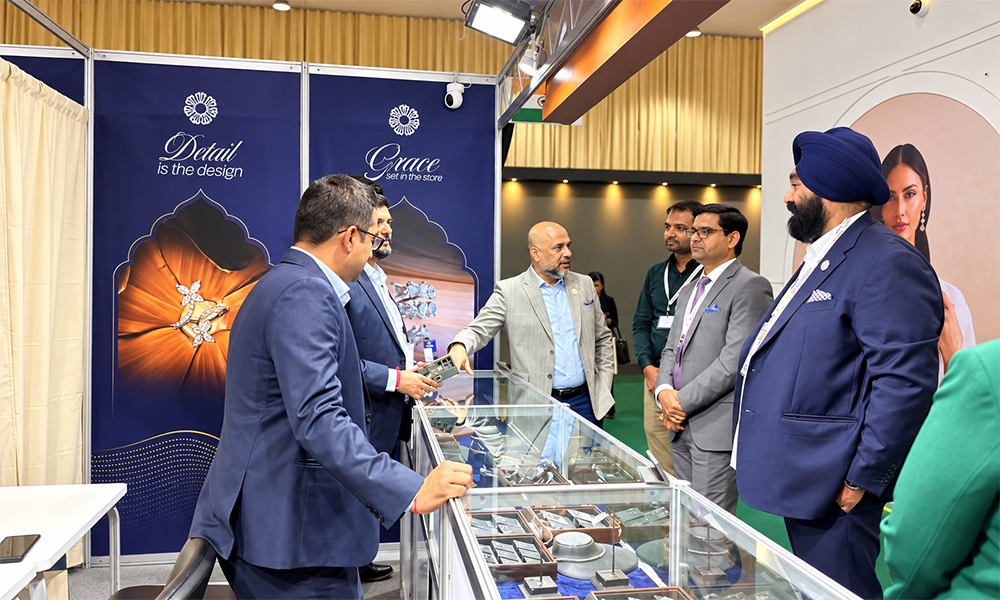
The India Pavilion organised by GJEPC made a strong opening at the 58th Watch & Jewellery Show Middle East 2026, being held at Expo Centre Sharjah from 30 September to 4 October.
Dr. Emmadi Vishnu Vardhan Reddy, Consul General of India, Dubai, visited the GJEPC-curated India Pavilion on the opening day. He was received by Antarpal Singh Sawhney, Regional Chairman – North, GJEPC, and Ashish Sakhardande, Head – India Jewellery Exposition Centre (IJEX), Dubai.
During his visit, Dr. Reddy interacted with participating exporters and viewed the jewellery and products on display. He appreciated the craftsmanship and design innovation represented at the Pavilion and highlighted the importance of exploring emerging markets and strengthening India’s global footprint in the gems and jewellery sector.
Bringing together 11 Indian exhibitors, the India Pavilion presents a cross-section of India’s jewellery manufacturing and design capabilities, with products spanning diamond jewellery, fine gold jewellery, silver jewellery, coloured gemstones, pearls, watches, and display and packaging solutions.
The participating exhibitors are Omega Jewellery, Core Jewellery Pvt. Ltd., Peacemoon Traders, Exclusive Diamond Jewellery Pvt. Ltd., Teyana Jewels LLP, Sejal Exports (India), Veekay Diamants, Harshwardhan Gems Pvt. Ltd., Sherly Jewels Pvt. Ltd., Rajesh Gems and Arina Jewellery LLP.
The Watch & Jewellery Show Middle East 2026 is expected to attract more than 66,000 visitors, including over 1,000 trade visitors from 52 countries. International participation includes Bahrain, China, Egypt, France, Japan, Kuwait, Lebanon, Pakistan, Poland, Qatar, Russia, Saudi Arabia, Sri Lanka, Türkiye, the UAE, the UK, the US and Yemen.
For Indian exhibitors, the Sharjah show provides an opportunity to engage buyers from the UAE and wider Middle East, while connecting with international visitors and trade representatives attending the event.


-

 National News2 days ago
Palmonas Unveils The Palmonas X Tanya Ghavri Collection
-
 New Premises6 minutes ago
Malabar Gold & Diamonds Opens Its Second-Biggest Showroom In Goa
-

 BrandBuzz2 days ago
De Beers India Introduces ‘Love, From Hubby’, A New Ritual For A Second Season Of Love
-

 National News2 days ago
Precious Metals Prices Remain Broadly Steady
