
National News
India-EFTA TEPA secures duty-free access for gems & jewellery to Switzerland, Norway & Iceland, Liechtenstein


As the India-European Free Trade Association (EFTA) Trade and Economic Partnership Agreement (TEPA) comes into force on 1st October, India’s gems & jewellery exporters stand to gain from sustained duty-free access to key European markets — an advantage that has been preserved and reinforced under the new pact.
Signed on 10 March 2024, TEPA is India’s first FTA with developed European economies — Switzerland, Norway, Iceland and Liechtenstein. It reflects a commitment not just to freer trade in goods and services, but also to investment, sustainable development, and job creation.
For the gems and jewellery sector, TEPA secures duty-free access for several important product lines across EFTA nations.
Switzerland: Cut & polished natural diamonds, gold jewellery, and polished rubies, sapphires & emeralds
Norway: Cut & polished natural diamonds, gold jewellery, silver jewellery, and imitation jewellery
Iceland: Gold jewellery, silver jewellery, and imitation jewellery
The agreement goes beyond tariff elimination by creating a stable and predictable trade framework for exporters. It also brings a strong investment component, with EFTA countries committing USD 50 billion in FDI over the first decade, followed by another USD 50 billion in the subsequent five years.
This inflow is expected to generate one million direct jobs, with opportunities for design innovation, precision manufacturing and technology upgrades that could particularly benefit India’s jewellery MSMEs. Additionally, easier access to advanced equipment, inputs and capital from Europe is set to strengthen India’s value chains and improve the competitiveness of its jewellery exports.


National News
IFSCA Notifies India Good Delivery Gold Framework
GJEPC Seeks Swift Rollout and Global Recognition. The Framework Is Expected To Strengthen Responsible Sourcing, Build Confidence In Indian-Refined Gold and Create Opportunities For Bullion Exports.

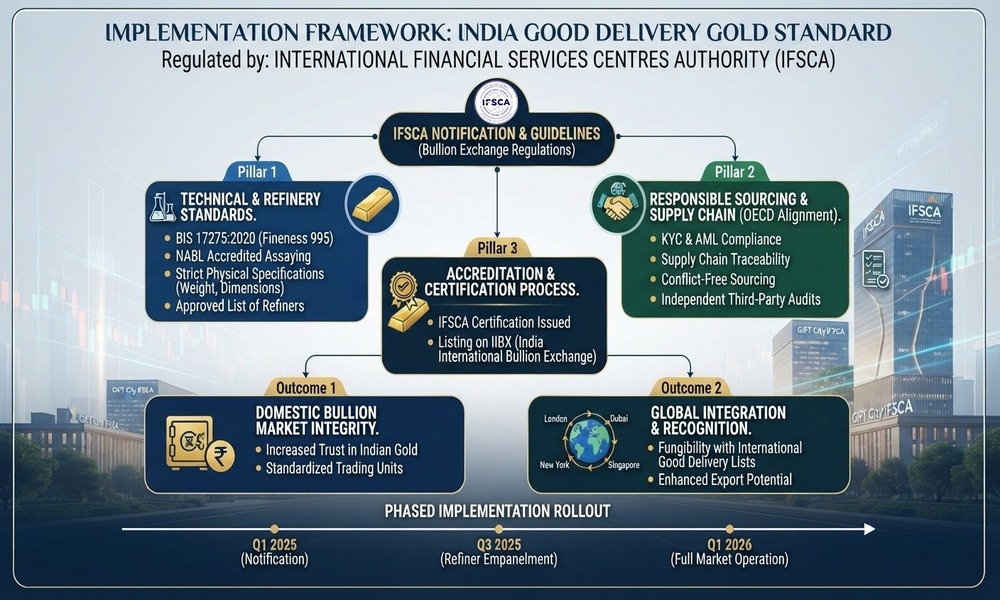
GJEPC has urged the Government to expedite international recognition and the implementation of the India Good Delivery Gold framework, following the notification of the International Financial Services Centres Authority (IFSCA) (Good Delivery) Guidelines, 2026. The framework is expected to strengthen responsible sourcing, build confidence in Indian-refined gold and create opportunities for bullion exports.
The guidelines establish a framework for quality assurance, responsible sourcing and traceability in gold refining. IFSCA, India’s unified regulator for financial products, services and institutions operating in International Financial Services Centres, will implement the framework through the Bullion Exchange in the IFSC. Gold from accredited refiners that meets the prescribed requirements can qualify for delivery on IFSC exchanges and for over-the-counter trading.
The framework extends beyond the purity and quality of gold bars to address their provenance. Refiners must trace raw gold to its source, assess supply-chain risks, verify suppliers and beneficial owners, and meet applicable responsible-sourcing requirements. Independent third-party audits will provide additional assurance.
The initiative follows the recommendations by NITI Aayog, a policy think tank, which had called for an India Good Delivery Standard and responsible-sourcing guidelines for refineries. The report highlighted the potential of domestic refining to retain more value within India, generate employment and support exports.


-

 TechBuzz5 hours ago
K. Srinivasan Unveils Doit Coimbatore Experience Centre
-

 GlamBuzz6 hours ago
Kalyan Jewellers’ Navratri Celebrations Bring Stars From All Industries To Thrissur
-

 National News5 hours ago
IFSCA Notifies India Good Delivery Gold Framework
-

 National News6 hours ago
World Gold Council Unveils Immersive Gold Experience At Phoenix Palladium, Lower Parel, Mumbai
